
Falak Youssef: The Middle East at a Crossroads, and Turkey Facing Its Last Opportunity
The Middle East faces a critical phase of intersecting crises, as Syria’s and Turkey’s futures are tied to Öcalan’s call; continued Turkish intervention hinders solutions, while embracing it could enable lasting stability and democracy.
Barjam Joudi
Kobani — The world and the Middle East are witnessing an extremely sensitive phase marked by rapid political and military transformations and intertwined balances of power. At the heart of this changing landscape, Syria and Turkey stand out as two of the most active and influential arenas shaping current developments.
Syria, which has spent fifteen years at the center of a struggle to reshape the balance of power among regional and international actors, is today entering a phase in which it seeks to emerge from fragmentation and rebuild its position. In contrast, the Turkish government is moving along two parallel tracks: on one hand, confronting the call for “Peace and a Democratic Society” launched by Leader Abdullah Öcalan last February; and on the other, attempting to turn the Syrian arena into a sphere of direct influence and reassert its presence on the new Middle Eastern map.
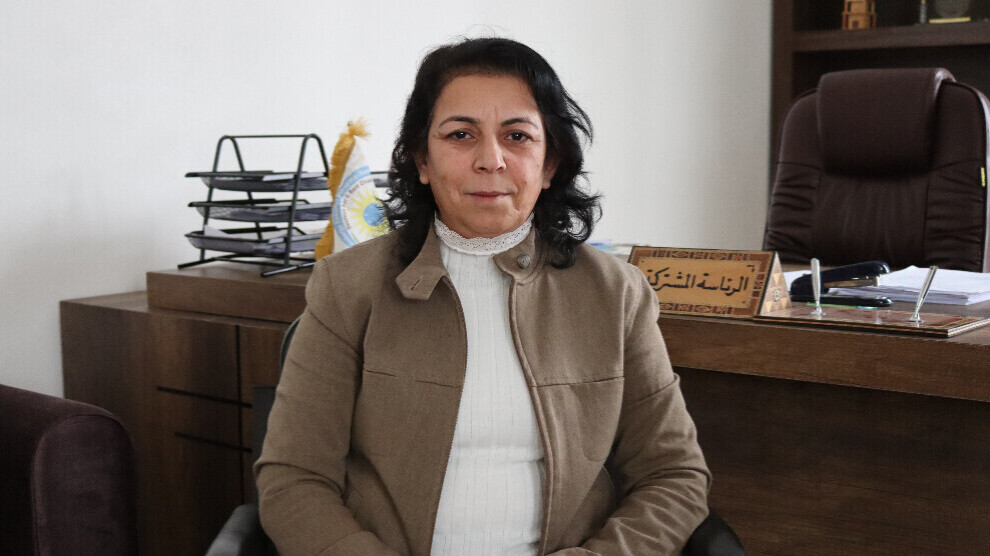
Falak Youssef, Co-Chair of the Social Affairs Committee in the Autonomous Administration of the Euphrates Canton in the North and East Syria region, presented an assessment of current developments, the situation of the Kurdish people, the path of peace and democratic society, as well as Turkish intervention in Syria and its implications for the country’s future, in an interview with our agency.
Amid the transformations witnessed in the Middle East and the world, countries that occupy Kurdistan appear to be at the center of many current developments. How can this scene be understood, and what is the nature of the process shaping these dynamics?
The peoples of the Middle East, especially in Syria and Kurdistan, are living through an extremely complex phase where wars and profound transformations intersect, while massacres, killings, enforced disappearances, and displacement continue. This reality casts a shadow over the entire region, particularly due to the forces occupying Kurdistan and practicing repressive policies against it.
In Syria, and in North and East Syria in particular—where our revolutionary project has deep roots—we have succeeded in building an alternative model in the face of the Baathist mono-authoritarian system that imposed repression on Syrian society in its identity, language, and national belonging. Through the Democratic Nation project, our institutions in North and East Syria have also been able to offer a practical formula for resolving the crises created by hegemonic powers.
Despite all the pressure, siege, and attacks carried out by the Turkish occupation and its mercenaries, we have managed to protect our society, organize it, and administer its affairs. Today, we are facing an extremely sensitive phase, with the approaching expiration of the Treaty of Lausanne and the efforts of hegemonic powers redrawing the world map to formulate a new Middle East project. Therefore, Kurdistan, the region, and the world are witnessing pivotal events that will have a profound impact on the future.
How is the future of the new Middle East project linked to developments in Syria and Turkey, and what role does the “Peace and Democratic Society” call play in shaping its features?
Movements aimed at redrawing the region’s map to serve the interests of hegemonic powers have become evident. In this context, the resilience of the Kurdish people and their achievements in North and East Syria and Northern Kurdistan have constituted a major obstacle to these projects, forcing those powers to reassess their calculations. Amid this complex and tense scene, and with chaos intensifying day by day, Leader Öcalan launched a historic call addressed to all.
Those close to him have long emphasized that the key to the solution lies in Imrali, and this is now clearly evident. The call for “Peace and a Democratic Society” is not limited to the Kurdish people and the region; it represents a path toward the salvation of humanity as a whole. A peaceful and democratic society is the true alternative to the nation-state system based on domination and authoritarianism. This historic call came at a decisive moment, less than a year after its launch.
As for the Turkish government, it has reached a stage of political, economic, and diplomatic collapse amid severe crises. For this reason, it sees its only way out as passing through Leader Öcalan. Within this framework, Öcalan took bold and impactful steps, most notably announcing the dissolution of the Kurdistan Workers’ Party (PKK), in addition to a group of freedom fighters destroying their weapons, signaling an end to armed struggle and the opening of a new phase based on peace and democracy.
What factors make North and East Syria a central axis in Middle Eastern transformations and the projects of regional and international Powers.
Events in the Middle East today are intertwined like interconnected links in a single chain. Since the outbreak of the Syrian crisis, many powers—foremost among them Turkey—have been deeply involved in shaping developments, and this intervention continues to this day. Turkey is considered one of the main reasons preventing the implementation of the March 10 agreement, while at the same time it has occupied vast areas of Syrian territory and placed the interim Syrian government entirely under its tutelage.
Despite the passage of a full year, this government has been unable to build a comprehensive national framework for Syrians, clearly revealing the extent of Turkish dominance and direct influence. Our position, however, is firm and clear: we call for building a decentralized, democratic Syria that guarantees the rights of women and peoples and prevents partition. Yet parties opposing decentralization and Syrian unity attempt to place the blame on us, while those actually working to divide the country are well known—especially the mercenaries who derive their vision and funding from Turkey. In those areas, the Turkish language has become official, and Turkish flags and currency are used.
After the fall of the former regime, our project became a direct target of attacks. Nevertheless, women, youth, and local communities, alongside the Syrian Democratic Forces, resisted in Tishreen Dam and other areas and thwarted these attempts. Subsequently, members of the Alawite and Druze communities were subjected to systematic killings that continue to this day. All these facts confirm that the aim is to divide Syrian society and tear apart its social fabric.
Leader Öcalan stated at the outset of the “Peace and Democratic Society” call that solving the issue in Turkey necessarily opens the door to a solution in Syria as well. How can this be understood today, especially in light of the current trajectory?
The complexity of the Syrian crisis and the delay in reaching a final solution are directly linked to the political and security path in Turkey and Northern Kurdistan. Leader Öcalan’s call to the peoples of the region carries a strategic dimension and will clearly leave a profound impact on the future of the entire Middle East. Nevertheless, Turkey continues to deal with this reality with a great deal of ambiguity. This is not the first such experience; it is the third initiative proposed by Leader Öcalan, yet Ankara always approaches it with caution and confusion.
This process, with all its conditions and requirements, cannot advance unless Turkey understands its true nature from the outset. There is a clear convergence around ending armed struggle, which Ankara views as achieving its objective. However, the essence of the issue goes deeper than that. The Freedom Movement, with its leadership and its male and female fighters, has struggled to affirm Kurdish existence, and the time has now come to transform this existence into a clear, guaranteed legal and constitutional framework.
If Turkey does not take a serious step, as Leader Öcalan emphasized at the beginning of the process, the Kurds will remain an integral part of Anatolia. This means that if Turkey does not genuinely engage in the process, it will face the risk of internal disintegration, while the Syrian crisis will deepen further.
In your view, what are the expected outcomes of this process within the framework outlined by Leader Öcalan? Conversely, how will Turkey’s opposing stance toward North and East Syria affect the course and future of this process?
Had Turkey withdrawn its hand from Syria, it would have been possible to activate the March 10 agreement and move toward a comprehensive solution. Instead, reality is moving in the opposite direction. Tensions are escalating daily, clashes and sieges continue in the Sheikh Maqsoud and Ashrafieh neighborhoods, alongside attacks on the Syrian coast and Suwayda, in addition to dozens of other incidents for which the interim government bears responsibility.
A full year after the fall of the former regime, this government still fails to control armed groups, revealing the absence of a genuine Syrian army. At the same time, attempts are being made to integrate the Syrian Democratic Forces into those groups, or even transform them into tools similar to those who carried out the assassination of Hevrin Khalaf.
With the arrival of a new year, it becomes clear that if Turkey does not undertake a radical shift in its policies during 2026, the existing conditions will lead it toward dangerous outcomes. The current situation does not serve Turkey; it is searching for a way out, yet at the same time it contributes to deepening destruction inside Syria.
We also observe that whenever talks begin between the Damascus government and the regions of North and East Syria, Turkish officials rush to visit Damascus, followed by a new wave of attacks and massacres. This confirms that Turkey is facing a last opportunity. Leader Öcalan has offered it a historic framework that could constitute a real exit.
Whoever invests in this opportunity and responds to Leader Öcalan’s call will secure a century of peace and democracy. Whoever wastes it will face collapse and chaos—something Turkey must understand and read deeply