
The Women's Battle in Tunisia... When Dark Forces Become Fierce to Break the "Pillar" of the Modern State
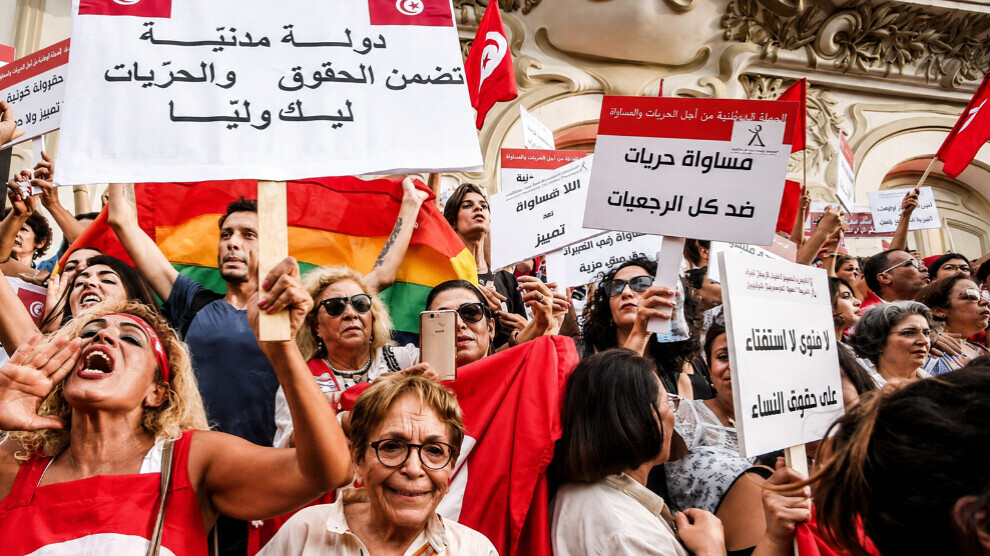
An Article by Tunisian Journalist Shorouk Al-Mashreqi
Tunisia was never merely a geographical spot; it was a living laboratory of modernity, an exceptional experience in its African and Arab environment that began before 1956, the year of its independence, when the "Personal Status Code" was established as the cornerstone for building a state of citizenship and equality—albeit partial. As we monitor the serious regressions, we find ourselves facing a painful paradox: How can a society indebted for its civic existence to the struggles of its women today find voices in protest squares calling for the abolition of alimony, the legalization of polygamy, and the demolition of the Code from its foundations? How can a society call for breaking what women have achieved? How can regression be accepted after awakening? How can our minds accept a return to the past after an intellectual and spiritual awakening?
When the State Was Built on "Women's Liberation"
Tunisia's feminist history was not a "gift" bestowed upon women but a series of battles fought by generations of Tunisian women, colored with their blood—from the time they came out demanding the right to wear trousers to all the rights through which Tunisia became distinguished in its surroundings. The pioneers of modernization believed that "there is no real independence without women's liberation." The laws that followed independence were the fruit of a political will meeting a strong women's movement, whose features began to emerge more clearly in the 1970s with the formation of feminist bodies for organization. In the 1990s, Law No. 24 of 1973 on safe childbirth and family planning emerged—a law that was not merely a health measure but a victory for women's right to decide over their own bodies, making Tunisia a global reference by granting women the right to decide over bodies exhausted by repeated pregnancies and the fear of social stigma when they stopped bearing children.
Women's struggles have always been "grassroots." The women agricultural workers who organized themselves individually, away from association frameworks, were the ones who forced the state to recognize their existence, leading to Law No. 37 of 2021 on the regulation of agricultural work and Decree No. 4 of 2024. With the same determination, domestic workers—before agricultural workers—won their right to a legal framework with the passage of Law No. 37 of 2021 as well. All these gains came through the pressure of women who believed that dignity is seized, not granted.
One cannot speak of Tunisian struggle without pausing at Law No. 58 of 2017. This law is not merely legislation against violence in all its forms but a pioneering human rights document internationally, as it criminalized "political violence" and all forms of violence against women. Tunisian feminists realized that liberation at home means nothing if women are excluded from the political arena and subjected to violence within institutions. This law was a "victory" intended to cut off the path of the guardianship mentality.
The Assassination of "Representation" and the Fall of Fortresses... From Parliament to Marginalization
The parliamentary years (2019–2021) were a major battlefield, where women were the "nerve" of the confrontation. Women, including the leader of the Free Destourian Party, Abir Moussi, were subjected to systematic violence within parliament by Ennahdha and their allies. Yet their presence was strong and undeniable. But after July 25, 2021, a process of "emptying" institutions began; the change in the electoral system led to the abolition of "parity" (stipulated by the 2014 law), replaced by an individual voting system, making women's access to parliament today nearly impossible, and eliminating the human rights diversity that once fueled legislation.
The blow was not limited to the center; it extended to stifling the "local governance" experiment. Vertical and horizontal parity (in the 2018 elections) enabled women to assume mayoral positions and manage local affairs. It was a pioneering experiment in proximity to citizens, but the dissolution of municipal councils under Presidential Decree No. 9 of 2023 ended this experiment, turning back the clock to when men alone manage public affairs.
Today, we find a worrying "fragility" in women's presence in decision-making centers. Even parties that raise democratic slogans practice exclusion behind the scenes; they are patriarchal parties that place women as "decoration" to absorb anger, while decisions are made in closed rooms. The imprisonment of active women leaders, such as Abir Moussi, is a clear message of intimidation. A state that arrests active political women is a state that empties the public sphere of "contestation." Women's presence in decision-making centers today is contingent on the approval of the patriarchal system, not on the assertion of their independent power.
Declining Numbers
The blow was not only political. After women's representation in parliament reached 31% during the 2019–2021 term, thanks to the list system and parity, the percentage dropped to less than 14% in the current parliament, according to data from the "Boussole" organization. This decline is directly attributed to the abolition of parity and the adoption of individual voting, which reproduced the logic of "male prestige" in electoral districts.
More alarmingly, this decline was not limited to parliament but extended to local councils after their dissolution in 2023, where 47% of mayoral positions were held by women. Today, the public space has been emptied of women's legislative voice, so laws affecting the family and women are now discussed and enacted in their absence.
The Last Line of Defense
The regressions we are witnessing, and the populist discourse that promotes the justification of violence against women, are not an inevitable fate but the price of complacency. Attempting to strike the Personal Status Code is an attempt to strike Tunisian identity. Let us remind women that feminist resistance today is not a luxury but the last line of defense for the state's civility. When democracy is absent within parties, women are excluded from decision-making centers, and the laws that protected them are attacked, the state as a whole staggers.
Tunisia today needs to restore the "fierceness" of the early feminist struggle. The Tunisian feminists who organized themselves in rural areas to win the rights of women agricultural workers are the same ones who will organize today to topple the illusion of "returning to the past."
The battle today is a battle of identity: either we continue to build a state governed by law and equality, or we allow voices of regression to take us backward.
We are aware that the laws we have won are not merely ink on paper but the blood and nerves of women who decided not to be followers of anyone. We will remain defiant against marginalization, in need of the solidarity of our fellow women. Our experience strengthens yours.