
Women and Young Women of Makhmour Participate in Training Courses on "Rebuilding the Self"
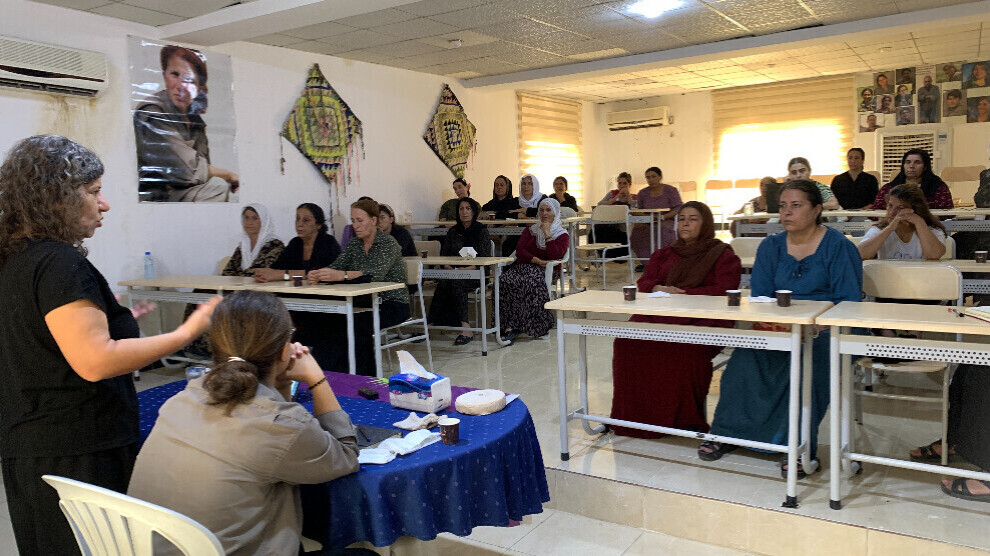
For 23 years, the Martyr "Jiyan" Academy has continued training women and young women of Makhmour camp. This year, it launched a series of courses focusing on "rebuilding" and enhancing women's awareness of their role and responsibilities.
PERIVAN TUNJ
Makhmour – The Martyr "Jiyan" Academy was founded in 2003 in Martyr Rustam Jodi Camp (Makhmour), in commemoration of the female fighter and martyr Jiyan, known as "Zeyneb Erdem," and in continuation of her struggle path. Jiyan was martyred on 13 September 1995 in Atrush camp, after forces of the Kurdistan Democratic Party (PDK) opened fire on participants in a march inside the camp.
Since its founding, the academy has continued its activity in the field of educating and training women and young women in Makhmour camp, turning over the past years into one of the centers concerned with the intellectual and organizational training of women in the camp. With the beginning of this year, the academy intensified its training programs, launching various courses in the neighborhoods, institutions, and the academy itself.
"Training Is Based on the Concept of Rebuilding"
Regarding the objectives and axes of the training courses, the spokesperson for the Education Committee at the Martyr "Jiyan" Academy, Kesar Bulut, said that the academy seeks to organize programs based on "the new intellectual model, the new phase, the statement sent by the leader, alongside the concept of rebuilding."
She explained that the training axes address multiple issues, including "the reality of gender, the tasks and responsibilities falling on our shoulders in the rebuilding phase, our relationship with the system, the system of the Ishtar Council, the course of the struggle for women's liberation from its beginning until today, in addition to the issue of integration."
She added that the academy has begun in this context to offer a variety of courses, in line with women's needs and the requirements of the new phase.
"Women's Participation in Training Aims to Understand the System"
Speaking about the participation of camp women in the training courses, Kesar Bulut indicated that the goal is not limited to acquiring knowledge, but goes beyond it to enhancing women's awareness of themselves, their role, and their responsibilities within society.
She said that women's participation in the training aims to "understand the system, understand gender, as well as the responsibilities placed on their shoulders at this stage, alongside enhancing integration."
She pointed out that the training helps women understand their position within the system, how to assume responsibilities, and identify the areas through which they can continue their struggle and perform their roles, considering that women's active participation in the discussions that take place during the courses represents an important and positive aspect of the training process.
The Year of Training in the Camp
Kesar Bulut addressed the academy's activities during the current year, noting the intensity of programs and courses it has launched since the beginning of the year. She said that this year can be described as "the year of training" for the camp.
She explained that "since the beginning of the year, we have opened various courses in the neighborhoods, institutions, and academies, and we currently have a number of ongoing training courses. We train women working in institutions, as well as women in the neighborhoods."
She also pointed to the existence of a group of young women who have been receiving training at the academy continuously for some time, confirming that the main goal of these programs is to prepare women to play an active role and assume responsibilities within "the new system being built."
A Call for Broader Participation of Women and Young Women
Kesar Bulut extended a call to the women and young women of the camp to participate more broadly in the training programs, emphasizing the importance of developing awareness of self, history, the system, and gender. "I invite young women to develop themselves by learning about their history, their system, and their gender, and to participate in the training and assume the responsibilities falling on their shoulders."
At the end of her interview, she stressed the necessity for women to define their roles within the new system and to contribute to building it through "plans and projects," enabling them to take their place and assume their responsibilities in the coming phase.