
The dereriorating Water Situation in Kabul Amid Increasing Climate and Administrative Pressures
Kabul faces acute water scarcity from climate change, rising population density, and absent infrastructure, pushing limited-income residents to queue for hours for a few drops of water.
BAHARAN LAHIB
Kabul-The suffering of women in Afghanistan worsening with the intensification of the water crisis striking both cities and villages, as women bear the greatest burden in securing their families’ water needs amid an acute scarcity of resources and basic services, making accesss to water an arduous task directly linked to their survival and that of their families.
Afghanistan’s cold regions spent almost all of last winter without snow, while the skies of major cities remained covered with smoke and polluted air_ a condition local residents describe as “Khoshk-e Khoshk”, meaning (cold weather devold of humidity or preciptation). On the other hand, sudden rains turned into destructive floods that swept away agricultural lands, making the environmental scene more complex between the absence of precipitation and the flow of floods.
Most Afghan provinces face a water crisis, but Kabul's situation differs due to rapid population growth, the expansion of construction, and increasing pressure on water resources, as Kabul is home to the largest number of the country's population, with many believing that job opportunities and services are more available there than elsewhere.
The construction of non-standard residential towers amid residential neighborhoods, according to what residents say, has also exacerbated the water crisis, and in some areas water scarcity has led to clashes between residents.
Although the water crisis in Afghanistan is not new, citizens confirm that successive governments over the past years have failed to find a radical and sustainable solution to this problem. Today, the Taliban movement — a party responsible for widespread human rights violations — is implementing road, overpass, and tunnel projects in Kabul and some provinces at an accelerating pace. Some residents believe that the focus on these projects hides from view more pressing problems such as poverty, unemployment, the suppression of women, water shortage, and rising food and fuel prices.
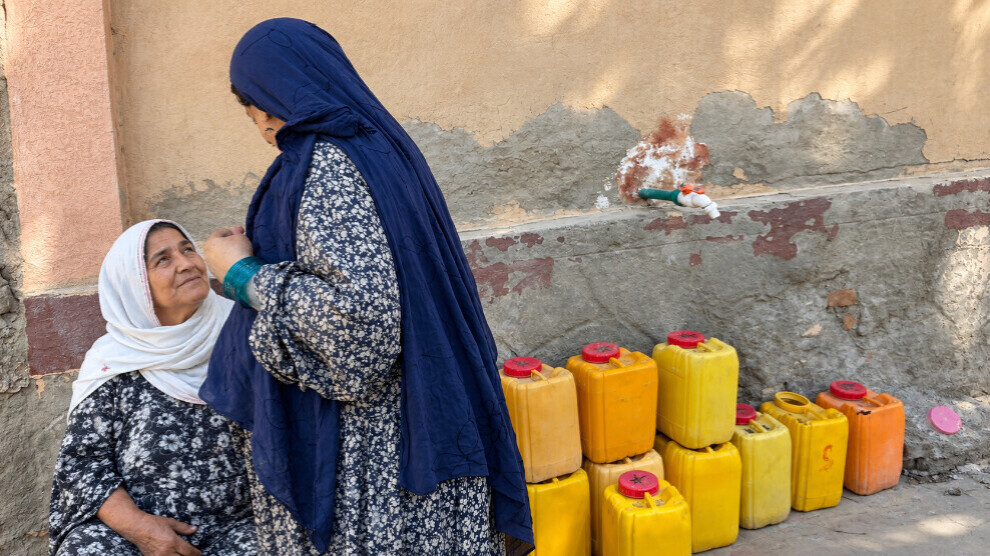
Nafisa Hassan stands near the tap and says that her family lives in a small house without a kitchen, and they share the courtyard with a number of neighbors, which makes the water shortage more severe. She points out that she spends most of the day moving between the houses of neighbors who own wells, while the tap provides them with water once a day, which forces them to wait a long time to store enough for several days.
Regarding the daily quarrels over water, she confirmed that tension has become part of their lives, as disputes recur and buckets are lost or broken, but they are forced to endure that to secure their basic needs and survive thirst.
Nafisa adds that her economic situation is getting worse, as she broke her foot last winter after falling, and she settled for treatment with a traditional bonesetter, which has made her rely today on a stick to move around.
Nafisa Hassan lives with her only daughter, after the daughter's husband was killed by the Taliban movement one week before it took control of the country. The daughter was a mother of four children, so Nafisa Hassan and her daughter bear the responsibility of supporting the entire family under stifling economic conditions that make the task almost impossible.