
Kurdish Teacher: Separating Male and Female Students Does Not Align with Syria's Diverse Reality
Kurdish language education and women's role in teaching attract widespread interest in Rojava, amid demands to preserve mother-tongue education and ensure equality in schools.
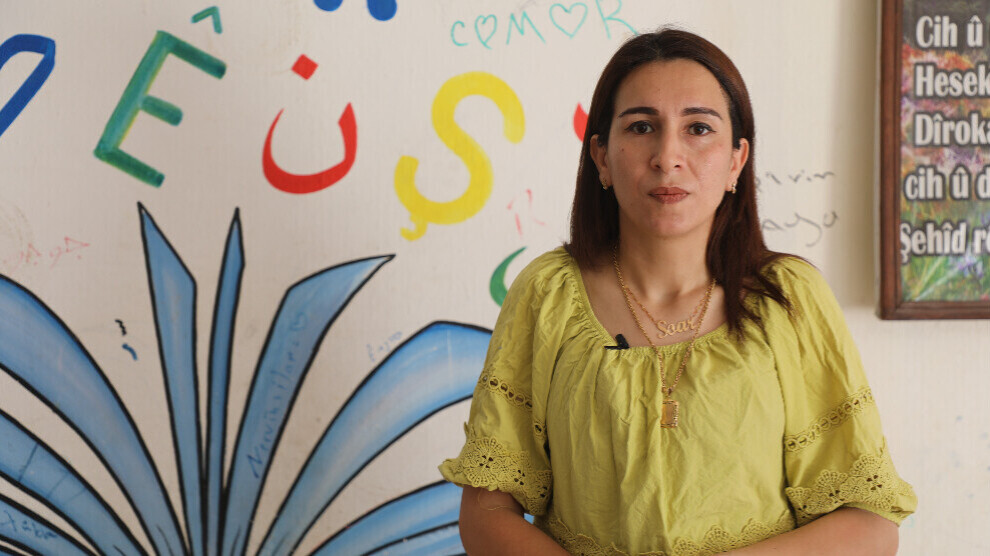
RONIDA HAJJI
AL-Hasakah – At a time when discussions continue in Syria about the future of education and the new curricula adopted by the Ministry of Education, the decision to reduce Kurdish language classes for students has greatly affected students, teachers, and the Kurdish community, followed by a decision to separate boys and girls in the secondary and preparatory stages.
These measures are not merely a conservative trend, but are also presented as an indication of a system seeking to subject society to its strict ideological and religious rules. These hardline systems primarily aim to keep women under strict surveillance by religious authority and patriarchy and to exclude them from the public sphere, which places the future of society at great risk. This religious ideology particularly affects women's rights, education, freedom of thought and belief, and standards of shared life.
Kurdish language teacher Jinda Ahmed said in a special interview with our agency that the new decision raised many major questions about the future of students, and that the demand for education in the mother tongue will continue. She explained that according to the Ministry of Education's decision, Kurdish is taught three classes per week, while many educational materials have not been translated, which creates major problems for students.
The students' situation is unclear, according to her, and it is not known how their future will be tomorrow. "The ministry's decision caused widespread discontent among the Kurdish people, students, and teachers, and activities and protests were organized to protect the right to education in the mother tongue."
She said that many students do not want to study scientific and literary subjects in another language, because they have received their education in Kurdish for years. "The students' position was that until the decision is changed, they will not enter classrooms, and their demand is that their education continue in their mother tongue. As Kurds, our position is clear: we want all subjects in education to be provided in the mother tongue, and we will not retreat from our demand."
Parliament Discussions on Kurdish Language Education
At the same time, the issue of Kurdish language education reached the Syrian Parliament and became present in discussions related to the state of education. Jinda Ahmed says that Kurdish MPs in Parliament demanded that Kurdish students be taught using curricula and materials in Kurdish, but the interim government presented many arguments, including that it is not yet prepared to translate all educational materials into Kurdish. It also said that students studying in Kurdish will face problems at university after completing their studies.
She recalled the experience of Rojava University, explaining that students who completed their primary, preparatory, and secondary stages in Kurdish began studying at Rojava University in 2016, and many of them currently work in institutions, schools, and various bodies.
The teacher warned that their arguments are not sufficient for the education sector in the region and do not convince the Kurdish people. "Our right is legitimate, and we will continue our activities until this decision is changed."
The position of the Kurdish people, teachers, and students had a major impact on public opinion. After that, certain other events occurred, which our interlocutor considered an attempt to change the agenda of demanding education in the mother tongue, pointing to the killing of Sipan Hazni, as well as the Kobani events. She also indicated that these events were carried out, according to her assessment, with the aim of changing the agenda and demands of the Kurdish people.
"Separating Female Students from Male Students Is an Intellectual Problem"
Kurdish language teacher Jinda Ahmed also addressed another educational decision requiring the separation of female students from male students, noting that this decision was applied in some schools. "This decision represents an intellectual problem and does not suit the conditions of the new and diverse Syria."
She confirmed that students of both sexes grew up in the education system of the Autonomous Administration, where the sexes were viewed as equal, and they studied together and benefited from one another.
"School Is a Place for Learning, Not a Place for Violence"
Jinda Ahmed also spoke about an incident that occurred at Abdul Rahman Al-Kawakibi School, explaining that a teacher from the Arab component used violence against a Kurdish female student after she objected to another language being imposed on her and to scientific subjects being taught in another language. "In all educational systems in the world, hitting students is unacceptable. A student comes to school to learn, not to be subjected to assault, torture, or unethical words."
Female Teachers and Their Role in Education
In the final part of her interview, Jinda Ahmed addressed the discussions that took place in the Syrian Parliament about the number of female teachers, noting that "the education sector stood on its feet thanks to the efforts of female teachers, and even under difficult conditions, this sector moved forward. Objecting to the number of female teachers represents a serious problem and dangerous thinking."