
Our Agency’s Correspondent Wins Award for Best Writeen Production on Peaceful Conflict
Journalist Nagham Karaja affirms Palestinian women’s media presence despite war, winning first place for a report on women’s issues and conflict resolution in the absence of the judicial system.
RAFIF ASLIM
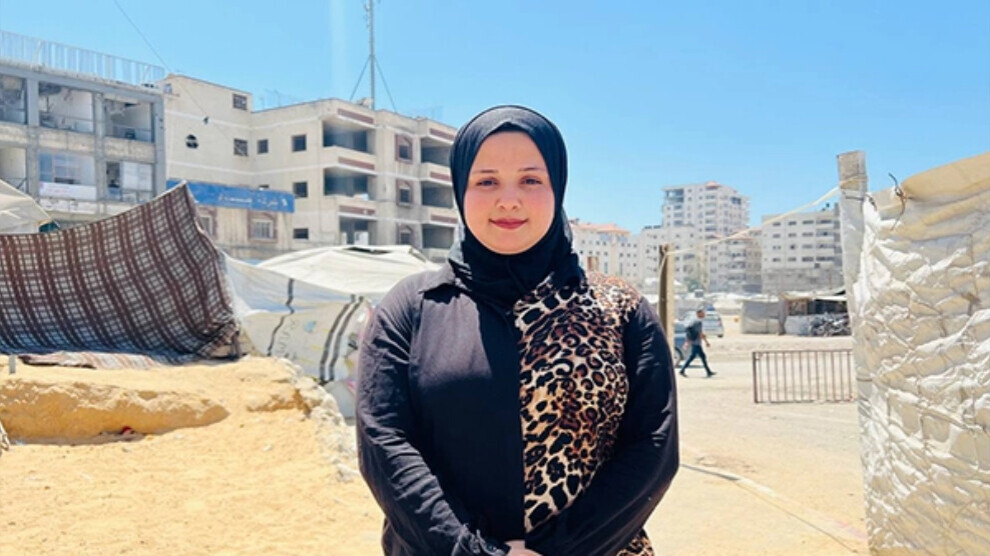
Gaza — Journalist Nagham Karaja, correspondent of our agency NÛJINHA, won first place in the competition for the best written journalistic production on mechanisms of conflict resolution through alternative methods, as part of the "Disseminating Justice" project implemented by the Community Development and Media Centre, aiming to work on resolving community dispute issues from a perspective focused on dialogue, mediation, and peaceful solutions.
Journalist Nagham Karaja explained that she won first place in the competition for the best written journalistic achievement within the "Disseminating Justice" project implemented by the Community Development and Media Centre. She noted that the top three places were won by other Palestinian female journalists, reflecting the presence of Palestinian women and their ability to compete and excel even in the darkest conditions being lived in the besieged city.
She added that the material submitted for the competition was produced under extremely difficult field, humanitarian, and psychological conditions, which posed a real challenge, especially since the journalist does not merely cover events from a distance but lives through every detail of them — anxiety, fear, and numerous difficulties. Despite this, she continues to perform her professional duty, conveying an image of reality and unfolding events, and being a voice for the voiceless. This is what she does as a Palestinian journalist from Gaza since the beginning of the war in October 2023.
She explained that the content of the submitted material focused on mechanisms and methods of conflict resolution through alternative approaches, and the role of dialogue and peaceful means in resolving community disputes since the judicial system became absent three years ago. She noted that in this context, the role of journalism is not limited merely to reporting transient events but rather to promoting a culture of dialogue, understanding, and community.
Details of the Story
According to Nagham Karaja, the story revolves around a woman who returned from the southern area of the Gaza Strip to the north to set up a tent on her father's land, in which she holds a share of inheritance. However, her male brothers prevented her from doing so, explicitly repeating, "Women have no inheritance with us." The woman turned to one of the volunteers in the tents — a specialised female team for problem-solving. They initially spoke with her brothers, who refused. They then resorted to training a larger committee and putting pressure on them.
She added that after a considerable period of dialogue and discussion, the woman managed to extract her right from her brothers and was granted her share of her father's land — her lawful inheritance — far from the threats her brothers had surrounded her with, whether by themselves or through intermediaries. She affirmed that this woman's situation is the situation of thousands of women and girls in the absence of the judicial system, despite the existence of alternatives that do not replace the judiciary and its role.
She added that any journalistic report concerning the situation of women regarding gender‑based violence is met with concealment of its details and high sensitivity during work on it. Such stories do not come to light because they are seen as a stigma. Women are barely persuaded to tell their stories as they fear their families and society. Their coming forward to the media requires a high degree of courage, both for the victim and for the journalist writing about the subject.
She explains that the Palestinian woman, in such conflicts, demonstrates her ability to solve problems and proves her marginalised role, as society refuses to give her the space she deserves. Therefore, we cannot judge her role, as she has given much and continues to try to give her best. She indicated that there is a problem in the management of the camps, where no woman is part of their composition; they are all men. Consequently, women lack someone who listens to them and understands their problems.
Nagham Karaja recommends that in every shelter centre there should be a woman heading the administrative councils so that women can submit their complaints to overcome the problems they face. She concluded by saying that this victory is a continuation of producing more journalistic and human stories despite the ongoing war and the bitter reality that Palestinian female journalists are living through.