
"War Paralyzed Me and Took My Family"... A Palestinian Woman's Struggle for Treatment and Her Child
Naila Merish, 23, suffers from paraplegia after an Israeli attack killed her mother and siblings. She now awaits treatment abroad to care for her five-year-old daughter.
NAGHAM JAJAN
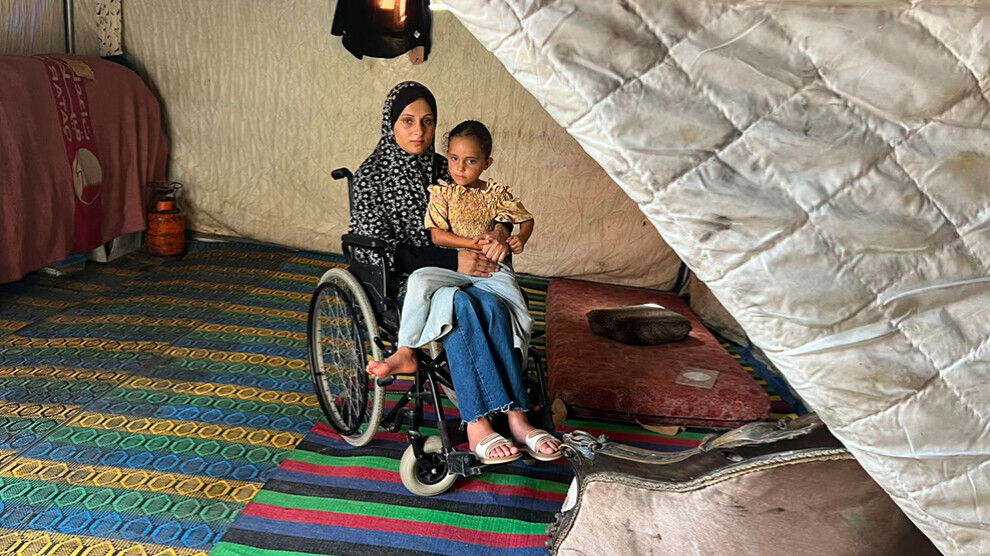
Palestine — In a small tent set up on one of the streets west of Gaza City, Naila Merish, 23 years old, sits unable to move, staring at a body that no longer obeys her as it once did, trying to comprehend a life that turned upside down in an instant.
Naila Merish was targeted five times during the war on the Gaza Strip. Each time, she survived with wounds, fear, or loss—until the last attack left an impact unlike any before. She sustained a severe injury that caused paraplegia, leaving her unable to move, while her mother, brother, and sister were killed in the same place.
Naila Merish says: "I still cannot believe that I lost my mother and siblings at the same moment I lost my ability to move. I feel like I am living inside a nightmare. Whenever I look at my body, I wonder: Can this really be happening to me?"
Pain was not the only thing she faced after her injury; psychological trauma compounded the weight of what happened. She remembers the moment she was told her mother had been killed, while still under the impact of her own injury. She says: "When they told me my mother was killed, I felt as though something inside me had broken. I could not process what was happening around me. Then I started looking for my siblings, before I learned that they were gone too."
The scene of arriving at Al-Shifa Hospital was one of the harshest images etched in her memory. Naila Merish was transported with her injured family members to the hospital, after they had been lying on the ground among dozens of wounded, amid severe overcrowding and a critical shortage of basic medical supplies.
She recounts: "I saw the wounded around me, everyone searching for a doctor, medicine, or a place to lie down. There was not enough for such a huge number of casualties. I was in pain and waiting, not knowing what would happen to me or my family."
Since that day, she has been unable to live her life normally. The injury that left its mark on her body has made her dependent on others for her most basic daily needs. She cannot move on her own, cannot perform the tasks she once did without thinking, and cannot even care for her only daughter, Sham, five years old.
"The War Kept Me Away from My Daughter"
She says with sorrow: "What pains me most is that I have become unable to care for my daughter. Sham depended on me for everything. Today, I need someone to help me. I see her in front of me and wish I could hold her, prepare her food, or accompany her as mothers of children do."
For Sham, her mother's absence from the details of her childhood is no longer a temporary choice but a reality imposed by injury and medical blockade. The little one watches her mother struggling for movement, while Naila Merish tries to hide from her the amount of pain weighing on her body and soul.
She adds: "My child does not understand why I cannot get up, why I need others to help me. I want her to live her childhood beside me, to find her mother able to play with her and care for her, not to see me helpless before her."
Her suffering is not limited to the loss of movement. Her condition requires further medical evaluation and specialized tests, including an MRI that is not available, according to her, in Gaza's hospitals and clinics—making travel abroad an urgent necessity to understand the nature of her injury and determine the appropriate course of treatment and rehabilitation.
She also faces a shortage of the medication she needs, which exacerbates her health condition and exposes her to painful seizure episodes that spread through her body and increase the difficulty of her days. She says: "I feel my whole body convulsing, and I cannot find the medicine I need. Sometimes I cannot bear the pain. I just wish I could find a chance for treatment outside Gaza, to know if I can stand on my feet again."
Hope Hinges on Treatment Outside Gaza
While Naila Merish waits for an opportunity to travel, the medical referral needed to continue her treatment outside Gaza is stalled, leaving her trapped in a place worn down by war—between increasing medical needs and limited treatment options, between a body requiring specialized care and no means to obtain it.
But the hardest thing Naila Merish carries is not physical pain alone. She is simultaneously trying to cope with the loss of her mother and siblings, and with the image of her new life she did not choose. "I miss my mother every moment. I needed her after my injury, but I lost her too. Sometimes I feel like I lost everything at once: my family, my health, and my ability to care for my child."
She pauses for a moment before continuing: "I do not want to spend the rest of my life like this. I want a chance for treatment and rehabilitation. I want to know what happened to my back and my body. I want to stand again. I only ask to be allowed to travel."
Today, Naila Merish lives in a tent, in conditions that do not provide the minimum of privacy or the care requirements that a woman who has lost her ability to move needs. Between the fabric walls, her suffering moves between unrelenting physical pain and a bloody memory she cannot escape.
Every time she looks at Sham, her will to survive is renewed. She says: "Sham is not to blame for any of this. I want her to grow up knowing that her mother tried for her, to return to her as I was, and to live ordinary days with her—even the simplest things that others take for granted."
Naila Merish no longer asks to fully restore her old life. It is enough for her to get a chance for treatment, to be allowed to undergo the tests she needs, to find medication to ease her body's convulsions, and to reach a medical center capable of assessing and rehabilitating her injury.
While she waits, Sham remains by her side, watching her mother—who was once able to carry her and care for her—before the war became a barrier separating them from the simplest details of life. Naila Merish clings to a small hope: that the doors of treatment will open for her, that she will find a way to regain some of her ability to move, to reclaim her role as a mother, and to give her child what she has long been denied: an ordinary childhood beside her mother.