
One Home Mourns Four Women and Girls... Testimonies from the Heart of the July 2025 Events
Two women from the Syrian city of Suwayda recount the events of July 2025, during which they lost four members of a single household, calling for justice for the victims and accountability for those responsible.
ROSHELLE JUNİOR
As-Suwayda – Families in the Syrian city of Suwayda continue to relive the events of what they describe as the "Black July" of 2025, during which around 4,000 civilians, including women and children, were killed amid conditions that survivors describe as marked by extreme violence and security chaos.
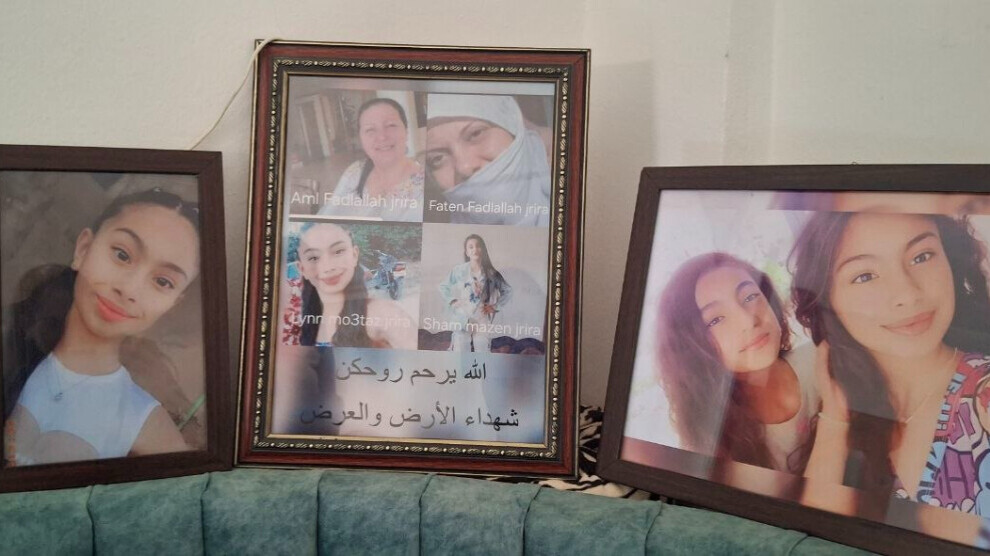
Against this backdrop, members of the Jarirah family share two deeply painful testimonies. During the violence, they lost four women from the same household while attempting to flee their home in the midst of intense fighting and a complete communications blackout, leaving them unable to reach safety or learn the fate of their loved ones for many hours.
Attempting to Escape Amid Shelling
Wafa Al-Younes, the mother of Sham Mazen Jarirah, who was killed during the July massacres, said her family believed they were living in a relatively safe area, far from the clashes. There were no armed factions or military positions near their home, located close to the National Hospital and the Fire Department. For this reason, they chose to remain there. She stressed that none of the family members carried weapons or participated in any military activities, nor did they anticipate the scale of the violence that would follow after communications were cut off.
She recalled that Sunday, when the violence first erupted, seemed relatively normal despite the sound of loud explosions. By Monday and Tuesday, however, the clashes had intensified dramatically. After all their neighbors had fled, her family became the only one remaining in the neighborhood. Twenty-one relatives had gathered in the home of her husband's mother.
On July 15, 2025, her brother-in-law was wounded while accompanying neighborhood men. Around 1:00 p.m., a shell struck near the house, causing a powerful explosion that left the children terrified and traumatized. The family then decided to evacuate.
She said the following day became an unforgettable tragedy. Her twelve-year-old daughter Sham, her cousin Lin Moataz Jarirah, and their aunts Amal and Faten Fadlallah Jarirah were all killed inside the family vehicle while attempting to leave the area.
"Why us?" she asked. "Why do our children die before our eyes while we can do nothing?"
She explained that she was unable to reach her daughter, while her son sustained serious injuries to his hand and abdomen and continues to undergo medical treatment and multiple surgeries.
Wafa said she could never forgive the loss of her daughter or erase the fear that still grips her surviving children, who continue to suffer severe psychological trauma. She added that she was deprived of seeing Sham fulfill her dreams and continue her promising future despite her academic excellence. "She was born during the war," Wafa said, "spent her entire life living through it, and ultimately lost her life because of it." She questioned how much longer children would be forced to live in terror while families continue losing their sons and daughters.
She also described what happened after arriving at the hospital, where she desperately searched to find out which of her children had survived. Although she felt relieved to learn that her injured children were still alive despite the severity of their wounds, her greatest wish had been to see Sham one final time. Instead, she was told that her daughter had already been buried, denying her even the opportunity to say goodbye—despite having held her in her arms only twenty-four hours earlier.
She then went to the hospital morgue hoping to find her daughter's body and bid her a final farewell. Instead, she encountered a horrifying scene. Bodies lay everywhere: at the hospital entrance, throughout the emergency department, and lining the corridors. According to her, "the hospital was covered with bodies."
Among the most painful sights, she recalled seeing a large body bag labeled simply with the name of an entire family, explaining that it contained only the dismembered remains of its members. Most of the victims she saw were women, children, and elderly civilians, their bodies piled throughout the hospital.
Overwhelmed by what she witnessed, Wafa said she could no longer continue searching for her daughter's body. She called on international organizations and all relevant authorities to ensure accountability for those responsible for killing civilians and to bring to justice everyone who, in her words, "betrayed their own people and their homeland." She concluded by urging that justice be served and the victims be granted the dignity they deserve.