
Despite War and Displacement... Salwa Badran Creates a Space for Hope
Amid war's devastation, a Lebanese woman clings to her food provisions and daily labor, resisting displacement and fear to preserve life's remnants.
RANA JOUNI
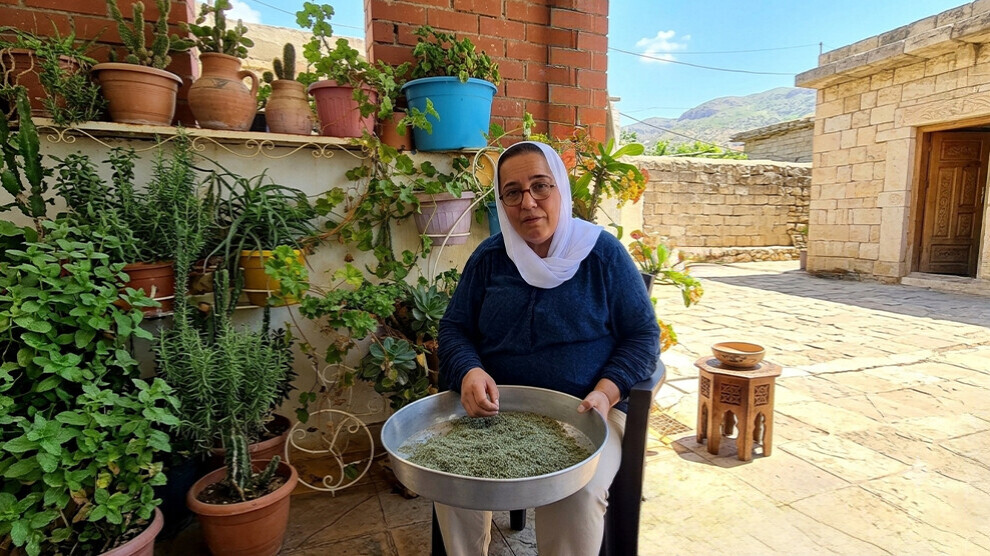
Lebanon — Salwa Badran has not abandoned the preparation of her household provisions, despite the unstable security situation in southern Lebanon. She chose to prepare dried thyme, wild za'atar, and dried mint, considering these provisions to form the "cornerstone of southern livelihood." During her latest displacement from her hometown of Deir al-Zahrani, the first thing she carried with her was her provisions, saying they were her "support in times of displacement."
For Salwa Badran, preparing provisions is not a seasonal custom, but a legacy she has preserved for over thirty years alongside her mother. She notes that Israeli attacks have made their preparation more urgent, adding that she feels fortunate to have been able to prepare them, while many have been deprived of them following the burning of olive groves and orchards and the damage to seasons in many southern villages.
While occupied with provisions, she continues her work at the small clothing shop near her home; however, the war has changed everything. She says: "Life has gradually returned, yet we feel at every moment that an unexpected event may occur. I reopened my shop and returned to work, but all my merchandise is still inside bags." She adds that her entire life has become suspended in a suitcase, with everything ready in anticipation of any new displacement.
Despite the fear and anxiety that afflict her, she affirms that she cannot stop working, saying: "If I do not work, I feel as though I am slowly dying. I love to work, I love preparing provisions, and I love to find joy in small details. We love life, and we know how to continue it no matter how harsh the conditions."
Salwa Badran considers provisions an integral part of the identity of the people of the south: "Thyme, olives, and bulgur… these are not just provisions, but part of our character. If they are absent from any southern household, one feels that something is missing. Just as people defend their land, we also resist to preserve these details. They are embedded in our blood, and we will not change."
The war has not only stolen the details of daily life from her, but has also stolen the weekly family gatherings she used to look forward to around saj bread and barbecues. Yet she still believes those days will return.
Between caring for her son, who has a special health condition, managing her work, and preparing provisions, Salwa Badran finds a glimmer of hope in her garden. She says: "Roses are life to me. When I was away from home, my first question was about my roses. Some may find that strange, but I love them. Life without roses and greenery has no taste."
She follows security developments moment by moment through her phone, while she still suffers, like others in the south, from weak internet connectivity, power outages, and water shortages, and fears that any escalation may impose a new displacement.
Despite everything, Salwa Badran concludes her words with a faith that war cannot shake: "War may have postponed gatherings, but it has not postponed our faith. We do not surrender. We await the return of loved ones, for us all to be together again, and for homes to be filled once more with laughter."
In a south that rises despite its wounds, Salwa Badran proceeds through her daily life as though guarding what remains of a life that war could not seize. Between provisions and work, she creates for herself and her family a small space of resilience, affirming that the south remains capable of awaiting tomorrow with steadfastness.