
From Armed Struggle to Political Dialogue
The July 19th Revolution rescued Kurdish identity from marginalization, creating a unique coexistence model where Kurds overcame oppression to lead efforts in building a democratic, pluralistic Syria.
Silva Al-Ibrahim
News Center — In 2011, at a time when Syria was fractured by the binary divide between the regime and the opposition, the Kurds chose a different path, which came to be known as the "Third Line." This choice was not merely a neutral political stance, but a comprehensive project launched from a vision based on building a participatory democratic model that includes all components of the region, away from polarization and military conflict.
This approach manifested with the launch of the July 19 Revolution from the city of Kobani, subsequently extending to other regions such as Afrin and Qamishlo, where a new phase began, characterized by the establishment of alternative administrative and political institutions. Over time, it transformed from a local resistance experience into an Autonomous Administration project, establishing itself as a key actor and an indispensable factor in any path toward a Syrian political solution.
A Pivotal Turning Point
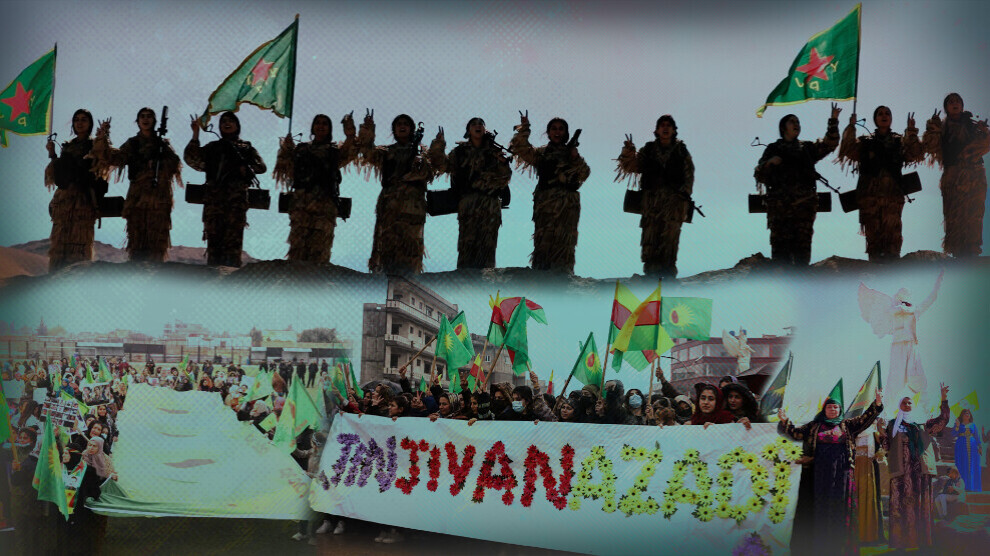
At a defining moment in the history of Kobani, voices that had long been marginalized under the weight of policies of denial and oppression emerged to declare their presence on the public stage and open a new chapter in the transformations witnessed by the region. Leyla Ahmed was one of the women who participated in those symbolic moments when residents headed to government institutions and lowered the flag of the former Syrian regime—expressing their rejection of a long era of marginalization—and raised their own green, red, and yellow flag as a symbol of identity and existence.
Recalling those moments, Leyla Ahmed says: "The Kurdish people suffered for a long time from the Arabization policies and identity denial practiced by the Ba'athist regime, where merely speaking Kurdish or expressing one's identity was a reason for arrest and exposure to violence. This injustice accumulated in people's hearts until it turned into an uprising and a collective will for change."
She added: "With that revolutionary and angry spirit, we headed to government offices and lowered the Syrian flag, declaring the end of an era of injustice. That step proved to us that oppression and denial have an end, and we saw how the feelings of liberation sparkled in the eyes of all participants in that uprising."
The Democratic Nation... and the Challenges of the First Experience
Despite the foundational role played by the Kurds in launching the "July 19 Revolution," its intellectual and political trajectory did not lean toward building an exclusive nationalist project. Instead, it was based on the philosophy of the "Third Line," which proposed a model founded on pluralism and partnership among the region's diverse components.
Through the "Democratic Nation" project, the revolution presented an alternative vision to the traditional nation-state model, based on participatory governance that recognizes the identities and rights of coexisting peoples. It transformed the achievements and institutions of the revolution into a shared space uniting Kurds, Arabs, Syriacs, Assyrians, Armenians, Turkmen, and Circassians. Leyla Ahmed believes that the gains of the "July 19 Revolution" were not confined to a single component, but became an experience in which the various peoples of the region participated, as it is built on the concepts of fraternity and coexistence.
This approach was institutionalized through the building of joint bodies in the political, military, security, and administrative fields, alongside a broad social movement led by women. This movement gave the experience its distinct character and highlighted the role of women, leading it to become widely known as the "Women's Revolution."
Leyla Ahmed explains: "The Kurds had no prior experience in managing their own affairs, so this stage constituted a first and different experience. Despite limited capabilities and harsh conditions, the liberationist ideology we relied on gave us the ability to establish our institutions and protect our regions, because it focused on social, intellectual, economic, and military liberation, placing women's liberation at the forefront of its priorities."
She points out that this experience, despite the challenges it faced, managed to attract international attention. However, it simultaneously became a target for forces opposed to the establishment of a political model based on the will of the peoples—chief among them ISIS and Turkey, both of which launched attacks targeting the project and its achievements.
The Epic of Kobani and the Price of Resilience
With the expansion of ISIS's influence and its control over vast areas of Syria and Iraq, the city of Kobani began on September 15, 2014, to face one of the most violent onslaughts in its history. However, the city, known for its distinctive community and leadership experience, turned into a symbol of resistance and resilience. It engaged in a 134-day battle against the organization’s attacks, becoming one of the most prominent milestones in the war against ISIS and receiving widespread solidarity from people around the world.
Since the peoples of North and East Syria began managing their affairs within the Autonomous Administration model, this project has faced continuous regional challenges and pressures. Turkey considered this model a threat to its authoritarian interests, despite it being outside its borders, making the regions of Rojava and North and East Syria a target for repeated military operations. Over the past years, the region witnessed Turkish military interventions that affected vast areas, including Afrin, Serêkaniyê (Ras al-Ayn), Girê Spî (Tell Abyad), Al-Shahba, and the outskirts of Manbij.
Amid the political shifts that followed the fall of the Ba'ath regime, and despite the existence of tracks calling for political solutions and dialogue, continuous military interventions led to a new escalation between the Syrian Democratic Forces (QSD) and its allied forces on one side, and Hay'at Tahrir al-Sham (HTS) on the other.
This phase began with the targeting of the Sheikh Maqsoud and Ashrafieh neighborhoods, amid violations committed by HTS jihadists described as rising to the level of war crimes, before the confrontations extended to other areas including Raqqa, Tabqa, and Deir ez-Zor, reaching the outskirts of Kobani, amid the collapse of several previous understandings and agreements, including the Deir Hafer understandings.
Ultimately, the January 29 agreement was reached, which stipulated a path for democratic integration between the institutions of the Autonomous Administration and state institutions on both the military and civilian levels, while emphasizing the preservation of the specificity of the Kurdish regions and the structure of the existing administrative setup there.
From War Trenches to Political Arenas
Leyla Ahmed believes that the survival of the Rojava experience, despite the various attacks and pressures it faced, has turned it into an unavoidable political reality and established its presence as an influential party in any discussion regarding the future of Syria. She says: "The Kurds of Rojava have moved from the trenches of defending existence to the arenas of political action; the people who were previously deprived of their right to their language and the expression of their identity have today become an essential partner in shaping the future of Syria."
She stresses that these transformations were not the result of a passing circumstance, but rather the fruit of long years of struggle, sacrifice, and a collective will that held onto its rights despite the challenges, adding that what has been achieved is the outcome of continuous resilience and great sacrifices made by the people of the region.
Regarding the current stage and its ongoing dialogues and political efforts, Leyla Ahmed clarifies: "We, the Kurds, are not advocates of war, but advocates of freedom. We have paid a heavy price to reach this stage, and today we are working through political and diplomatic channels to guarantee the political, cultural, and social rights of the Kurds in the future Syria, as these are natural rights for all components of the country."
She notes that the democratic model based on the recognition of pluralism and partnership can form a framework capable of accommodating the various components of Syrian society, away from exclusion and discrimination, in line with the scale of sacrifices made by the peoples of the region during the years of conflict.
Between the fields of confrontation and the dialogue tables, the "July 19 Revolution" proved that the will of the peoples is capable of reshaping reality and imposing its presence on political equations. The experience that began with defending existence has transformed into a project carrying new political and social visions, and Rojava, with its accumulated experience and achievements, has become an undeniable part of any vision for the future of Syria.
The path of this experience was forged through years of work and sacrifice, carrying a vision based on pluralism, coexistence, and partnership among the components of the region, to remain a testament to the ability of local communities to build new models in the face of challenges.