
When war closed the last window of freedom for girls in Iran
For many young women in Iran, university dormitories offered a rare opportunity for independence and self-reliance. War and university closures stripped them of this chance, forcing many back into restrictiions.

Sara Bourkhezri
Kermanshah – Inside university dormitories, many young women wage a difficult battle with all their might. Amid bitter choices, they try to carve out a small window toward freedom and a measure of independence from the heart of these harsh conditions.
In a society where male‑dominated laws and customs determine many of life's foundations, women do not enjoy the freedom to act even in their simplest personal needs. They cannot make decisions based solely on their needs; they must find an acceptable justification or a compelling reason for every choice, so that their behavior gains legitimacy in the eyes of the family and society. In such a social structure, a woman's independence is not seen as a natural right, but as something suspicious and undesirable.
Studying as an opportunity to experience independence
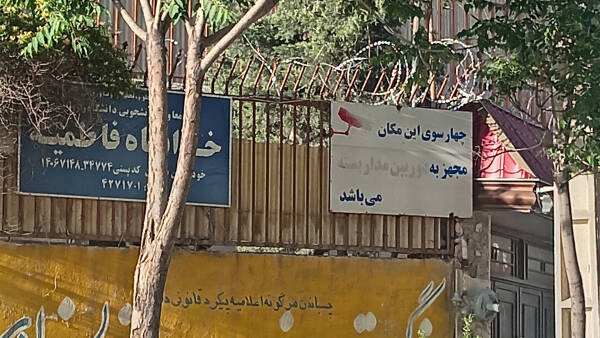
For example, girls are not allowed to live in another city simply because they need independence or personal development. According to the prevailing patriarchal logic, such a decision is unacceptable and inappropriate. However, the same choice becomes more acceptable when it is backed by a social or academic necessity, which softens the weight of judgments and criticism.
In recent years, many young women have been able to live in other cities under the pretext of continuing their studies, staying in university dormitories. Studying has become a shield for them, giving them implicit permission from family and society to experience a limited form of independence. Although this independence remained governed by restrictions and supervision, it represented for many their first real opportunity to make decisions about their own lives.

Setareh G. tells the story of her friend Roya Y., who has lived for years in the dormitory of Razi University in Kermanshah. She says: "For more than six years, she has been studying at this university. Every time her graduation approached, she sought to enroll in a higher level of study so she could stay in the dormitory. She always said that returning to her village near Sanandaj was like a nightmare for her – a nightmare that pushed her to study with all her energy so she would not be forced to go back."
In the dormitory, she lived a different life – happy and full of energy. She cooked her own food, exercised in the dormitory yard, and gradually managed to find small jobs that provided her with an independent income. "She built a private, independent life for herself there – a life she could never have lived in the village, neither in terms of possibilities nor in terms of permission. She always repeated: 'This is the first place where I can be myself without fear or restrictions.'"

She pointed out that her friend did not see the dormitory merely as a place to stay, but as a home she chose for herself – a place that gave her the chance to experience freedom, personal growth, and to build a different future.
The collapse of a life built with difficulty
Due to social pressures that prevent women from living in complete independence, as well as economic conditions that stop them from renting private housing, university dormitories became the only refuge for them in other cities – the place where they could taste the minimum of an independent life.
However, the outbreak of war and the closure of universities forced these young women to return to their family homes. For many, this return was a sudden fall back into the same cycle of pressure and violence that they had spent years trying to escape.
This forced return has left deep psychological effects. The loss of independence, the severing of ties with friends and the university environment, and the return to a space that evokes memories of years of repression – all these factors made them feel that their path toward growth and freedom had collapsed in an instant.
What makes it even harsher is that the closure of university dormitories, which at first seemed a temporary result of the war, has continued. Moreover, the heavy shadows of the war have placed their burden on families, making homes more closed and tightening forms of control within them.
Young women who had tasted, even for a limited time, the flavor of independence, free movement, and breathing outside the constant surveillance of the family, were not only deprived of that but some of them even lost the right to leave the house. This sudden restriction came as a suffocating shock to many of them.
Farnakis F., a women's rights activist, says that the longing for freedom is deeply rooted in human nature, and no authority can completely eliminate it. However, this longing takes on a sharper dimension for women, because throughout history they have borne the greatest share of restrictions on freedom and independence. For this reason, many young women turned to university dormitories – not because they were ideal or flawless places; quite the opposite. These dormitories themselves are subject to many restrictions, strict regulations, and constant supervision that make them resemble a small prison. Yet, this semi‑restricted space remains, for many young women, more bearable than the suffocation they experience inside their homes.
According to our speaker, these young women find themselves facing two choices: "either a home that strangles freedom at its roots, or an environment that is subject to supervision but nevertheless opens a small window toward personal independence. Naturally, many choose the second option, because all they seek is to find a path – however narrow and fragile – that leads them to a more independent life." But the forced return home extinguished even that glimmer of hope. "Many families, because of the war conditions, not only prevented their daughters from continuing their studies but also refused to allow them to return to the dormitory. As a result, young women who had taken their first steps toward building an independent future suddenly found themselves facing a forced interruption of their education."

After this imposed interruption, many of them have no choice left but forced marriage under family pressure – a choice that does not stem from desire or conviction, but is imposed on them due to the lack of alternatives. This forced path, for many young women, is not just a disappointment; it resembles a slow extinguishing of their dreams and personal abilities.