
An educational initiative restores hope to the children of the Jabalia camp
Just meters from Israeli military vehicles and the yellow line, Mada School gives children from kindergarten to middle school their right to learn, defying displacement and ignorance through education.
Rafif Aslim
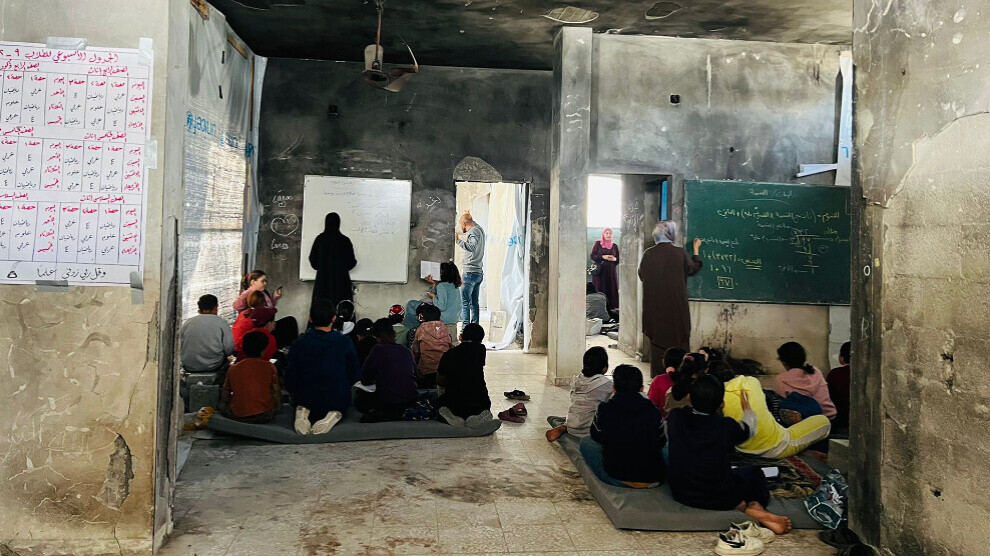
Gaza – Amidst the rubble of destroyed homes in the Jabalia camp, a small educational initiative has been launched, led by young men and women who refused to let the camp’s children fall prey to ignorance and deprivation. Despite harsh security conditions and a severe lack of basic necessities, a partly destroyed house has been turned into an educational hub that restores the children’s natural right to learning and gives them hope that transcends the limits of war and siege.
Teacher Fida’ al-Wahidi explained that the idea of opening the school came as an initiative by the young people of the area. They watched the children of the camp grow up without education, especially after school disruption extended from days to months, and because families were unwilling to send their children to educational centers several kilometers away amid volatile security conditions.
A school on the ruins of a destroyed house
She said: "The school was established on the ruins of a semi‑destroyed house, only about 150 meters away from the yellow line. It has been divided into two main sections: tents for the elementary stage, and a concrete building for middle school students." She noted that as an educational point, it lacks the most basic necessities – no desks, no books, not even pens or notebooks.
She explained that students search among the rubble for suitable stones to use as代替 for tables. They sit on the ground, which causes them health problems, especially with the long school hours. Yet she confirms that their determination pushes them to refuse to give up and drop out of school. "Everyone here manages with the bare minimum to acquire basic skills in reading and writing in Arabic and English, and to perform arithmetic operations."
She added: "It is a big problem that a child reaches 12 years old without knowing how to read, write, or do arithmetic. This is not an individual crisis, but a collective responsibility, and everyone must contribute to solving it. It is not the fault of these children that they are from the Jabalia camp, which refuses to submit to the occupation's policies aimed at emptying the land in order to build a settlement of educational deprivation on it." She pointed out that even young children have adopted this mindset and refuse to displace themselves to the city or the south.
She does not deny the impact of the security situation on the students' concentration – the sounds of shelling and the movement of military vehicles cause their minds to be scattered the next day, making it difficult to focus and absorb information. Therefore, the school is keen to enhance extracurricular activities and organize individual and group psychological support sessions for the students.
She explained that all the teachers supporting the educational initiative carry painful stories of loss. The founder of the idea lost his entire family; his wife, before her death, advised him not to abandon the education of children. So he established the educational point in loyalty to her memory. Seventeen teachers (5 male, 12 female) work at the school without salaries or rewards, hoping for the crisis to end and for schools to return to their normal work.
Teacher Fida’ al‑Wahidi calls on all relevant institutions to support the educational points in Gaza with what they need – desks and schoolbooks. She explains that young children cannot rely on themselves to walk 3 kilometers (the nearest educational point), and with no transportation, the only solution is to revive this educational point to confront the policy of ignorance.
Between love of the land and the absence of schools
Raghad Al-Muqayyad, a middle school student, says that since joining the educational point, she has noticed great progress in her English skills and her ability to solve mathematical equations – which qualifies her to move to high school within a year. However, she expressed concern about the lack of a nearby high school.
She explains that she hates the days when field conditions deteriorate and she cannot come to school, because the administration prepares all circumstances to provide appropriate educational, recreational, and psychological care. She notes that the school needs desks and tools to help them learn, so that more girls can obtain their right to education, as well as separation between grade levels since more than one level learns together.
Meanwhile, Fatima Salem interrupts her predecessor’s talk, affirming girls' right to education. She points out that the school provides the four basic subjects through specialized teachers and helps students develop their reading and poetry writing skills. She describes that she fears living in that geographical area, but she loves her country and does not think of leaving it – even if better educational opportunities were available elsewhere.