
From under the rubble to a sewing machine... A story of resilience in a displacement tent
In a tent west of Gaza, Israa Abu Al-Qumsan is rebuilding her life after losing her workshop and her home, turning sewing from a profession into a space for resilience and self-reconstruction.
Nagham Karaja
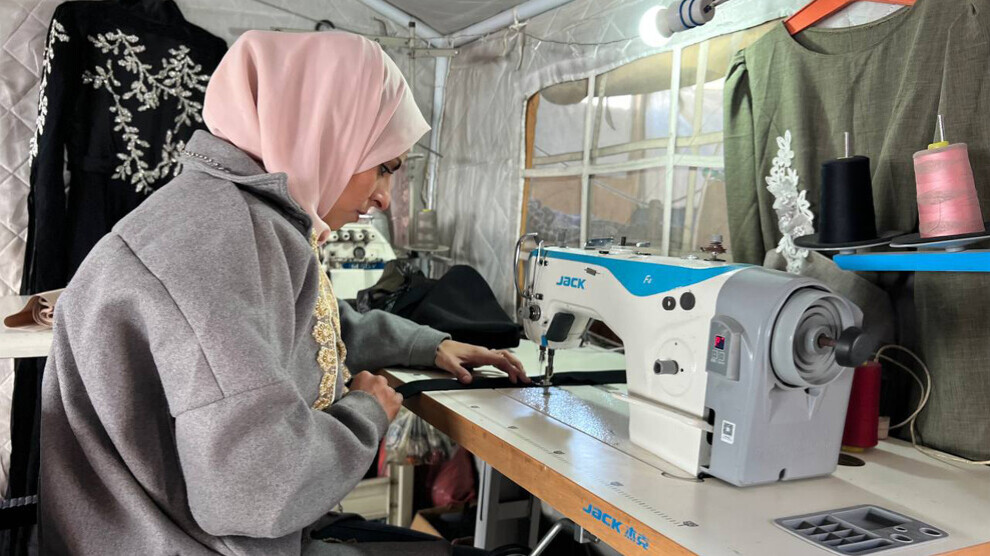
Gaza — In a narrow tent in the "Al-Zuhur" camp west of Gaza, whose fabric walls barely contain the human capacity to endure, sits Israa Abu Al-Qumsan (33 years old) in front of a small sewing machine, as if rearranging life from the cracks of pain. This machine is not merely a work tool but a window through which she tries to reclaim what was taken from her twice: her home, her workshop, and her life that was built on thread, needle, and dreams.
Israa Abu Al-Qumsan's story with sewing began many years ago when she studied fashion design and interior design. In 2012, she established her own workshop, where she not only produced clothing but also trained other women, opening a small space for economic independence for them. She saw her work as more than a profession; it was an extension of the idea that a woman can carve out a place for herself even in the most difficult environments.
But the 2014 war on Gaza came as a sharp cut in her path. She says, in a voice that holds what remains of that moment, "The workshop was my dream… and suddenly everything ended." The destruction was not just a material loss; losing it was a breaking of an entire path of building, effort, and professional identity. Yet she did not stop for long. She gradually returned to work from her home, trying to repair what could be repaired of her life, until she managed to reopen her workshop again in 2020, as if sewing a new garment from the remnants of what had burned.
But the recent war that broke out in 2023 was harsher and more comprehensive in its impact. This time, neither the workshop, nor the home, nor the tools she had built her years of work with survived. She adds, "I couldn't save anything… I was just trying to survive with my children."
With repeated waves of displacement reaching up to ten times, stability became a distant idea, and the ability to plan or even think about the future dissipated. Every time she left, she left behind a part of her life, until she found herself finally with no real shelter, no source of income, and no work tools.
She describes that period, saying, "Each time we left in a worse state… no tent, no necessities, nothing." Inside this heavy void, the dream receded, the passion for sewing faded, and a sense of helplessness took over. The machine no longer meant much to her at a moment when survival was the only priority.
A passing post brought life back anew
The turning point came from an unexpected place: a post she wrote on social media announcing her intention to return to work without a clear plan or real resources. "I wrote that I would return to work… without expecting anything." But the response was faster than she expected. Women reached out to her again, and her old customers started looking for her, as if the stalled life was waiting for a small sign to begin anew.
That moment restored a feeling she had lost: that she was still capable of producing. She started with small steps, borrowing friends' machines, and fulfilling limited orders according to available fabric and resources. Then she decided to take a bolder step: she turned her tent into a small workspace, placing a machine and some basic tools inside, despite high prices, the difficulty of bringing in materials, frequent power cuts, and reliance on primitive solutions.
She says, while continuing to sew a piece of fabric in her hands, "As soon as I sat behind the machine, the passion returned as if I had never stopped." In that moment, she was not just regaining a profession; she was reclaiming her definition of herself.
Although the tent has become a dual space for living and working, she tries as much as possible to balance her daily responsibilities and the care of her two children, who are not yet eight years old. In the same corner of the tent where she works, she tries to be a mother, an educator, and a worker at the same time, managing her day between thread and needle and the needs of two children who do not understand the complexity of what is happening but live its effects in every detail. "Sometimes I work while watching them, and sometimes I leave everything for them. There is no separation between home and work here; everything is mixed."
This harsh overlap between work and life inside the tent reflects a broader reality experienced by many women in Gaza, where the temporary space becomes a permanent space for life with all its burdens, and where family and production details are managed in an area of no more than a few square meters under the pressure of fear and resource shortages.
Despite this weight, her experience highlights an image of the Palestinian woman who redefines the concept of resilience. It is not just about the ability to endure, but about rebuilding life every time it is destroyed. The woman turns the little available into a form of continuity. In many cases, the tent itself becomes a production space, limitations become a driver of innovation, and deprivation becomes an incentive to seek alternatives for survival.
Rebuilding the self from under the rubble
Israa Abu Al-Qumsan clearly represents this path. She does not see her return to work as merely an economic decision but as a daily act of resistance against collapse. "I do not work only to live; I work to prove that I am capable of starting anew no matter the circumstances." This meaning transcends sewing as a profession; it becomes a form of re-establishing the self in a violently changing reality.
From another angle, her experience reveals a rights dimension that cannot be ignored. The loss of shelter and work in the context of armed conflict is not only about individual losses but affects the basic rights guaranteed to civilians, foremost among them the right to adequate housing, the right to work, and the right to protection from forced displacement. Moreover, the destruction of civilian income sources, as happened in the case of her workshop and home, places women in direct confrontation with double economic fragility without real safety nets.
Today, between simple fabrics hanging inside a tent and a sewing machine operating with limited resources, Israa Abu Al-Qumsan is quietly rebuilding her life. She does not claim the path is easy, nor does she hide the scale of the loss, but she continues to work as if every stitch reattaches a part of her world that collapsed. Between two children waiting for a mother who never stops moving, and a tent that has become a dual space for life and work, she continues to draw the features of a new beginning that does not resemble previous beginnings but carries the same determination to continue.