
"Al-Mashnaqa": A popular name hiding a unique architectural heritage in Sweida
Popular memory intertwines with archaeological truth at Al-Mashnaqa, where collective imagination created a name and symbol that endured, until recent studies revealed a different narrative balancing history and memory.
Rosheil Junior
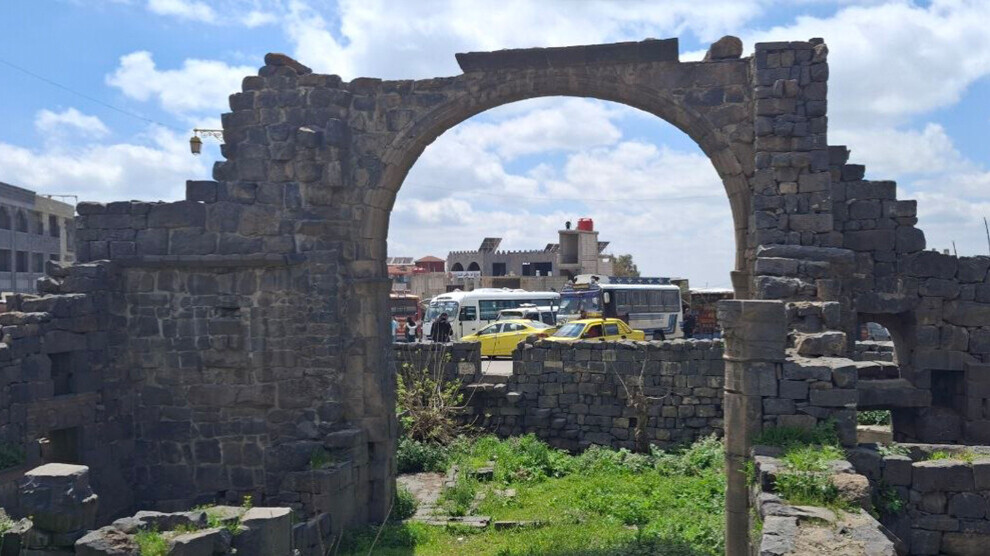
Sweida — In the Syrian city of Sweida, places are not always known through official maps or historical books. Rather, their features are often drawn in people's memory, and their stories are condensed into common names that carry tales and meanings beyond physical reality. Among these places is the "Al-Mashnaqa" area, one of the most present sites in popular consciousness, where it has transformed from mere archaeological remains into a living geographical landmark used in daily life.
This name, repeated on everyone's lips, did not come from nowhere. It is the product of a long interaction between people and place, between the mystery surrounding the site and the need to interpret and understand it. With the lack of sufficient documentation for long periods, popular narratives arose to fill the void, reshaping the site's identity according to the collective imagination. Here, oral memory played an essential role, especially through women who carried the story from generation to generation, preserving the name, weaving stories around it, and making it a symbol that transcends time.
But with the development of archaeological studies, a completely different truth from that entrenched in the popular imagination has begun to unfold, placing us before an important question: How can one place carry two narratives? One living in memory, and another proven by evidence?
A different reading of the site and preserving the popular narrative
In this context, Noor Ashti, a graduate of the Faculty of Archaeology and Museums, offers a different reading of the site, attempting to restore historical truth without negating the cultural value of the popular narrative. She says that the Al-Mashnaqa area is not just an archaeological site but a name repeated in daily events, as well as a landmark used by everyone for guidance. "If a stranger comes and we say 'Al-Mashnaqa area,' they can find it immediately. It is like an unwritten map, drawn or engraved in people's memory, not on paper."
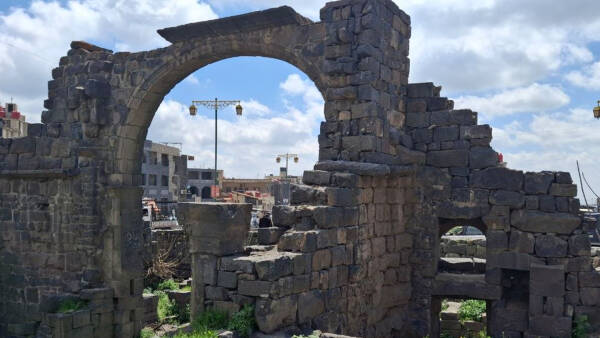
The name "Al-Mashnaqa" (the gallows) came from popular narratives in which women played a major role in shaping them, due to the absence of historical truth and lack of information. Society interpreted the arch based on its shape, linking it to imagined events and stories. Here, women emerged as interpreters of the place, makers of the symbol, and preservers of a memory that transcended physical reality.
The word "Al-Mashnaqa" might have fallen historically, but women did not let it fall. Noor Ashti explains, "We do not write history only in books; we preserve it with our voices, with places that turn into landmarks we use for guidance, and we keep it in stories without realizing it."
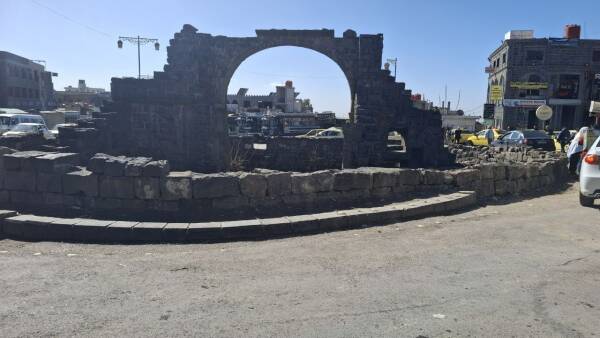
She points out that the Al-Mashnaqa area is the same as the "Triumphal Arch," which is an entrance to the city of Sweida. It was said that during the Hamdanid era, hangings were carried out on it, but this information is incorrect. The site is originally a church unique on a global level.
An ancient civilizational and historical value
This church is distinguished by a rare characteristic: its apse faces north, while typically it faces east. It dates back to the period between the 4th and 6th centuries AD, a period of flourishing Christian architecture, when Sweida was an active civilizational center, witnessing the construction of many churches and religious buildings.
Noor Ashti explains that the church is built of black basalt stone, which is abundant in Jabal al-Arab, characterized by its hardness and resistance to natural and human factors. This contributed to the survival of the arch to this day, despite the disappearance of the rest of the church.
It belongs to the basilica style, with a rectangular design, an entrance on the western side, a central nave for worshippers, rows of columns, and an altar on the eastern side. The eastward direction held deep religious significance, symbolizing light, life, and resurrection, so worshippers would face it during prayer.
Noor Ashti stressed the necessity of preserving what remains of the Al-Mashnaqa ruins, as natural and human factors could lead to their destruction. This can be done by restoring damaged stones under the supervision of specialists, continuously cleaning the site, and placing signs or a fence to protect it.
Documentation is also very important. Preservation does not only mean keeping the ruins standing; they must be culturally and scientifically recorded through studies, photography, and documenting their condition, to ensure their survival in memory even if they are damaged in the future.
She adds, "There is a lack of information due to the limited excavations carried out at the site, but we hope that in the future, more light will be shed on the city's antiquities, given their historical importance." She affirms that women are the backbone of this process, through the narratives they transmitted and the grandmothers' tales that shaped children's consciousness.
At the conclusion of her speech, Noor Ashti stressed the importance of redefining the place, affirming that it is a church, not a gallows, and that it has great civilizational and historical value. She wishes for every woman in Sweida to contribute to spreading this truth and highlighting the true meaning of this place.