
Btween folkore and renewal…. A Yazidi woman revives heritage and preserves the memory of Shingal
After all tragedy in Shingal, Yazidi women consolidate their presence as symbols of resilience and heritage preservation. Turku's story of running a traditional Yazidi clothing shop represents determination to protect her community's cultural identity.
Clstan Azi
Shingal — Yazidi heritage faces increasing challenges threatening its continuity, given the wars and displacement it has suffered in recent years. As traditional practices decline and some symbols disappear, efforts are escalating to preserve this heritage as a fundamental pillar of Yazidi identity.
If one chooses to walk this path, they will encounter a wide spectrum of human experiences, some that bring a smile and others that touch the depths of pain. When the place is Shingal, these emotions intensify even more, as experiences are lived from the roots, especially after the genocide and the suffering it left behind—suffering that cannot be reduced to words. In this context, Yazidi women have emerged as symbols of resistance and steadfastness, affirming their presence in various fields, and repeatedly declaring in the face of attempts at extermination: "We are here."
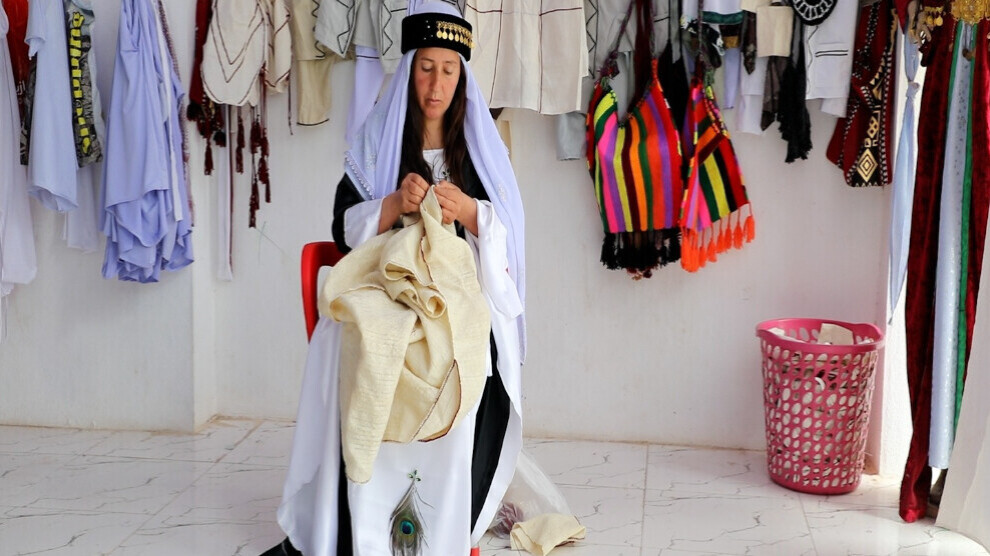
In this context, the story of Turku emerges—a woman from the village of Borek, from a simple Yazidi family, a mother of five children who runs a shop sewing traditional Yazidi clothing. She affirms in her speech that she finds passion and motivation to continue in her work, saying that she will continue on this path as long as she is able.
Turku learned sewing skills from her childhood and has continued practicing this craft for twenty-five years. Despite the large number of women working in this field, her experience stands out for her specialization in sewing exclusively white Yazidi clothing, which gives her work a clear specialized character.
She explains her motivation for choosing this profession by saying that she noticed the scarcity of traditional Yazidi attire in the markets, which pushed her to find a way to contribute to serving her community. From this starting point, she and one of her friends began sewing these traditional clothes, aiming to enhance their presence and spread them among members of the Yazidi community.
She pointed out that over time, she was able to develop a unique style that blends elements of Yazidi folklore with modern touches, allowing her to create diverse designs based largely on traditional old attire. She notes that there are clear differences between Yazidi clothing in the past and contemporary clothing; previously, clothes were shorter and more rounded in their cuts, while today they include additional elements such as covering the head with a black scarf.
Turku also reviews some of the social symbolism associated with traditional dress, explaining that the bride used to wear a red hat on her wedding day, then would wear it again after giving birth to her child, before later replacing it with a white hat. She confirms that each Yazidi tribe has its own distinctive clothing, and the customs and traditions related to dress varied from one tribe to another, reflecting a rich cultural diversity within the Yazidi community.
The color white holds a sacred status among Yazidis. According to Turku, a newborn is dressed in white from the moment of birth and continues to wear it until reaching adulthood and marriage. If someone passes away, they are also shrouded in white, so this color remains a symbol accompanying Yazidis throughout the various stages of life.
She said: "Nowadays, most Yazidis, young and old, are keen to wear white clothes on holidays and special religious occasions, such as the Friday of Sheikh Hadi, the Friday of Sharaf al-Din, the Friday of Shabil Qasim, and others. During these times, the shop sees great activity and demand for purchasing white clothes."
She explained that her shop provides a wide range of folk costumes, extending from children's clothes up to those for people in their seventies. These designs are suitable for both girls and boys alike, with the possibility of tailoring orders as needed. She pointed out that in the past, she and her friend used to sew all the pieces by hand, but later they switched to using a sewing machine without abandoning handwork.
Regarding the difficulty of hand sewing, she affirmed that it requires more time and greater effort, as well as the need for skill and precise knowledge of traditional techniques. "Handmade embroideries differ in quality and character from those made by machine, which gives them a special artistic and heritage value."
She indicated that she has made great efforts to develop and improve her work. "If it were possible, we would have expanded our work further. Unfortunately, we have not received any support so far. We were the first to open a shop in Iraq bearing the name of Yazidi culture, yet no one has helped us. This shop is the shop of all Yazidis."
Each tribe in Shingal has its own distinctive dress. She explained: "If the headscarf has no edge, it is called the headscarf of the poor, but if it has an edge, it is known as the headscarf of the youth, also called Torik or Johar. In the past, shepherds would place their food inside this headscarf and carry it on their shoulders. It was also used in the Berat celebrations."
She noted that the shop also includes boxes decorated with traditional Yazidi drawings. The box is an essential part of every Yazidi home, used to store "Berat" or "Darnat." Berat are pieces that Yazidis place in their holy land in Lalish, over which they recite prayers, and each piece is called a "Qabi," each with its own significance and meaning in the Yazidi faith.
She continued: "The shop also contains special vessels for 'Qawal,' in which the Qawal are placed after being eaten, believing that they bring good luck to the home. The shop also includes tobacco pouches, traditional food utensils, money bags, in addition to bags made from bee wool."
She affirmed that she intends to continue her work as long as she is able, adding that her greatest aspiration is for the Yazidi community to preserve its customs and traditions. "Yazidi identity is essentially based on heritage and culture," considering that the loss of these elements would threaten the existence of the community itself.
She believes that preserving cultural heritage is an essential condition for the continued existence of Yazidis. She extended her congratulations to the members of her community on the occasion of the Wednesday of April (Çarşema Sor / Red Wednesday), wishing that the Feast of Tawûs Melek (Peacock Angel) would be an occasion bringing goodness, tranquility, and happiness to all Yazidis.