
A Moroccan artist uses theater to raise women's issues and social representations
Moroccan theater artist Fatima Zahra Al‑Sandadi combines theatrical work with engagement in women's issues, addressing gender identity and social representations in Moroccan society.
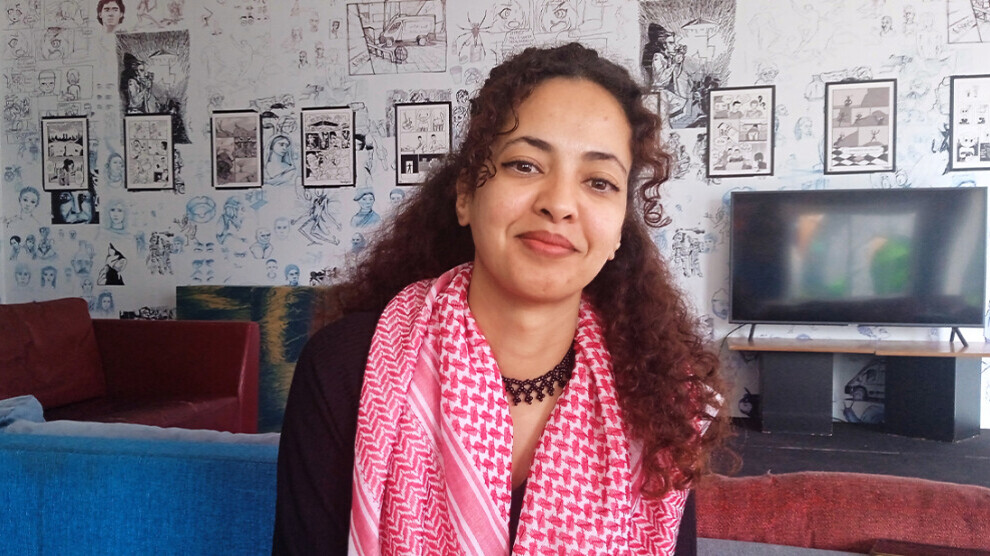
Hanane Hart
Morocco – In a conservative rural environment in "Dar Boubakar" on the outskirts of Agadir, where girls' education was sometimes seen as futile and their role limited to housework and preparation for marriage, Moroccan theater artist Fatima Zahra Al‑Sandadi chose a different path. Although her parents had intermediate education and belonged to this conservative milieu, they believed that education was a gateway to a better life for their six children, which allowed her to continue her studies and move beyond the village limits to university.
Initially, Fatima Zahra Al‑Sandadi chose the field of tourism and worked in it for a while, but that path did not reflect what she was looking for in terms of self‑expression and convictions. She later decided to move to the city of Kenitra, enroll in university, and specialize in theater – a step that represented for her a departure from the traditional molds imposed on women in a conservative environment, where women's roles were often confined to the domestic sphere, while she had believed from her early years that women are capable of contributing to social and cultural change.
Art as a space to raise women's issues
From this awareness, Fatima Zahra Al‑Sandadi chose to make theater a space for discussion and engagement with women's issues. She began working on topics related to power, gender hegemony, the body, and social representations of women, trying to use art as a tool for expression and for raising questions within society.
She said that her work on women's issues in theater was not the result of a specific moment or a decision separate from her personal journey; it came naturally from her experience as a woman living daily with various forms of pressures and social representations that women face in society.
She explained that these issues remained present in her daily life and in her artistic and intellectual work, adding that in her view, art is not an aesthetic act separate from life, nor a beautiful practice isolated from the pulse of reality; it is a tool for conscious engagement with society and a means of expressing the principles and convictions she carries within her.
She noted that her background linked to cultural, social, and protest activities contributed to shaping her artistic choices, which made her inclined to integrate human rights and women's rights issues into her theatrical works, considering that theater offers different possibilities for expression that direct speech or slogans do not provide. "I always try to maintain a balance between the aesthetic dimension of the theatrical work and the critical or advocacy dimension."
She pointed out that direct speech can be expressed in protest, on social media, or in political discussion, while theater requires a special artistic language based on dramaturgical research, deep exploration of social reality, and its transformation into aesthetic forms capable of influencing.
She believes that the aesthetic impact within a theatrical work can push the audience to think more deeply and sensitively, explaining that art works not only at the level of ideas but also at the sensory and psychological level, allowing for a kind of internal interaction in the audience.
Speaking about her theatrical works, she explained that she has worked on several projects addressing topics related to the body and power at various political, social, religious, and cultural levels, adding that some of these performances faced difficulties or rejection due to the nature of the topics they raise.
She noted that one of her performances dealing with the concept of "honor" in Moroccan society was rejected by some audiences, considering that part of this rejection is sometimes related to society's unpreparedness to confront certain questions or discuss topics it considers sensitive.
She also spoke about her experience with the performance "Amouddo," which she began working on in 2018, and said that the performance was stopped during its first presentation in an academic space concerned with gender, society, and culture issues. She considers that what happened reflects the continued existence of social and cultural sensitivities toward certain topics related to women, power, and the body.
The double fragility of the female artist
Fatima Zahra Al‑Sandadi believes that the challenges facing an artist are not only related to institutions or freedom of expression but also to society itself. She explains that an artist who chooses to work on sensitive issues may find himself marginalized or far from circles of support, production, and presentation, especially if he does not align with the prevailing trends within cultural policies.
She added that a theater artist already lives in a state of fragility, while a female artist experiences "double fragility," whether due to society's view of the woman artist or due to some forms of discrimination within the artistic milieu itself.
In this context, she spoke about being subjected to some situations she described as disturbing during collective experiences in theater, considering that some female artists experience pressures or practices that may seem normal within the artistic milieu, but deeply reflect imbalances related to the view of women.
She explained that this reality was among the reasons that often pushed her to work on solo performances, not only as an aesthetic choice but also to preserve a greater space for freedom to express her positions and convictions.
Asked whether difficulties or negative reactions ever made her think of stopping, Fatima Zahra Al‑Sandadi says there are moments of fatigue and frustration she sometimes experiences, especially when facing resistance from the audience or society, but she affirmed that she cannot produce art separate from her convictions or the principles she believes in.
She added that the meaning of art for her is linked to the ability to clash with reality and resist through artistic language, adding that this path has become part of her personal, intellectual, and human identity.
She believes that art does not provide ready‑made solutions or immediate results, but it creates a space for discussion, reflection, and reconsideration of some prevailing ideas, considering that artistic work may sometimes push the audience to notice things they had not seen before.
She pointed out that many artistic and cinematic experiences around the world have contributed to opening societal debates or sparked legal and social changes, considering that art, even when it does not directly change reality, remains capable of creating discussion and moving consciousness.
Theater as an act of resistance
In her discussion of women's issues, Fatima Zahra Al‑Sandadi stressed the importance of paying attention to women who live in more fragile conditions in marginalized and remote areas, considering that part of feminist discourse must open up more to women who suffer economic, social, and cultural marginalization.
She revealed that she is working on a theatrical performance titled "The Tattooed Woman," in which she chose to evoke the character of Fatima Ouharfo, as one of the Amazigh women who participated in resistance but remained absent from memory despite her struggle experience. She believes that many women belonging to the margins have their stories and experiences erased, so through the performance she tried to re‑highlight this character from a different angle, combining visual and aesthetic dimensions with symbolic weight.
She noted that the performance begins with a woman in the kitchen washing dishes, surrounded by a pressure cooker symbolizing the social and psychological pressures women experience in society. While the character appears immersed in daily life details and domestic burdens, she gradually begins to evoke major events and transformations, ranging from "Generation Z" protests to the experience of Fatima Ouharfo, in a visual theatrical scene through which she tried to express the relationship between women and social change.
Through this artistic construction, she seeks to convey the idea that despite the constraints and traditional roles imposed on women, women remain present at the heart of the transformations society undergoes, interacting with political, social, and cultural issues, even if this presence is sometimes erased or its importance diminished.
In conclusion, Fatima Zahra Al‑Sandadi sent a message to women calling for more resistance, affirming that the struggle for rights, dignity, and freedom remains an ongoing path, whether within art or within society in general.