
Yemeni Journalists Warn of Escalating Violations Against Media Workers
Female jouralists confimed escalating violations against media workers at the Yemen obsevatory launch, warning of widening risks, digital violence, and ongoing prosecutions.
RANIA ABDULLAH
Yemen — With the escalation of violations against journalists, the Yemeni media landscape is becoming increasingly fragile as a result of declining legal safeguards and continued restrictions on publishing and access to information, which deepens the risks of media work and weakens the independence of press institutions in a turbulent security and political environment.
The Media Freedoms Observatory in Yemen ("Marsadak") documented 42 violations against journalists and workers in media institutions during the period from January to June of this year, including two killings and 11 cases of arrest and arbitrary detention, warning of the continued decline in levels of protection and accountability in the country.
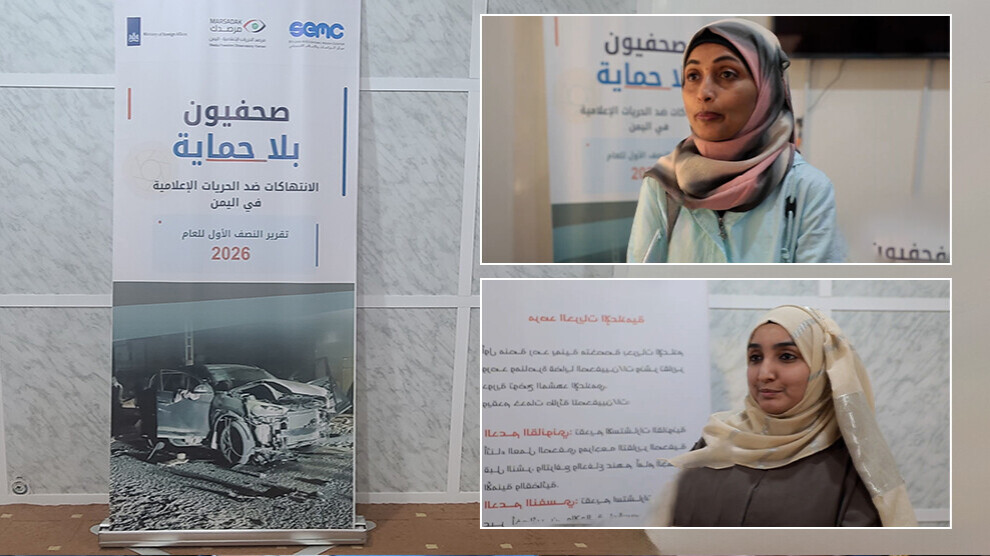
This came during the observatory's launch on Wednesday, August 26, of its semi-annual report "Journalists Without Protection," attended by the Deputy Head of the Mission of the Kingdom of the Netherlands to Yemen, Bart Vinstra, the Yemen file officer at the Arab Network, and the Communication and Information Specialist at the UNESCO Office for the Gulf States and Yemen, with the participation of about 80 male and female journalists, both in person and online.
Security Prosecutions
The violations documented by the report included, in addition to killing and detention, summons, investigation, security and judicial prosecution, assaults, threats, incitement, as well as the prevention and obstruction of journalistic work.
The report also documented 19 cases of digital violence targeting female journalists and media women, distributed across defamation, blackmail, abuses, and privacy violations, noting that the continuation of this type of targeting may push some female journalists to reduce their media activity or avoid addressing certain issues.
According to the report, the documented violations were distributed as follows: two killings of journalists, one injury, seven cases of summons or security and judicial prosecution on the grounds of media work, five assaults, five cases of prevention and obstruction of journalistic work, four cases of incitement, three threats, in addition to violations against media institutions and one case of electronic blackmail. Hadramawt recorded the highest number of violations with ten cases, followed by Aden with eight, then Taiz with seven.
Government entities or those affiliated with them topped the list of entities attributed with committing violations with 18 cases, while ten cases were attributed to influential figures and activists, six to the Houthis, six to unknown parties, and two to the Southern Transitional Council.
The report pointed out that the decline in the number of cases recorded in Houthi-controlled areas does not necessarily mean an improvement in the media freedom environment, given the continued restrictions and repression and the declining presence of independent and partisan media outlets, in addition to the difficulty of accessing information and documenting violations due to journalists' and their families' fears of reporting them or revealing their details.
42 Violations
Media professional Naaim Khaled affirmed that recording 42 violations in a short period, including the killing of journalist Mohammed Ayedh, is an unprecedented matter and an indicator of the confiscation of freedom of opinion and expression, where efficiently conveying the truth now costs the journalist their life.
She called on international and Arab organizations and relevant bodies to provide urgent protection for journalists, with dedicated protection mechanisms for female journalists who face direct violations and systematic campaigns in cyberspace, pointing out that female journalists are now being forced to practice careful "self-censorship" as a last resort to survive and avoid becoming new victims.
In a living testimony to the bitterness of reality, journalist Ilham Al-Faqih explained that self-censorship has become an obligatory choice to protect oneself and families from political labeling and continuous threats, and she recounted her personal experience and the pressures and polarization she faces.
She affirmed that the state of intimidation reached its peak with the assassination of her husband, journalist Abdulsamad Al-Qadi, because of his words and journalistic freedom: "The spread of fear, killings, and arrests has made journalism a repelling profession, even for university students who are now avoiding studying it."
For her part, Bushra Al-Aghbari, secretary of the Media Freedoms Observatory in Yemen, said that "the launch of the periodic report for the first half of this year, which documented 42 violations varying between killing, arbitrary detention, direct threats, and the exploitation of legal and security procedures to restrict journalistic work."
She explained that Yemeni female journalists were not isolated from this wave, as the report documented 19 cases of digital violations specifically targeting female journalists, including defamation campaigns and digital harassment, affirming that these numbers represent a serious indicator whose impact is compounded in a conservative societal environment that views women's work in media with a limited perspective, forcing many of them to forcibly stop practicing the profession.
According to the observatory, the total violations it has documented since 2015 amounts to approximately 2,717 violations, including 72 cases of killing of journalists and media workers, 540 cases of arbitrary detention, and 320 violations targeting media institutions.
The observatory called on the authorities and concerned parties to ensure the safety of journalists, end arbitrary detention, implement judicial rulings, open effective investigations into violations and hold those responsible accountable, in addition to protecting female journalists from digital violence, strengthening the independence of media institutions, and working to end impunity.
"Marsadak" warned of the continued risks facing male and female journalists in Yemen, amid weak protection and accountability mechanisms, calling for urgent measures to ensure a safer environment for media work.