
Young Afghan Woman Confronts Taliban Policies Through Art"I Wanted to Be the Women Voice "
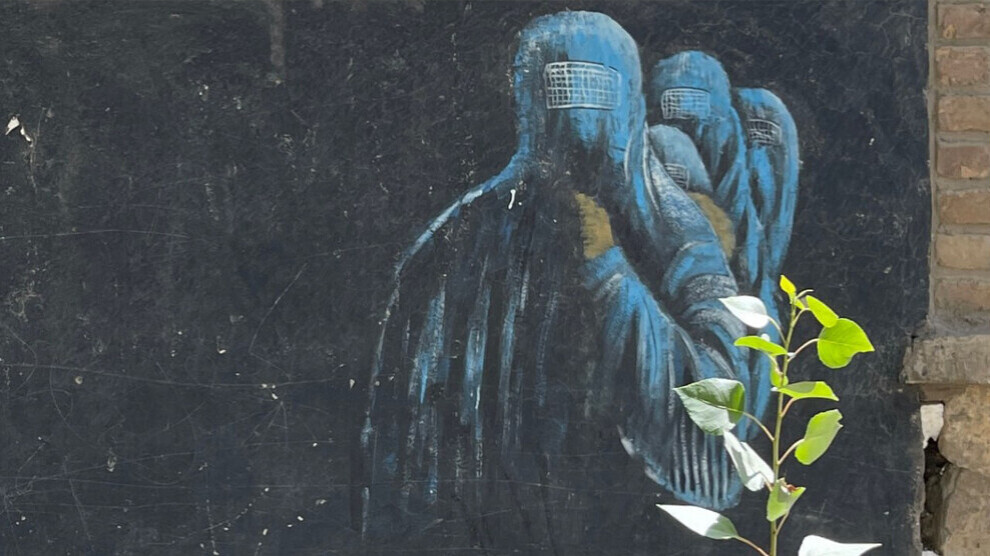
Eighteen-year-old Afghan painter Layla Ahmadi painted a government wall mural protesting the Taliban's arrest of Herat women, aiming to be a voice against gender oppression.
BAHARAN LAHEEB
Herat-When reviewing Afghanistan’s history, and due to the dominance of a patriarchal culture, the role of struggles and social movements has often been minimized—even though women have consistently played a pivotal role in the economy, culture, literature, arts, and societal advancement.
The long-term deprivation of women’s most basic rights in Afghanistan, coupled with successive regimes using concepts such as "honor" and "dignity" to justify their suppression, has fostered a growing awareness and spirit of resistance among women.
Among the various historical eras, the reign of King "Amanullah Khan" stands out as a period when women received greater recognition as equal members of society. During his rule, the first schools for girls were established, women were sent abroad for education, and opportunities for employment and participation in diverse fields were opened to them.
With the Taliban's return to power, feminist movements expanded once again. Women, individually and collectively, stood against anti-women policies despite facing arrests, torture, insults, and persecution. These struggles were also influenced by regional feminist movements and the activism of figures like Meena Keshwar Kamal, members of the Revolutionary Association of the Women of Afghanistan (RAWA), and the women’s wing of the Solidarity Party. This legacy inspired Afghan women to raise their voices demanding justice and solidarity through even the simplest forms of protest across the country.
This female legacy drove 18-year-old painter Layla Ahmadi from Takhar to express her solidarity with the women of Herat—who were recently detained by the Taliban’s "Ministry for the Propagation of Virtue and the Prevention of Vice"—by painting a mural depicting violence against women, aiming to serve as their voice.
The artwork was secretly painted on the wall of a government building. Layla Ahmadi recounts, "I was in the sixth grade when the Taliban seized power, and Takhar was one of the first provinces to experience war, falling under Taliban control well before many others. They announced across all districts and villages that families must raise two flags over their homes: a white flag if the household included a young girl, and a red flag if it included a widow. This decision sparked widespread terror, forcing many to flee to Kabul and other provinces, only to return later after the Taliban took control of the entire country."
She added, "I was furious when I heard that announcement, and the situation worsened when I was banned from continuing my education. However, I witnessed the courageous women and girls of Afghanistan—specifically in Takhar—taking to the streets to demand their rights from the very first days of Taliban rule. I was young, so I wasn't allowed to join those