
Solidarity with Syrians…How Moroccans from Diverse Backgrounds Unified Around a Single Cause?
Former members of the Moroccan Youth Committee in Support of the Syrian People are preserving the memory of civic solidarity, tracing how diverse activists united around a shared humanitarian cause.
HANANE HARATE
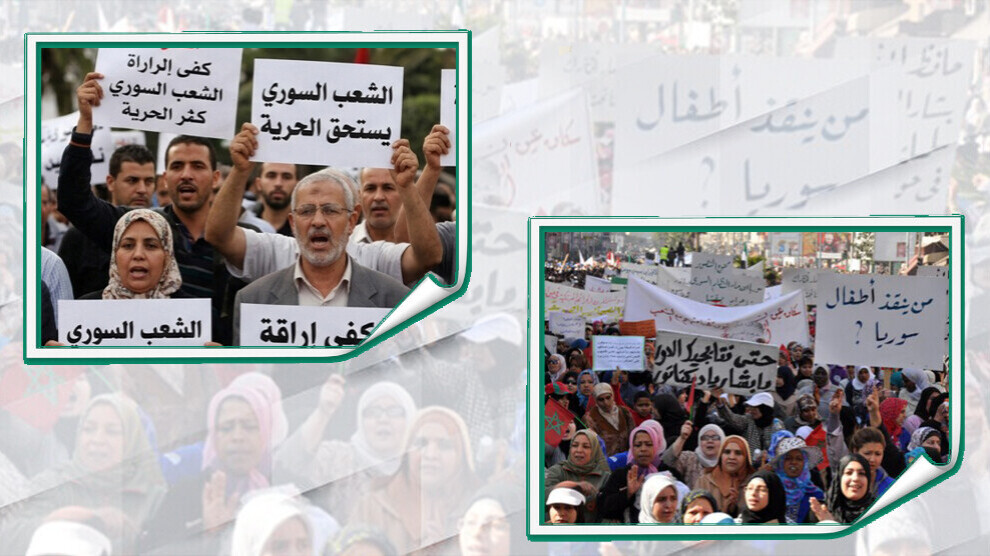
Morocco-For the former members of the Moroccan Youth Committee in Support of the Syrian People, the challenge is no longer organizing marches or solidarity sit-ins—as was the case more than a decade ago—but rather rescuing the memory of a civic initiative from fading into oblivion.
Years after the solidarity movement with Syrians subsided, several former members have embarked on a mission to gather remaining photographs, documents, statements, videos, and testimonies documenting more than 300 solidarity events held across various Moroccan cities. This archive risks being lost to outdated phones, inactive digital accounts, and the dispersion of participants, each holding a fragment of history.
This report draws on the testimony of Hanane Rihab, coordinator of the Moroccan Youth Committee, to examine the circumstances of its founding, how it successfully united diverse political and civil components within a single framework, and the key milestones that marked its work over a span of more than three years.
The idea started from Daraa
Recalling the committee’s early beginnings, Hanane Rihab explains that the initiative was conceived immediately after the outbreak of protests in the Syrian city of Daraa in March 2011. It arose in solidarity with the Syrian people, particularly the children of Daraa, whose images of detention and torture sparked widespread sympathy at the time.
She notes that photographs and videos emerging from Syria via media outlets and social networks conveyed the immense suffering endured by civilians in the cities where protests first erupted. This prompted several young activists in Morocco to establish a civic framework to voice their solidarity.
For many young people, supporting populations demanding freedom, dignity, and social justice was viewed as a matter of principle. This conviction led to the creation of the Moroccan Youth Committee, with the participation of more than seven political and civil entities.
Rihab points out that from its inception, the committee brought together activists from leftist parties, Islamists-leaning organizations, trade unionists, human rights defenders, and civil society actors. It was an experiment that united different factions under one umbrella while respecting the independence of each component, united by the goal of supporting the Syrian people and raising awareness of their plight.
Over 300 Events Across Moroccan Cities
Amidst this diversity, Hanane Rihab coordinated the committee’s work—a role that extended far beyond preparing for sit-ins and marches. It involved harmonizing different factions, distributing responsibilities, and ensuring the continuity of regularly scheduled initiatives.
Since its founding, the committee strived to move beyond mere statements and symbolic positions, translating its mission into an ongoing field program. This included protest sit-ins, solidarity marches, seminars highlighting the humanitarian situation in Syria, cultural festivals, poetry evenings, and meetings with members of the Syrian community residing in Morocco.
Its activities expanded to several Moroccan cities, featuring solidarity events and demonstrations, including rallies held outside the Syrian Embassy at a time when the Syrian issue commanded a prominent place in public debate in Morocco.
The Peak of Mobilization
Among the various initiatives organized by the committee, the march in the "Sraghna" square in Casablanca on February 26, 2012, stands out. Drawing thousands of Moroccans, it marked one of the high points of Moroccan solidarity with the Syrian people.
Rihab describes the march as the culmination of weeks of collective effort, embodying the capacity of disparate political and civil groups to work together in defense of a humanitarian cause.
She believes the high level of mobilization accompanying the committee’s activities mirrored widespread public engagement with events in Syria at the time. Moroccans followed developments so closely, she notes, that "if you asked any Moroccan back then about Syria, they knew what was happening in Aleppo, Deir ez-Zor, Daraa, or the rural Damascus countryside, and they clearly expressed their solidarity with the Syrians and their rejection of the violence and intimidation faced by civilians."
This general awareness lent popular momentum to solidarity initiatives, keeping the Syrian issue firmly anchored in Morocco’s public discourse throughout those years.
Rihab adds that the committee was driven by the belief that the demands of peoples for freedom should not be met with violence. This conviction was reflected in the sustained involvement of Moroccan women from various partisan backgrounds, alongside human rights and civil activists. These women played a vital role in coordinating committee components, preparing activities, mobilizing participants, and organizing cultural, legal, and humanitarian campaigns for Syrians.
For Rihab, who coordinated the committee throughout its active years, this engagement came at a personal cost; due to her outspoken positions supporting the Syrian people, she faced campaigns of verbal abuse, defamation, and accusations.
Memory of a Civic Experience
Today, more than a decade after the committee’s launch, several of its former members—both women and men—are working to collect remaining photographs, documents, and testimonies from that era. They are striving to preserve the memory of one of Morocco’s most prominent experiences of civil solidarity with the Syrian people.
While the documents of that era remain scattered across personal archives, loose photographs, and digital accounts vulnerable to disappearance, the organizers of this documentation initiative aim to safeguard this legacy. They view it not merely as a record of solidarity events, but as a testament to a civic endeavor that demonstrated how a humanitarian cause could unite diverse political and civil factions, while highlighting the instrumental role played by women in organization, coordination, and the sustainability of joint action.