
Students and Professors of Rojava University Protest Against Reducing Kurdish Language Classes
Students and Professors of Rojava University in Qamishlo, during a protest vigil regecting the Syrian Ministry of Education’s decision to allocate only three classes for Kurdish, demanded the guarantee of mother tongue education and linguistic equality.
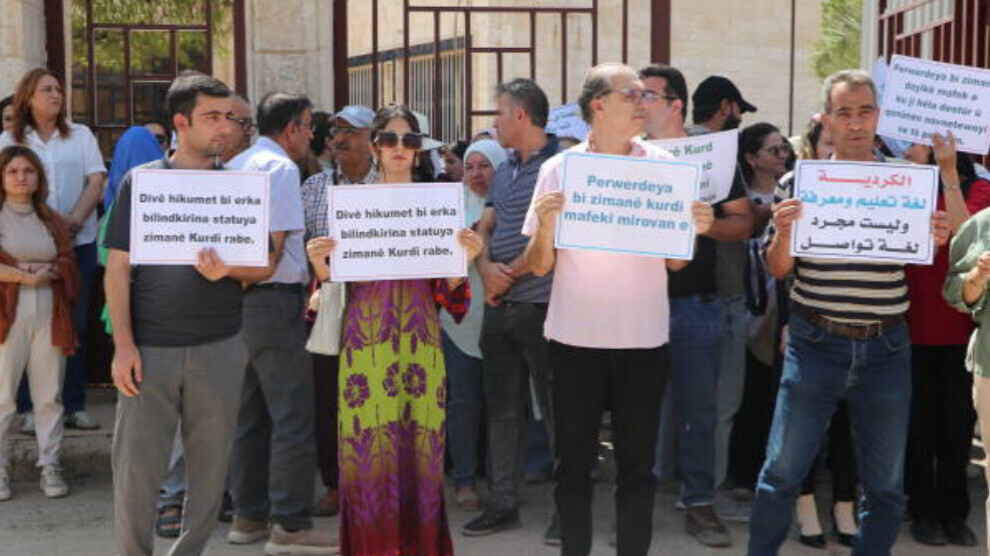
Qamishlo_Students of Rojava University organized a protest vigil today, Monday, August 31, 2026, in front of the university building in Qamishlo, attended by dozens of students and professors, in rejection of Decision No.964/2068 issued by the Ministry of Education in the Syrian Interim Government, which allocated three classes for Kurdish.
Professors and students of Rojava University delivered a statement during the protest vigil, stating: "We do not accept in any way Decision No. 943/2068 issued by the Syrian Education Authority, which strips us of our cultural and linguistic rights. This decision nullifies mother tongue education that has continued for 12 years. It also causes other peoples' languages to prevail over our language, and leaves our language under systematic marginalization and obstruction policies without legal or rightful status."
They noted that since 2014, Kurds in Rojava have received education in their language. Despite the non‑recognition of Kurdish‑language certificates by various governments and powers, a full educational system has been managed, and over a decade it has been proven that Kurdish is capable of being a language of education and science, and that the experience of a multilingual system can be achieved in Syria and Rojava.
The statement clarified that "after the issuance of Decree No. 13 by the head of the Syrian Transitional Government, under which Kurdish became a national language in Syria and Kurds were recognized as an authentic component of Syria, the Syrian Ministry of Education's decision treated it as a foreign language."
The statement affirmed that "this decision absolutely does not align with the hopes and demands of the Kurdish people and students who have studied in Kurdish. This decision will also cause great harm in the future to the quality of students' education, and will drag Syria's situation from its current state to a worse one."
Through the statement, students and professors directed their calls and demands to the relevant authorities and parties that protect linguistic independence, to withdraw this decision and instead work on issuing decisions in the new Syria that guarantee equality for all, without any ethnic or linguistic discrimination.
For her part, Kurdish teacher Brivan Hassan expressed her demands, saying: "The Syrian Interim Government's decision to teach Kurdish only three hours a week is unacceptable. None of our teachers or students accept this decision. Through this decision, they want to cancel our efforts and struggle, but we will not stop demanding our right to education in our language."
She stressed the need for Kurds in their areas to take to the streets in protest against this decision and demand education in their mother tongue.