
Regional Workshop Aims to Strengthen Regional Cooperation and Reform Family laws
The arab women organization,through its regional workshop,seeks to reform family laws from a gender-equality perspective,safeguarding human dignity,promoting justice,and strengthening social cohesion.
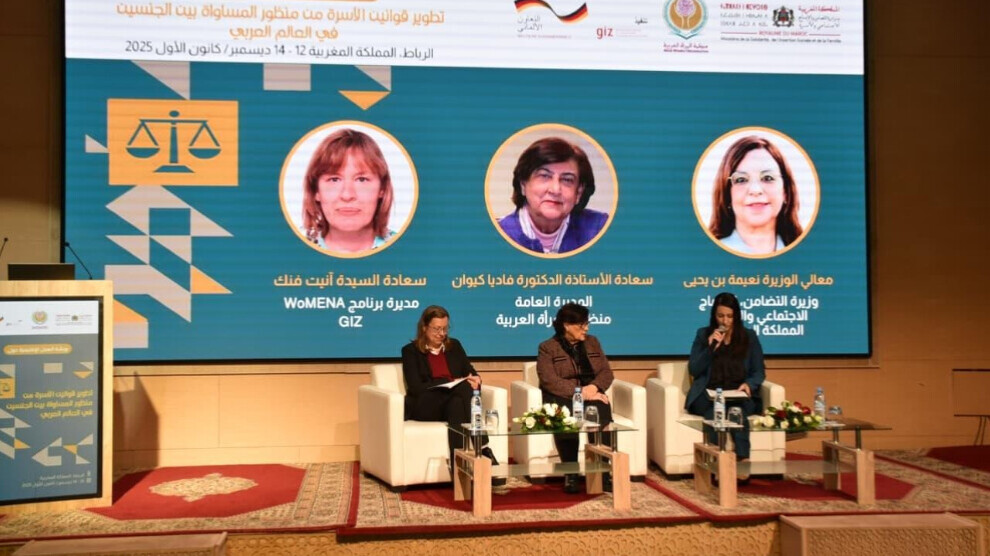
News Center — The regional workshop organized by the Arab Women Organization provides an interactive space for discussion and the exchange of expertise among participants on national experiences in reforming family laws, strengthening legislative analysis from a gender-equality perspective, and enhancing regional cooperation.
In cooperation with Morocco’s Ministry of Solidarity, Social Integration, and Family, the Arab Women Organization held a regional workshop in the Moroccan capital, Rabat, on Friday, December 12, titled “Developing Family Laws from a Gender Equality Perspective in the Arab World.” The workshop brought together parliamentarians, legal experts, judges, and representatives of governmental and civil institutions from various Arab countries.
In her opening remarks, the organization’s Director General, Fadia Kiwan, explained that the workshop aims to foster discussion and exchange experiences in equality- and justice-responsive legislation. She emphasized that cooperation is essential, as Arab countries share culture, history, and social realities shaped by factors such as wars, armed conflicts, and natural and economic crises, noting that political will in Arab states has a major impact on developments.
She expressed hope that the workshop’s outcomes—ideas, recommendations, and shared experiences—would enrich efforts to achieve legislative justice and equality, particularly in family laws.
Family-Related Legislation
For her part, Morocco’s Minister of Solidarity, Social Integration, and Family, Naima Ben Yahya, affirmed that the workshop comes amid profound regional and international transformations and a growing need to review family-related legislation in ways that safeguard human dignity, entrench justice, and strengthen social cohesion.
She noted that the topic is of great importance, as it represents a key lever for achieving sustainable development and social stability. As the primary unit of society, the family requires modern and fair legislation capable of keeping pace with rapid changes and guaranteeing the rights of all its members within a framework of shared responsibility and mutual respect.
She added that major reform projects have been implemented, marking a qualitative shift toward consolidating women’s rights, protecting children, and reinforcing the principles of equality and fairness, with the aim of positioning Morocco among countries that place women’s empowerment and dignity at the heart of public policy.
Strengthening Gender-Just Policies
Meanwhile, Annette Fonk, Project Director at the German Agency for International Cooperation (GIZ), explained that the WoMENA project is implemented by GIZ in partnership with the Arab Women Organization, with the goal of strengthening gender-just and equality-responsive policies in the political and economic spheres across the Middle East and North Africa (MENA) region.
She pointed out that women in the region continue to face unique challenges, including violence and discriminatory laws, particularly in family law, which governs marriage, divorce, inheritance, and child custody. Discrimination in these areas significantly affects many aspects of women’s lives, including legal status, economic opportunities, and social roles. She expressed her anticipation of hearing the perspectives and ideas of participating experts and legal professionals of all genders.
The workshop, which runs until Sunday, December 14, serves as an interactive platform for exchanging expertise on key discussion topics, including an overview of the state of family laws in Arab countries; legal analysis and impact assessment from a gender-equality perspective; methods for redrafting laws accordingly; advocacy strategies for family law reform; parliamentary tools to support successful change; national action plans and regional networking on legislative reform; and, finally, a vision for next steps and follow-up mechanisms.