
Kulestan Kalo: Integration Must Protect Women's Gains and Identity
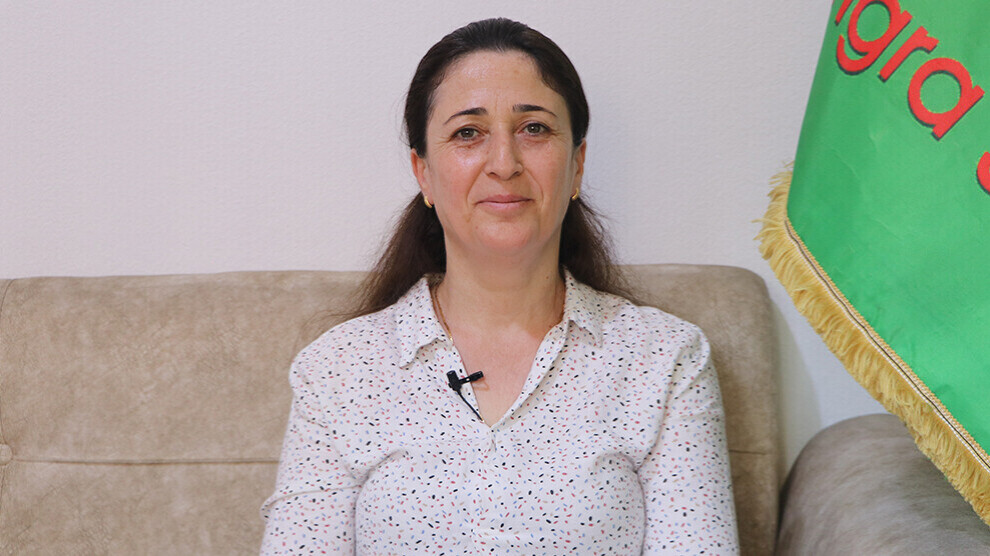
The spokesperson for Kongra Star, Kulestan Kalo, confirmed that Syria cannot be managed with a unilateral mentality, indicating that true integration is achieved through women's participation in building the new Syria.
NAGHAM JAJAN
Qamishlo – After a long struggle and fight waged by women for many years to build a democratic society and protect their rights, integration in Syria is not merely a political matter for women; rather, this stage has simultaneously become a gateway to determining their future in building the new Syria.
The spokesperson for the Kongra Star, Kulestan Kalo, said in an interview with our agency that the Kongra Star believes the agreement of 29 January came with the aim of protecting the people of Rojava from the risks of genocide and annihilation, amid efforts by some states to weaken the administration in the region. She explained that the agreement, although it does not represent the final ambition of the people who have waged a long struggle, constituted a necessary step to avoid grave dangers.
Amid the continuation of the process of integrating the institutions of the Autonomous Administration and the existence of popular objections to some decisions, especially regarding security and the Kurdish language, how does Kongra Star assess the new phase of the integration path, and what is its position?
Regarding the integration of the Autonomous Administration's institutions, the process has not yet ended, but from the military aspect, Mr. Mazloum Abdi announced that the process of integrating the Syrian Democratic Forces has ended, and the security and military files related to them have been completed, and three brigades have been formed for the Kurdish areas.
There are some topics on the agenda that still constitute an obstacle. The issue of the Kurdish language is also one of the main topics on the agenda. Initially, it was announced in Decision No. 13 that the Kurdish language would be a national language in the Kurdish areas, but on 27 August a decision was issued granting the Kurdish language only three hours per week.
This decision caused widespread discontent and rejection by students, teachers, and the Kurdish people, who have been raising their voices for days against this decision and demanding the protection of their linguistic right. This rejection and discontent also show that some decisions and steps in the integration process still face rejection from the people.
In the integration agreement, women's rights were not discussed as required... What is your position on that?
From the women's side as well, there is a lot of discontent and objections regarding integration. In this process, most of the main tasks and responsibilities are undertaken by men, and the marginalization of women's role in administration and decision-making is noticeable.
Recently, many meetings were held, the last of which was a meeting with the governor of Hasakah. In these meetings, we, as women's movements and organizations, demand the protection of our identity and role, and we emphasize that women's status and representation must be guaranteed within the institutions that will be unified in the integration, and that women must take their role in both administration and decision-making.
Protecting women's rights is a great task and responsibility that falls on the shoulders of women's organizations. Before the integration process began, we as women's organizations possessed joint platforms, and all of them had a unified position based on the issues of women's rights, freedom, and role.
But after the issue of integration was placed on the agenda, this process affected the position and work of women's organizations. In this context, there are some fears and risks surrounding the way women's organizations, their identity, and women's rights are protected. Accordingly, our main and central issue is how we can, during this process, protect our organizations, our identity, and women's gains, and ensure the continuation of women's role in both administration and decision-making.
What will the form of women's struggle be in the coming periods?
We have waged a great struggle for the Women's Protection Units (YPJ) to remain a military force specialized in protecting women. We believe that with integration, many of the gains achieved as a result of women's struggle and the revolution could face serious risks, especially since the Damascus government does not place women's rights as a fundamental and essential issue before it.
Accordingly, in order to protect and guarantee women's rights in the constitution, this is a main issue that must be discussed and raised. Since there are still mentalities that diminish the role of women, we must strengthen the levels of women's education and training, and open the way for their participation in all fields, so that we can protect the gains of the women's revolution and enhance the role of women in the process of building and developing society.
We, as women's organizations, must take our place in decision-making positions and in writing the Syrian constitution. This is not merely a demand directed at the interim government, but is also a message to international forces that we are one voice and holders of a unified decision. In order to protect women's rights and existence, women's rights must be included in the Syrian constitution clearly and substantially.
How does Kongra Star see the future of women in this new phase of Syria?
We do not see the future of women in the interim government positively, because it has not yet presented anything that guarantees women's rights and roles. Since the beginning of the announcement of this government, only one woman has held a position in it, and this one woman cannot represent all women.
In this geography, we have trained and organized thousands of women. At the same time, there are many women's institutions that manage themselves by themselves, and we have the "Women's House" that solves the problems of thousands of women. But the interim government shows only one color of women, and presents a woman with specific clothing and appearance. We have struggled for long years so that women can live freely, manage themselves, and possess a role and authority in decision-making in all areas of life.
There is still a mentality that diminishes the role of women in education and building society, and this mentality takes its place in decision-making positions. How do you view these positions?
An important event occurred on the agenda recently. During a meeting of the Syrian People's Council, one of the representatives expressed his opinion regarding raising and educating children, saying that when they go to schools, they find that a large number of schools are run by women, and he considered this a danger to children, claiming that men should educate children in order to make them strong.
This opinion shows that there is still a mentality that diminishes the role of women in education and building society, and views her as an inadequate or weak force. But unfortunately, those who share these views do not know history and the role of women in building society well until now. Women are not merely educators and teachers; throughout history, they are the ones who built society, protected it, and managed it. Accordingly, it is necessary that our struggle continue so that we can stand up to these mentalities and show the role of women in building society strongly and clearly.
What is required for integration to protect the rights of all components and women democratically?
For a true and sound integration to be achieved, it is necessary that we be partners in building this homeland, because we have struggled for long years in this region. Our desire is for the gains and experiences achieved during the revolution to become the property of the Syrian people.
We do not yet see democratic integration in many aspects of this process. For a true and democratic integration to be achieved, a change in the mentality of this government is necessary, as Syria cannot be managed with a unilateral mentality and a single method. The government's positions show that there are still obstacles to building a democratic system in the region.