
Why Are Moroccan Lawyers Still on Strike After Parliament Passed the Legal Profession Bill?
The legal profession bill controversy in Morocco persists despite parliamentary approval. Government cites reform, bar associations decry independence infringement, as all await the Constitutional Court's decisive ruling.
HANAN HART
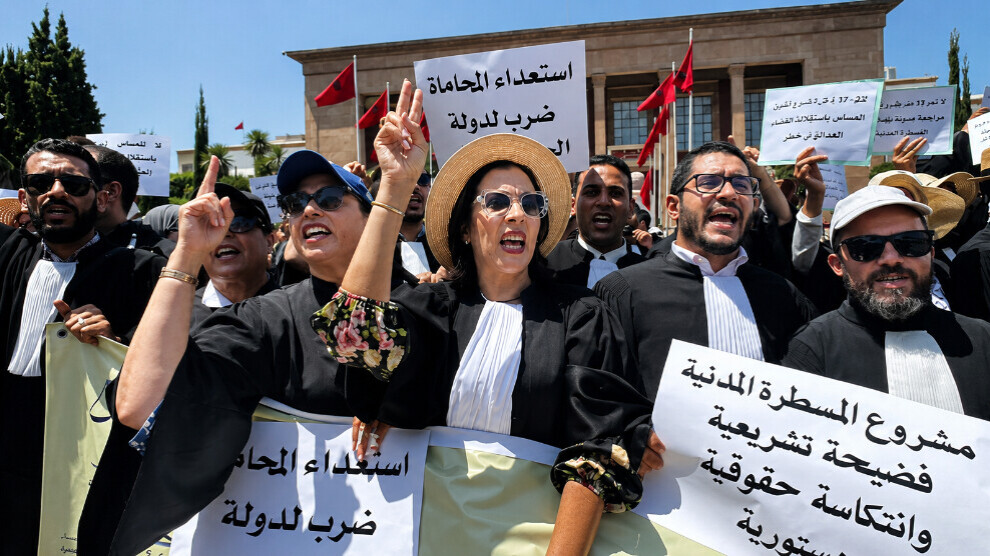
Morocco — The vote by the Moroccan House of Representatives, which passed Bill No. 66.23 pertaining to the regulation of the legal profession by a majority of 85 votes against 35 opposing deputies nearly two weeks ago, has not put an end to the debate surrounding the text. Following its referral to the Constitutional Court, lawyers await its decision regarding the appeals lodged against a number of its provisions, while protests and strikes continue in objection to what they consider an infringement upon the profession's independence.
To comprehend the reasons for the persistence of this debate, the experience of Moroccan lawyer and parliamentarian Loubna El Sghiri emerges as illustrative; she found herself debating a bill that does not concern a professional category distant from her, but rather regulates the very profession she practices daily.
Between the dome of parliament and the robe of the advocate, she has reconciled two roles: a deputy who participated in the discussion and voting on the bill, and a lawyer defending what she deems the fundamental guarantees for the independence of the defense profession.
From her position as a member of the Justice and Legislation Committee in the House of Representatives, Loubna El Sghiri has followed the various stages of the bill's discussion, from its referral to the committee until the vote following its return from the House of Councillors.
She states that her participation was not exceptional, but rather came within the framework of an active female presence within the Justice and Legislation Committee, explaining that female parliamentarians from both the majority and the opposition, including lawyers, participated in the discussion of the various articles of the bill and contributed to enriching the debate through their legal expertise and political affiliations.
She affirms that the presence of female parliamentarians was not merely formal, but contributed to the discussion of the various provisions of the bill, expressing her satisfaction with the role she played during this phase, both as a parliamentary deputy and a lawyer who participated in the discussion of a law affecting the profession to which she belongs.
Loubna El Sghiri considers that the continuation of the lawyers' strike after the parliamentary approval does not reflect a rejection of the principle of reforming the legal profession per se, but rather expresses objection to the manner in which the bill was drafted and its content, stating that the text did not receive its due share of discussion, and deeming that the participatory approach was not sufficiently respected, and that bar associations, as the parties directly concerned with regulating the profession, were not sufficiently involved in the bill's preparation.
She clarifies that the crux of the disagreement pertains to the independence of the legal profession, particularly the principle of self-regulation, which grants bar associations the authority to manage the affairs of the profession independently. She believes that certain provisions of the bill grant other authorities wider competencies, which bar associations consider an infringement upon the profession's independence.
"Laws That Raise Controversy Regarding Freedom of Expression"
She points out that Article 50 of the bill raises, from her perspective, concerns related to the lawyer's freedom to express opinions on matters connected to defense, rights, and liberties, while Article 77 raises debate regarding the guarantees afforded to the lawyer during pleading, in addition to other provisions concerning the role of the Dean (Bâtonnier) and the relationship between the profession's institutions and the competent authorities.
Despite her criticism of a number of the bill's provisions, Loubna El Sghiri considers that it includes a new and positive gain, namely the establishment of female representation within professional councils. However, she deems, conversely, that "the text does not take gender into account," explaining that a number of its articles still employ legal formulations in the masculine form, which she considers does not reflect the increasing presence of women within the legal profession, adding that enhancing female representation is a positive step, yet remains limited pending the achievement of parity within the profession's institutions.
She affirms that the referral of the bill to the Constitutional Court means that the legal debate has not yet been settled, stating that "hope still remains, because the Constitutional Court will decide on the bill, and the legal process has not yet concluded."
She explained that the Court has requested written submissions from the concerned parties before ruling on the appeals, expressing her hope that its decision will contribute to addressing the provisions whose constitutionality lawyers challenge.
Between her experience within parliament and her daily practice of law, Loubna El Sghiri considers that reforming the justice system remains a necessary goal, but it should, in her view, simultaneously preserve the independence of the defense profession, as one of the fundamental pillars for guaranteeing the right of litigants to a fair trial.
Appeals to Ensure More Equitable Representation for Women
In contrast, the Ministry of Justice affirms that the bill falls within the framework of the reform of the justice system, aiming to update the legal framework regulating the legal profession and enhance its role within the judicial system in line with the transformations the sector is witnessing. The Ministry also emphasizes that the bill is the product of a consultative process and includes new developments aimed at strengthening the governance of the profession, developing training, reinforcing defense guarantees, in addition to enhancing female representation within professional councils.
Between the government's insistence on the bill as a step in the path of justice reform, and the bar associations' determination to continue their protests pending the Constitutional Court's decision, the bill on the legal profession remains open to a debate that transcends the details of its articles, raising a broader question on how to reconcile the modernization of the profession with the preservation of its independence, and ensuring more equitable representation for women within its institutions.