
Education near the Yellow Line in Palestine: between danger and the policy of enforced ignorance
The Al-Bureij Association for Community Rehabilitation continues to provide basic educational services to children despite the siege and the encirclement of the area by the Yellow Line, standing firm against the conditions of war and numerous dangers.
RAFIF ESLIM
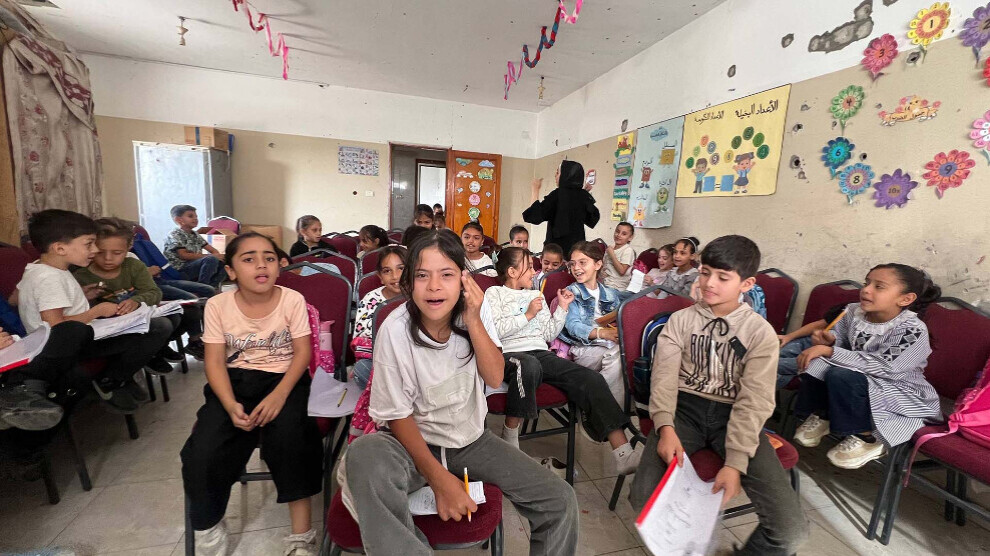
PALESTINE_Education continues in the Al-Bureij Camp area in Dier al-Balah, central Gaza Strip, Palestine, despite the Yellow Line encircling the area from several directions and fall of injuries and deaths among teachers and students. The Al-Bureij Association for Community Rehabilitation provides its basic educational services for the primary stage, affirming children's right to education and rejecting the policy of enforced ignorance.
The executive director of the Al-Bureij Association for Community Rehabilitation, Manal Al-Nashwi, says that establishing educational classes for children with and without disabilities was a necessity due to the halt of education services, especially those provided by the Palestinian Ministry of Education and the UN Relief and Works Agency (UNRWA), after the two surviving schools were turned by bombardment into shelters for displaced people affected by the war, leaving children waiting for an unknown future.
She points out that because the area is located in the Al-Bureij camp, which has a particularity compared to other areas of the Strip due to the tightening of the noose on it from the eastern and northern sides by the so-called Yellow Line, attracting funding has become extremely difficult, as the donor refuses to work there because it is a red zone. She adds that teachers and students alike face danger to their lives when coming to the place, especially in the early morning hours at the peak of gunfire, and the school has already lost a child killed during an Israeli raid adjacent to the location.
Difficulties and challenges
She explains that providing education in the camp is accompanied by many difficulties and challenges imposed by the security situation, the siege, and the economic situation, including the difficulty for families to provide their children with the minimum means. "However, the association is forced to continue providing services, since the area was inhabited by 48,000 people before the war, while today that number has doubled due to displaced people who set up their tents on the outskirts of the camp because there are no other places to displace to."
She indicates that demand for the center is large given the current capacity to accommodate only 360 children in two shifts, morning and evening, and therefore there are many children still on the waiting list in the hope that funding will double. She explains that the large demand is because the building is made of concrete, making it an escape from the reality of the tent, even though the place is not fully equipped.
According to Manal Al-Nashwi, the center receives children from first to fifth grade, including children with intellectual disabilities who are provided with education and rehabilitation services — a complex matter that requires a prepared environment, capabilities, and a staff with high abilities to deal with this group. She points out that before the war, the association had equipped an integrated building for this purpose, but it was bombed and became near the Yellow Line, so the institution lost its main headquarters and was forced to rent and equip a place.
Assistance to ease the burden on students
She adds that to solve the stationery problem, educational packages were printed and distributed to students with the support of partners. Children, especially those with disabilities, were also given a school bag containing everything the child needs during the semester, to ease that burden on families exhausted by the costs of displacement, famine, and the difficult living situation, especially amid rising prices and inflation that has come to deprive the family of its most basic rights, such as educating its children.
Manal Al-Nashwi explained that the building now needs several repairs, especially since there is damage to the roof that must be reinforced so that children are not harmed, in addition to the need for study desks designed for that purpose. She points out that clothing and shoes are another problem students face, as is proper nutrition, since the available food is unsuitable, and several cases of fainting and anemia have been recorded. Children with disabilities also need preparation tools to reach the place, since what has been recycled is no longer sufficient.