
Questioning Patriarchal Templates... A Reading of the Dimensions of Judy Chicago's "The Dinner Party"
Judy Chicago's feminist artwork "The Dinner Party," dating back to the 1970s, is considered the first iconic feminist artwork in history.
News Center — Throughout history, concepts such as "genius" and "exceptional talent" in the arts have often been associated with male artists. In contrast, women artists have had to fight a much greater struggle than men to assert their artistic production and carve out a visible place in this field.
In this context, Judy Chicago, one of the pioneering figures in feminist art, responded to inequality through her work "The Dinner Party," which is classified as one of the most important feminist artworks in art history.
This work, the result of five years of effort between 1974 and 1979, is now permanently on display at the Elizabeth A. Sackler Center for Feminist Art at the Brooklyn Museum.
Judy Chicago's work brings to the forefront women whose achievements and contributions have been marginalized throughout history. The starting point of the work is based on the idea that women, who for centuries have been associated with preparing food and setting tables for men, are this time honored in their own names at a dinner table. Through organizing a symbolic dinner party, Chicago gathers women who left their mark on history but whose successes were overlooked, placing them at the head of the table as guests of honor.
Bears the Signature of 999 Women
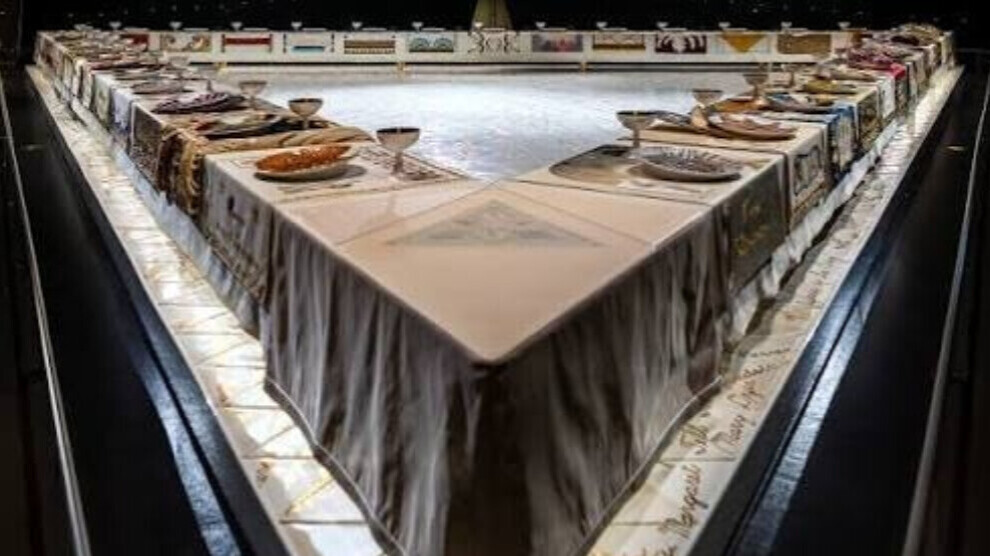
The large, triangular table sits on a ceramic floor called the "Heritage Floor." Each of the three sides of the table has places for 13 women. Each guest has her own place setting, consisting of a gilt goblet, fork, knife, spoon, porcelain plate, and an embroidered table runner. The 39 women seated around the table represent women who played important roles in different periods and fields. The work also includes a "Heritage Floor" on which a total of 999 women—either known by name or forgotten by history—are symbolically evoked.
The first wing of the table is dedicated to representing women in the history of existence and mythology. This section includes figures such as the "Mother Earth," fertility goddesses, the Babylonian goddess Ishtar, the Hindu goddess Kali, the goddess of wisdom Sophia, the Amazon warriors, Judith who saved the Israelites by beheading the Assyrian general Holofernes, and the Greek poet Sappho. The second wing includes women who excelled in fields such as art, literature, medicine, and war. The third wing is dedicated to women who played important roles in the struggle for women's rights, constitutional rights, and the battle for identity.
"The Dinner Party" does not merely aim to remind us of women forgotten by history; it also seeks to question and challenge how women have been positioned within patriarchal traditions of thought, language, and religious narratives. Judy Chicago and her fellow feminist artists, through their works, aimed to create social awareness regarding women's historical and cultural visibility.
The immense attention the work received during its first exhibition clearly demonstrated its impact. During its three‑month exhibition, over one hundred thousand people visited the work, and it later traveled to various countries and cities, reaching millions of viewers.
Judy Chicago's work draws attention to the need to view women not only as members and subjects of art but also as makers and active agents in the history of art.
Thanks to the space opened by feminist art, women artists have had the opportunity to question, transform, and freely discuss the templates imposed on them by patriarchal discourse. The increased presence and visibility of women in art history have also paved the way for questioning the representation of the "weak and submissive woman" that had been reproduced for centuries. "The Dinner Party" maintains its place in art history as one of the most powerful and enduring symbols of this structural transformation.