
The Resistance of Tishreen Dam: Days Where Pain Intertwined with Steadfastness
The resistance at Tishreen Dam succeeded through the participants’ deep faith in their cause, as women risked everything, proving their voices and presence are an essential part of the revolution’s spirit.
Asmaa Mohammed
Qamishlo — A year ago, the Syrian regime fell, followed by external attacks on Syria that began to gnaw at the body of a country already exhausted by war. From the south came Israeli expansion, and from the north intensified the attacks of the Turkish occupation. The primary target was Tishreen Dam, due to its strategic importance.
In response, the peoples of the North and East Syria region rose from all areas to protect the dam and support the military forces in resisting the brutal attacks driven by the Turkish occupation and carried out by its mercenaries, with aerial cover that killed many civilians and journalists—both men and women—throughout months of resistance.
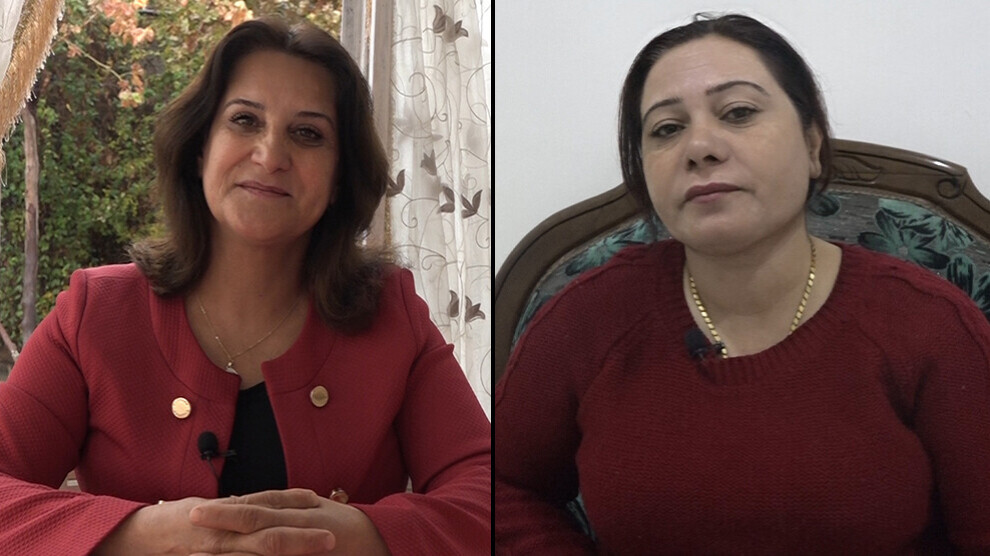
Women who bore witness to the resistance of Tishreen Dam recalled those days with our agency, among them Ibtisam Al-Hussein from the city of Qamishlo. She said that Tishreen Dam stood as a testament to the unity of all components of North and East Syria, recalling the figures targeted by Turkish occupation aircraft:
“We remember the souls of the martyr Manija Haidar, Bafi Tayyar, Bafi Kifo, and all the martyrs of freedom who were killed on the land of the resistance at Tishreen Dam. No matter how much we speak, words will never be enough to describe that historic resistance which wrote the most magnificent pages of steadfastness. What the people lived through during the resistance of Tishreen Dam is beyond imagination and beyond belief. They were days in which pain was mixed with resilience, fear with willpower, and victory with an unshaken determination.”
“They all carried the same goal”
She affirmed that the people were one hand during those days:
“Everyone was of a different color, yet they carried the same goal. All stood as a human shield to protect the dam from the continuous attacks launched by the Turkish occupation. With a spirit of sacrifice, the people tore away the mask of fear and death and declared with one voice: we are greater than death. When we headed to the dam, we knew we might not return, but we went fully aware that we were a sacrifice for the land watered by the blood of martyrs. Once we arrived, we felt that our strength was greater than any threat, because everyone there was united—hand in hand and voice to voice.”
“The words of martyr Jihan Bilkin inspired women and the media”
She pointed out that the people left an indelible mark on this resistance, and that the role of the media was decisive in revealing the truth—especially as the Turkish occupation waged a special war on the region, attempting to spread rumors, instill fear, and promote false claims that the dam had fallen. However, free media stood on the front lines, conveying the real image, amplifying the voice of the people, and proving that willpower cannot be broken and that truth is stronger than all campaigns of disinformation.
She said:
“The words of the martyr Jihan Bilkin inspired women and the media alike. The media played a pivotal role in the people’s steadfastness and in thwarting all attempts by the occupation to fragment society and spread terror.”
She noted that the resistance represented a great victory for all the people, and that the Syrian Democratic Forces, alongside the population, presented a unique model of defense and perseverance:
“Thanks to this unity, the resistance foiled the special war aimed at undermining stability, sowing doubt, and distorting the truth. Women stood at the heart of this epic—as mothers, sisters, doctors, fighters, and a fundamental pillar of resilience. They offered inexhaustible support and proved to the world that women are capable of bearing responsibility under the harshest conditions, and that they are a cornerstone of every resistance.”
She praised the role of elderly women who chose to stand on the front lines alongside their sons and refused to abandon the land:
“We all swore to continue resisting until the last breath and not to allow the occupation to seize even an inch of land watered by the blood of martyrs. We said: we are here and we will remain here—with our determination and steadfastness—to protect our land and confront anyone who tries to assault a people who waged a historic resistance unlike any other.”
The legacy of resistance
Ibtisam Al-Hussein addressed a heartfelt message to the new generation, saying:
“We have lived through fifteen years of revolution, during which we offered thousands of martyrs so that the new generation could live in safety and security. Today, every young man and woman who studies, works, or has the ability to give must be one hand and preserve the sacrifices of the martyrs who gave their lives so that we may live with dignity. They must return to their true history, cling to the legacy of resistance, and stand united against an enemy that sought to break the will—but never succeeded.”
She affirmed that the resistance witnessed across North and East Syria will remain etched in the collective memory, and that the new generation is always called upon to revive it and pass it on to future generations:
“This resistance was a school for young people and a gateway to understanding the meaning of sacrifice and belonging. No matter how much we write or how much ink flows on paper, we will never be able to record everything that happened, because what the land recorded in those days is greater than can be contained in words.”
She concluded by stressing that the blood of the martyrs shed at Tishreen Dam was a victory in itself, and that their memory will remain alive in every event and every step toward building a democratic, decentralized Syria—multicolored, inclusive of all components, and protective of their rights—guided by the thought of leader Abdullah Öcalan and the slogan Woman, Life, Freedom:
“We want Syria to be one hand and a united people, living side by side, protecting their land and future with one spirit and an unbreakable will.”
Not merely a water facility
Roudin Issa, who also participated in the resistance at Tishreen Dam, said that the dam was not merely a water facility, but a symbol of resistance and popular will that stood like a mountain in the face of occupation:
“This dam turned into an arena where the deep values of the people of North and East Syria were tested, where the souls of fighters and civilians—Kurds, Arabs, and Syriacs—merged into a single message: that this land will not submit, and that free will will never bow.”
She explained that Tishreen Dam witnessed one of the greatest images of unity among components:
“The Kurd stood beside the Arab, and the Syriac sat next to his brothers. Everyone became one body and one soul. Ethnic affiliations and different backgrounds no longer divided them; they all shared one goal—defending a land they hold in common, a history they write together, and a future they dream of with one voice and one dream.”
She stressed that the message of Tishreen Dam to the Turkish occupation was clear:
“This land is not weak, and its people are not fragmented. Every component is a support for the other. The people there declared that one hand is stronger than armies, that cohesion is stronger than steel, and that when resistance is popular, it becomes a wall that cannot be brought down.”
“Our strength would not have emerged without the sacrifices of the martyrs”
She explained that Manija Haidar considered all the fighters, women, and civilians around her as her family, working tirelessly and without hesitation to protect those around her, giving everything she could without waiting for thanks or reward:
“We all made a promise to continue on the path of the martyr, preserve her legacy, and follow her approach to steadfastness and the defense of human rights and land—thus honoring the memory of all martyrs who sacrificed their lives for the homeland, freedom, and dignity.”
She added:
“She was among the most patriotic and conscious women, raised on the principles of leader Abdullah Öcalan. She knew well how to empower women, raise their awareness and morale, help them discover themselves, and believe that their strength is part of their society’s resilience. I was always by her side, drawing inspiration from her, learning together how to face challenges and prove that women are capable of changing reality and supporting one another with sincerity and love. She was a blend of mother, sister, and friend—carrying a spirit of honesty and loyalty, present in every place and occasion that required courage. She participated in every difficult stage—in Serêkaniyê, in Afrin, and in every resistance—always working with a spirit of love and camaraderie, providing psychological and moral support to those around her and planting confidence and strength in every fragile heart.”
She noted that Manija Haidar was a pillar for all women:
“She taught us that success does not come without patience and giving, that solidarity among women is stronger than all fear and frustration, and that our success today came from her determination and resolve. She taught us how to turn fear into courage, weakness into strength, and despair into hope.”
“Resist and do not surrender”
Roudin Issa addressed a message to the women of North and East Syria, saying:
“Be a support to one another in all circumstances. Today we are living through a sensitive period in which some try to marginalize the role of women and undermine their power. Every woman must be aware of the importance of her position and responsibility in society.”
She explained that through their resistance to occupation and their great sacrifices, women proved that nothing can break their will, that they are capable of confronting the harshest conditions, and of delivering a clear message to the world: that women are a symbol of strength and steadfastness.
She called on all women to step out of their homes, to work and struggle for their dreams, and to defend their rights and dignity—there is no room for waiting or fear:
“Strengthen yourselves and make your will your weapon. Turn every obstacle into an opportunity to prove that women are capable of change and are an inseparable part of struggle and resistance. You are a force that cannot be ignored, and a hope that cannot be diminished. Let your steps be firm, your actions sincere, and your steadfastness the title of your determination.”
She concluded by saying that Tishreen Dam bore witness to the strength, loyalty, and sacrifices of women:
“We will remain, to prove that true resistance is not merely words, but action and steadfastness—and that the will of free peoples can never be broken.”