
Between waste, Insects, and Hunger: A Women and her Mother Face a New Catastrophe
The suffering of Ibtisam Ghabn and her mother embodies a painful picture of the reality of the displaced in Gaza, where hunger, disease, and lack of services intersect with loss and fear, turning daily life into a bitter struggle for survival.
NAGHAM KARAJA
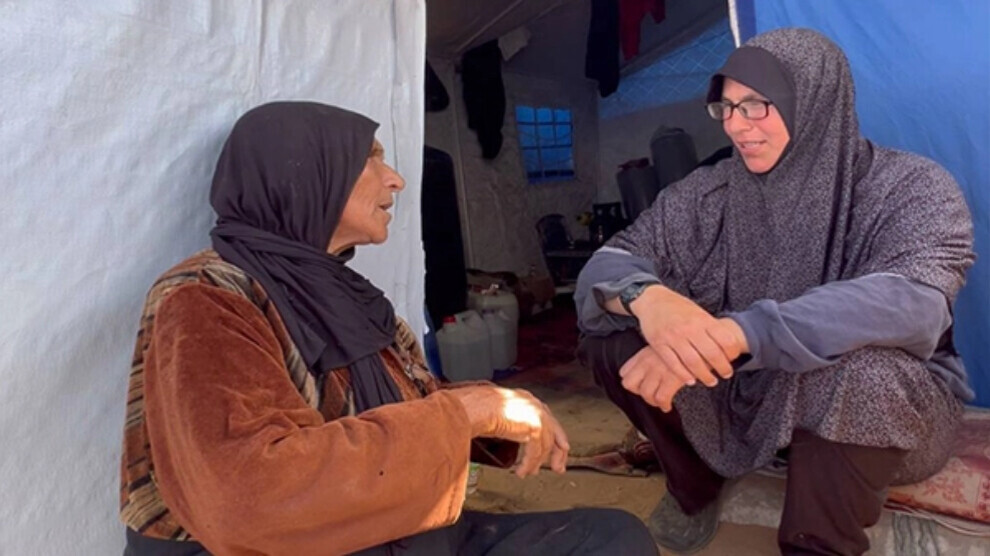
Gaza_On the outskrits of a landfill west of Gaza City, where the smells of accumulated rubbish mix with swarms of insects and rodents, Ibtisam Ghabn, in her forties, lives with her mother inside a dilapidated tent that does not provide them with the minimum requirements for a safe life. In this place unfit for human habitiation, the two women spend their days between hunger, illness, and fear, after losing their family and everything that had connected them to a stable life.
For many months, the small tent has become their only world. No source of income, no relatives able to help, and no ability to cope with the harsh conditions imposed by the war. Ibtisam Ghabn, who lost her family members, finds herself daily facing a new battle: searching for a morsel to satisfy her hunger and that of her sick mother.
Daily Suffering on the Brink of Hunger and Disease
Ibtisam Ghabn sits in front of her tent, surrounded by piles of waste accumulating nearby, while she watches over her mother in silence, fearing that something might happen to her during her absence. She says in a voice blending sorrow with exhaustion: “ I live with my mother alone after losing everyone who stood by us. We have no money for food, water, or even medicine. Every day we wake up not knowing how we will get through the coming hours.”
She adds: “When I go out to lool for food, I remain afraid for my mother all the time. If I stay with her, we both go hungry. Our life has become based on choosing between two bitter options. Sometimes I return empty-handed after hours of waiting, so I sit and cry because I have nothing to offer her.
She explains that obtaining food aid has become an almost impossible task for her, as she is sometimes forced to stand for long hours in front of soup kitchens or aid distribution points, but she cannot leave her sick mother alone inside the tent, especially with the spread of insects and rodents around the place.
Ibtisam Ghabn cannot hold back her tears as she speaks of the moments when she is forced to face her mother without being able to provide a single meal during the day. She says: "I feel helpless when my mother looks at me and asks if I managed to bring something for us to eat. What pains me most is that I cannot protect her from hunger or disease. I cry a lot when I fail to provide food for us, because I feel that I am losing my dignity and humanity in the face of this harsh reality."
The Pain of Years Renewed in the Displacement Tent
Her mother, Amina Ghabn, in her nineties, burdened by the weight of years, suffers from worsening health problems due to the environment surrounding the tent. The spread of insects and rodents has caused her several painful skin conditions, including shingles on her head, in addition to continuous infections that increase her daily pain.
She sits inside the tent surrounded by whatever simple blankets and tools are available, and says, pointing to her weary head: "The insects leave us neither by day nor by night. We wake up to their bites and sleep in fear of them. I have caught painful skin diseases and found no proper treatment. Even obtaining a painkiller has become difficult."
She adds: "Everything around us is contaminated. The air is contaminated, the place is contaminated, and even the water we sometimes get is insufficient or not as suitable as it should be. I feel that the illness is increasing day by day while I find no one to help me."
But for Amina Ghabn, the pain does not stop at illness or displacement. This woman, who lived through the Nakba of 1948 and its accompanying displacement, loss, and forced settlement in a life of refuge, believes that what is happening today in Gaza surpasses everything she has witnessed over her long decades of life.
In a voice mixing anger with sadness, she says: "I lived through the first Nakba as a child, and I saw what befell our people of displacement and homelessness. But what is happening today surpasses all that we have known. This is the real, greater Nakba. We have never before witnessed this level of destruction, hunger, fear, and loss of loved ones. Today, people are not only losing their homes, but they are losing their lives, their future, and everything they possess."
She points out: "In the first Nakba, we remained dreaming of return and clinging to life despite everything. But today, I see people searching only for water, food, and medicine. I see the elderly and children living through indescribable conditions."
A Humanitarian Reality Suffocating Between War, Poverty, and the Collapse of Services
As evening approaches, Ibtisam Ghabn returns to her tent after another day of searching for enough to keep body and soul together. She sits beside her mother, facing the darkness that envelops the place, while insects continue to fly around them and the smells of waste rise from every direction. As they continue their daily struggle for survival, their dream remains painfully simple: one meal sufficient for a single day, and a safe place where they do not have to sleep on the edge of hunger and disease, away from the waste and insects that besiege their lives, waiting for an end to a tragedy that has left them only with patience and the hope of survival.
The story of Ibtisam Ghabn and her mother reflects an aspect of the harsh human reality experienced by thousands of displaced families in the Gaza Strip, where the effects of war intersect with poverty, displacement, and the collapse of basic services. The makeshift camps, hastily erected, lack the most basic public health standards, while the accumulation of waste and the deterioration of sewage systems have created a fertile environment for the spread of diseases and epidemics, especially among children, the elderly, and the sick.