
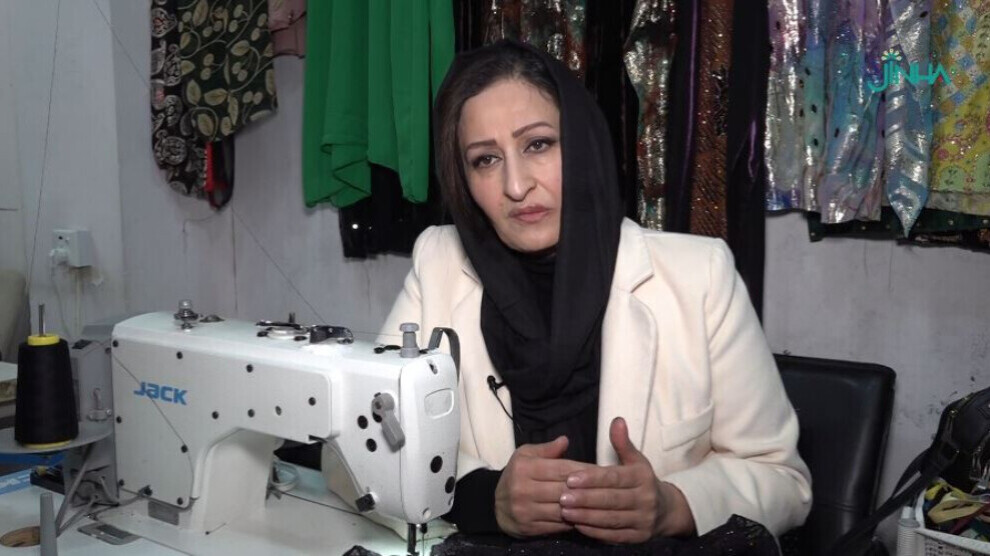
With sewing machines and fabric, a tailoring journey that has lasted for 25 years continues.
Women's role in precise, patient crafts like tailoring proves they are not merely workers, but the backbone of the family and society's economy.
Hevi Salah
Sulaymaniyah_The story of tailor Shenu Abdullah began over two decades ago when she picked up the needle and thread with great passion,deciding not to wait for anyone’s hand to secure her livelihood. She started her work at a time when it was not easy to see a woman owning a shop in the market,but with firm will,she broke through cultural barriers and turned her shop into a sanctuary for creativity and work.
During these twenty-five years, she not only tailored clothes for thousands of people but also wrote a history of sacrifices—sacrifices that women know well when they have to balance the responsibilities of motherhood, household management, and the exhaustion of work. Those moments when she endured pain, her eyes reddened from fatigue, were all to preserve her children's dream and her financial independence.
Her sacrifices are epitomized in long sleepless nights and the weariness of her hands, all so she could remain an active and productive person in society, and to pave the way for the generations after her to realize that no obstacle stands before a woman's dreams if she believes in her abilities. Today, her shop is no longer just a place for cutting and sewing fabric; it has become a school for learning patience and a lesson in how women continue to shine despite all difficulties.
Shenu Abdullah says: "I have been working in the field of tailoring as an independent professional for 25 years. Throughout my career in sewing and design, I have taught many girls this art. I also owned an institute, and the last time I gave a training course in sewing was at the Joker Cultural Center for people with special needs and for the deaf. The courses were open to anyone wishing to participate."
She pointed out that many women learned sewing at the institute and today have become professionals with independent businesses. "I have loved sewing since childhood, like any little girl who loves to sew clothes for her doll. My mother was very skilled in handicrafts and had a great influence on me; through her, I learned a lot."
About the beginning, she says: "I started working on an old sewing machine, and the first thing I made was sewing a curtain. Sometimes I would use my mother's machine to sew my own things, and sometimes I would break it, making my mother angry. Later, in 2000, a sewing course opened where I learned many things. After that, I started sewing only for my family and close friends. Then, due to need and the changes in the economic situation in recent years, I managed to turn my profession into a good source of income."
She explained that no work is without difficulties, especially at the beginning when one lacks experience; you might make mistakes in your work or face situations where customers are not satisfied with the sewn piece. But the most important thing, as she emphasizes, is for a person to keep trying, develop their skills, and increase their knowledge.
As advice for women starting work: "The most important thing is to discover their abilities and know the field in which they possess true skill, because choosing a profession is very important. Also, family support is an essential factor; when the family supports a woman, her path to success becomes easier and stronger."
A Person must have great faith in themselves
Regarding the development of technology, Shenu Abdullah said that technology and the evolution of machines undoubtedly have a significant impact on the tailoring profession. "Today, machines have become much more advanced; in the past, we worked on a small machine, but now working on these machines is easier. They are less prone to breakdowns and have fewer thread breaks. Nowadays, there are also electric cutters and specialized machines for different types of embroidery."
She mentioned that in the past, decorations were done only by hand and were limited to some simple patterns. Now, however, very advanced machines for embroidery and design have appeared. She considers that "no matter how advanced the machine in your hands is, if the person themselves is not skilled, it remains just a machine; it is the person working on it who creates the beautiful work."
She pointed out that she shares the work with another woman she describes as "skilled." She added, "We have been working in the market for a long time. In the beginning, I worked from home and sewed only for my relatives, but later I was compelled to go down to the market and work like others. At first, it was very difficult, especially since our shop is located inside the market, a public place not exclusively for women."
She explained, "Certainly, a woman faces many difficulties at the beginning, but one must have great faith in oneself and overcome the obstacles. Working in a public market in this way is not easy for a woman, but at the same time, it proves that women's capabilities are much greater than what is commonly believed.
The shape of Kurdish clothing should not be changed because it is cultural attire."
Shenu Abdullah explained: "We sew all types of fabrics and execute any design requested by customers, but due to our shop's location, most of what we sew is Kurdish clothing, especially according to seasons and occasions, as women nowadays wear Kurdish clothing more during events."
In recent years, some changes have been introduced to Kurdish clothing under the name of design or development, but she believes that "its basic form should not be changed because it is cultural attire. In all four parts of Kurdistan, we all have Kurdish clothing. Some details may differ depending on the region, but in the end, it remains the same Kurdish clothing."
Kurdish clothing generally consists of several pieces: the dress (shirt), the jacket (Hilk), the belt, and trousers (Shirwal). It can consist of seven pieces and sometimes up to nine pieces. As for colors, they depend on the person's own taste.
Regarding the tailoring of Kurdish clothing, there are some simple fabrics that do not require much time, while there are other fabrics that are embroidered or decorated with crystals or metal pieces, and these require more time. She explains: "Sometimes the machine cannot sew directly on these fabrics because the needle might break, so they must be prepared first. This is done in various ways, including heating, removing some crystals and hard pieces, and sometimes small metal pieces are hammered before sewing."
“Economic independence is important for women.”
Shenu Abdullah believes that economic independence is important for every individual in society, but it is especially important for women. "Some people think that if a woman has an independent income, she will seek to dominate the home or everywhere else. But the truth is, when a woman has economic independence, she helps her husband, her brother, her sister, and her parents, and she herself benefits from this independence. As a woman who owns her own business, I ask every woman who is currently working or wishes to work in the future to believe in herself, because self-confidence is one of the most important reasons for success."
Shenu Abdullah concluded her talk by affirming that "honest work is never shameful. Every work faces difficulties at its beginning, but women must realize that those difficulties and obstacles will eventually end, and they will all turn into experience. With time, work proceeds on its right path, and the goal must be self-reliance and standing firm."