
Director: Women Are Creating a Stronger Presence in Cinema
Director Amine Uysal Berger praised the organization and supportive atmosphere of the third Amed International Film Festival, stressing the vital role of women in cinema despite challenges and the prevailing patriarchal mindset
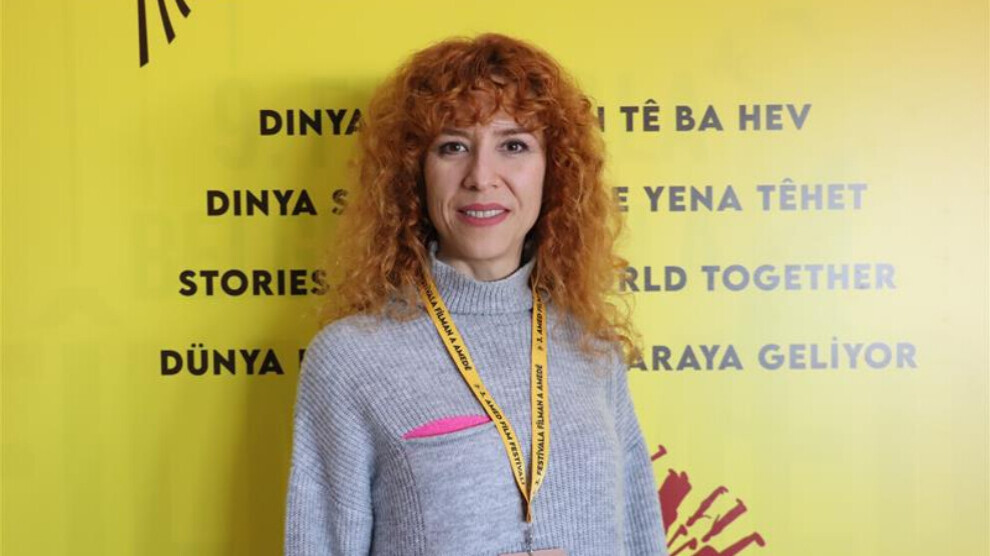
Arjin Dilek Öngel
Amed — Under the patronage of the Amed Metropolitan Municipality, and under the supervision of the Middle East Cinema Academy and the Cinebir Foundation, the third Amed International Film Festival was held under the slogan “The World Comes Together Through Stories,” from December 7 to 14.
The festival took place at the Amed Culture and Conference Center, with wide participation from artists and attendance by thousands of people. This year’s edition was dedicated to reviving the call for “peace and a democratic society” launched by leader Abdullah Öcalan on February 27.
The first edition of the festival was launched in 2012, followed by the second in 2016. However, the appointment of trustees to municipalities, successive crises, and protests led to an eight-year suspension. After this long hiatus, the festival returned to Amed, presenting audiences with a selection of films and documentaries that promote independent cinema, embrace an environmental vision, and uphold principles of gender equality.
This year’s edition featured 84 films and documentaries, alongside numerous artistic workshops, and concluded on December 14 with an awards ceremony.
Directors Amine Uysal Berger and Özgür Ceylan also participated in the festival with their film “Gukla,” a psychological thriller and horror work. The film follows three characters from different generations in İzmir who coincidentally meet inside an abandoned mansion. It focuses on their relationship with the city and their sense of belonging, while addressing themes of asylum, identity, and confrontation. Through a powerful narrative style, the film tells the story of three women whose paths intersect within the city’s historical fabric.
Women in the World of Cinema

Director Amine Uysal Berger explained that she began making short films during her years of study and participated in the festival coming from İzmir, saying:
“We were very happy that our film reached Amed on this journey. The feedback and impressions we received from the audience were a true reflection of the spirit and story of the film.”
She noted that “Gukla” tells a women’s story, as the main character is a woman, and the narrative revolves around a group of women who come together in one setting and collectively embark on a journey of struggle for existence.
She emphasized that the presence of female directors and screenwriters in cinema plays a major role in highlighting women’s stories and making them more visible. “Shedding light on their work increases their presence in the cinematic scene and supports the emergence of films in which women are the central focus,” she said. For many years, she added, men were the ones telling women’s stories in Turkish cinema, “but when a woman tells another woman’s story, stronger characters emerge, and the narratives are presented with greater depth, honesty, and intimacy.”
Berger pointed out that filmmaking involves many challenges, in addition to the difficulties of confronting the prevailing patriarchal mindset in the industry. She recalled an experience from her university years:
“We were supposed to go and shoot a documentary as part of a project. I wanted to participate, but I was told the team would consist only of men. That was painful for me. Filmmaking itself is already demanding, and facing such situations is not easy.”
Critiquing Patriarchal Discourse in Contemporary Cinema
She added: “Patriarchal discourse is still present in the world of cinema, but in independent cinema women appear more prominently, and this is due to the spirit of determination and resistance that women possess.”
Berger also offered an evaluation of the third Amed International Film Festival, affirming that it overcame numerous challenges. “Organizing a film festival is not an easy task; it requires careful planning, coordination among multiple teams simultaneously, and great flexibility to identify problems as they arise and resolve them quickly. This approach was clearly evident at this festival.”
She concluded: “As a team coming from another city, we felt from the moment we arrived that the festival embraced us and did not make us feel like strangers. Its relationship with the city was truly special. The festival gave us the opportunity to meet other filmmakers, which is invaluable both for sharing our film and for exchanging ideas. It was a rich and deeply satisfying experience by every measure.