
Women Guarding the Story… A Feminist Cultural Evening Revives Palestinian Heritage
Through folk songs, embroidered dresses, and grandmother’s tales, Gaza’s women revived cultural memory at the “Women Guarding the Story” evening, creating space to preserve Palestinian heritage despite war.
RAFIF ESLIM
PALESTINE-The “Women Guarding the Story” evening turned into a space where women meet around Palestinian memory, from song and folk proverb to the embroidered dress, dabke, and the tale in an attempt to recover the details of cultural life that was subjected to marginalization and destruction during the war.
Under the slogan “Women Guarding the Story,” the Palestinian Women’s Cultural Forum organized yesterday evening, Saturday, the third of October, a Palestinian cultural, folkloric, and heritage evening, in a feminist event aimed at celebrating Palestinian cultural, folkloric, and heritage evening, in a feminist event aimed at celebranting Palestinian heritage and recovering its details through songs, folk proverbs, dabke, and various arts, amid a notable women’s presence.
The evening came from the Forum's vision that the Palestinian story is embodied in women's presence and resilience, and in the cultural legacy they preserved and transmitted from one generation to another, so that it remains present in memory and extends toward the future.
From Women to Women
On the sidelines of the cultural evening, Faten Harb, president of the Palestinian Women's Cultural Forum, said that this evening represents the first activity of the Forum since its launch, and carries a specificity as it is an event "from women to women." It includes various artistic segments, including heritage songs, folk proverbs, dabke, alongside competitions and other segments linked to Palestinian identity.
Harb explained that the event comes after a war that left widespread destruction, noting that women wanted "to come out from under the rubble to building," and to create a space that touches Palestinian reality and preserves heritage in the face of attempts to erase cultural identity.
She added that the targeting of cultural centers and archaeological sites during the war increased the need to protect and recover Palestinian heritage. She noted that the evening is not limited to the cultural aspect, but also provides a space for psychological release for women, who need moments of joy, gathering, and recovering their Palestinian symbols.
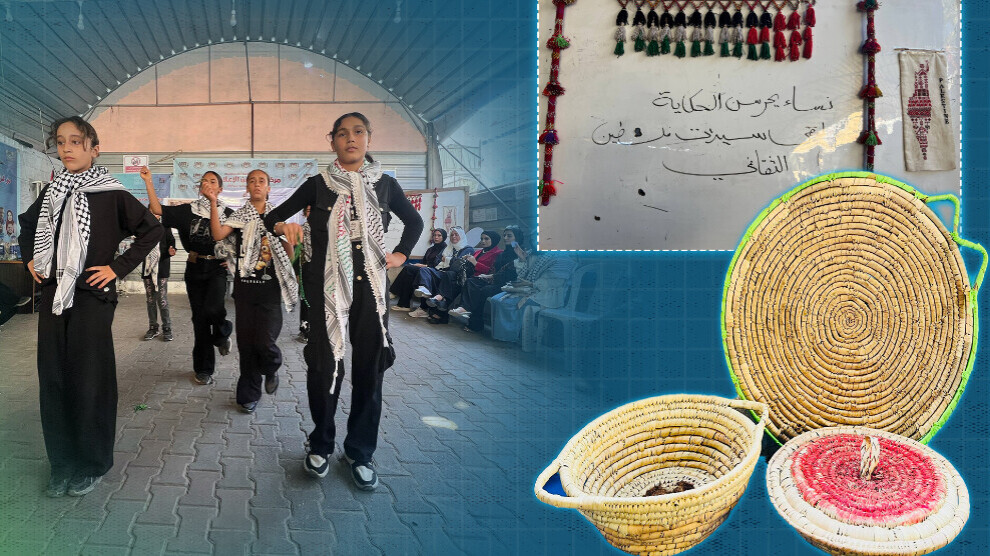
The participants adorned themselves with embroidered Palestinian dresses and the keffiyeh, in a scene that evoked elements of Palestinian popular and heritage memory.
Heritage in the Details of Life
For her part, community activist Juliet Abu Shanab said that her attendance comes in support of women's creations in the cultural field, especially those linked to heritage. She noted the importance of reusing and recycling some of the belongings destroyed by the war, and encouraging women to preserve heritage and own even one piece of it.
She explained that the embroidered dresses specific to each Palestinian city, alongside pottery and copper vessels, are among the most prominent features of heritage. She evoked a famous Palestinian folk proverb, "From the clay of your country, not on your shoulder," which mothers and grandmothers used to repeat when one of the sons decided to marry someone of another nationality.
She added that Palestinian embroidery is present in the details of daily life, from household tools and paintings, including Palestinian wedding paintings, to clothes and personal belongings.
Juliet Abu Shanab recounts that when she was forced to displace from her home for ten days, she was keen to carry her heritage belongings with her inside a small bag. When she returned to her home, she returned every piece to its place, in an indication of the connection of those belongings to memory, home, and identity.
A Space for Gathering and Recovering Life
For her part, Amal Al-Batrawi, a social specialist at the Gathering of Palestinian Families, said that her participation in the evening represents her first attendance at a feminist cultural event since the end of the attack. She noted that she met during the event a number of her friends for the first time in a long time.
She believes that women meeting women contributes to improving mental health, and enhances productivity and creativity, especially when the events are related to heritage, which is not limited to costumes and belongings, but includes customs, traditions, and the teachings of grandmothers that were passed down through generations.
"The Grandmother's Word Was a Substitute for Google"
As for Sumaya Thabet, she confirmed that folk proverbs represent a fundamental part of the Palestinian story and heritage, explaining that grandmothers in the past formed a source of knowledge before the emergence of search engines and artificial intelligence.
She said that much of what generations experience today was already expressed and warned about by grandmothers through folk proverbs, as the details of daily life were linked to proverbs, such as "The neighbor before the house," "Live long, you'll see much," "The door from which the wind comes to you, close it and rest," and "The summer's storage benefits the winter."
She confirmed that Palestinian heritage is a legacy transmitted to children, expressing her happiness at the participation of young women and girls alongside their mothers to listen to the tales and learn about Gaza's heritage.
She wished that the number of participants in upcoming events would double, confirming that women's presence and their continuation in practicing their cultural and social lives represents for her an expression of the Palestinian woman's continued adherence to her role and presence.
"The Tents Band"... Art Is Born from the Heart of Tents
In the same context, Heba Abu Hadaf, one of the members of the Tents Band for Palestinian Folklore, which was founded in 2026, spoke about the band's experience, which "was born from the womb of tents," as she described it. Its members were chosen from the girls who lived in tents, and roles were distributed among them.
She explained that the band includes 16 girls who present Palestinian heritage songs, including "Ala Al-Hawara," "Ya Ghazatna," and "Tmeen Elli Gal," alongside dabke and theater performances.
She noted that the band has so far presented 14 different performances varying between dabke, singing, and theater, despite the challenges it faces, foremost among them the lack of a fixed place for training and performances.
She confirmed that the band members try to overcome these difficulties and continue presenting art, as a means of preserving Palestinian heritage and conveying its message to new generations.