
The Education Sector… Escalating Challenges Threatening the Future of Thousands of Children
Between displacement, economic crisis, and Kurdish-language education challenges, Hasakah's children face a difficult educational reality threatening their schooling and right to learn in their mother tongue.
RONIDA HAJI
Al-Hasakah – The education sector in Hasakah city is facing an extremely sencitive phase, amid the intertwining of a set of challenges threatening the right of thousands of children to education.
Alongside the repercussions of displacement and difficult economic conditions, the issue of education in the Kurdish language and the discussions and decisions associated with it stand out, in addition to the difficulties facing students, teachers, and curricula.
Amid the continuation of these challenges, the need has become urgent for unrgent steps that ensure the continuation of the educational process and protect children’s rights to access education,enabling them to build a more stable future.
According to current statistics, Hasakah includes 2,317 schools,attended by about 41000 male and female students, and in which about 35000 male and female teachers work. These figures reflect the scale of responsibility placed on the shoulders of the institutions concerned and society, to guarantee the right of all children to education and providing suitable conditions for the continuation of their studies.
The Future of Displaced Children at Risk
The conditions of students displaced from Sari Kani/Ras al-Ain are among the most prominent challenges facing the education sector. Thousands of children who were forced to displace are still stuck in camps, after the closure of schools and the halt of the educational process in them, while they await return to their original homeland.
Kurdish language teacher Laila Darwish sheds light on the difficult conditions these children are living in, considering that depriving thousands of displaced students of their right to education represents one of the most prominent problems requiring urgent treatment. She calls for accelerating the handling of the displaced persons file and preparing the conditions that ensure the safe return of children, confirming that their future is directly linked to the continuation of their education.
In the Sâri Kani and Washokani camps, more than 6,200 male and female students were deprived of going to schools due to the absence of educational capabilities, which led to their interruption from studying and depriving them of a fundamental right of their rights.
Education in the Mother Tongue... Protection of Identity and Culture
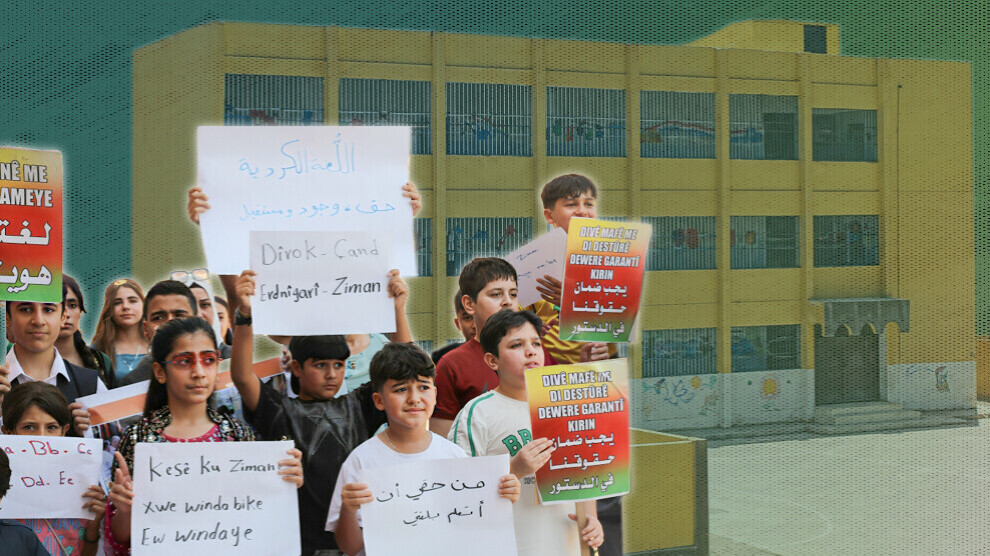
The challenges facing education in Hasakah are not limited to displacement and economic conditions, as the issue of the Kurdish language occupies a prominent position in the ongoing discussions about the future of education. The decisions related to restricting and reducing the teaching of the Kurdish language within the educational system sparked widespread reactions in society.
Laila Darwish confirms that education in the mother tongue represents a fundamental right, rejecting the reduction of Kurdish language classes. She stressed the importance of continuing education in it as part of students' right to learn in their mother tongue.
History and Culture in Educational Curricula
The discussion about education extends to the content of historical and cultural curricula, amid demands that curricula reflect the history and cultures of peoples truthfully. In this context, Laila Darwish expressed her rejection of policies that lead to erasing the history and culture of the Kurdish people or presenting them within narratives that do not express their reality, confirming the necessity that every people learn its history truthfully and objectively.
In the field of scientific education, she pointed out that education in the Kurdish language in the scientific field has been continuing for 14 years, wondering about the reasons for imposing restrictions on the continuation of this path, at a time when the mother tongue is a fundamental and effective means of conveying and entrenching knowledge among students.
For her part, student Nour Ahmed expressed the importance of the mother tongue issue, saying: "The mother tongue is the foundation of education. We want to learn in our language in order to preserve our language, culture, and identity."
She believes that studying in the Kurdish language is not limited to learning the language, but goes beyond that to preserving culture, identity, and national existence, which makes the issue of education in the mother tongue closely linked to preserving the cultural identity of new generations.
Women Are an Essential Partner in Building the Educational Process
One cannot talk about the educational journey in isolation from the role played by women. Women have contributed effectively in various aspects of the educational process, whether as teachers, students, principals, founders, or leaders of educational institutions.
Laila Darwish confirms that women constitute a fundamental pillar in society, and that restricting their role or questioning their ability to contribute to building society reflects a traditional mentality that limits their presence.
She believes that building a free and developed society requires recognizing the role that women play in education and in various fields of public life, and not dealing with their participation as a secondary or marginal role.
The Economic Crisis and Protecting the Right to Education
Difficult economic conditions increase the burdens of education, amid the rise in diesel prices, living costs, and the difficulty of securing school supplies. Children in villages and remote areas also face additional challenges due to transport difficulties and high costs, which may threaten their continuation in school.
The need emerges for measures that ease the burdens on families, ensure children's access to their schools, and prevent their interruption from education due to economic conditions.
The repercussions of displacement, the restrictions imposed on the Kurdish language, economic difficulties, and transport problems intertwine to form accumulated challenges before the future of education in Hasakah. This requires taking urgent steps to return displaced students to school seats, guarantee their right to education in their mother tongue, and provide a safe and suitable educational environment. Protecting children's right to education is a shared responsibility, and the continuation of education today is the foundation for building the future of coming generations.