
Study: Sexual harassment restricts Moroccan women's freedom of movement, undermining their sense of safety.
A Casablanca field study revealed widespread sexual harassment against women in Morocco's public spaces and transportation, restricting their freedom of movement and diminishing their sense of safety.
HANAN HART
MOROCCO_The effects of sexual harassment that women are subjected to in public spaces and transportation do not stop at the limits of harassment but extend to affecting their sense of safety and restricting their freedom of movement and may push some of them to avoid using public transportation.
A field study conducted by the Challenge Association for Equality and Citizenship on the phenomenon of gender-based sexual harassment in public spaces and urban public transportation in the city of Casablanca revealed the continued spread of this phenomenon and the multiplicity of its manifestations, recording a gap between the adopted legal arsenal and the reality experienced by women and girls.
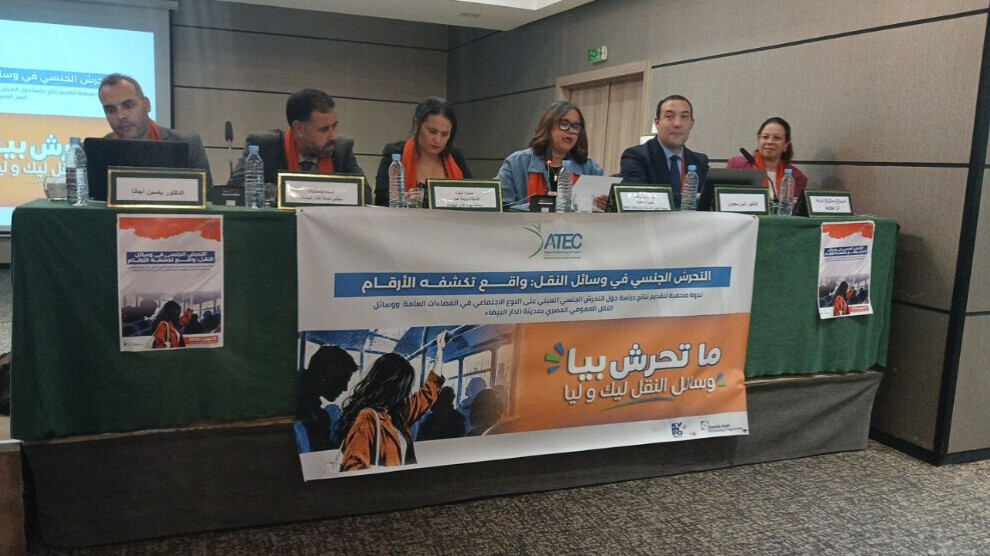
The study, whose results were presented during a press conference organized by the association yesterday, Friday, November 12, shed light on the scale of sexual harassment and its repercussions on the right of women and girls to movement and safe access to public spaces.
The study adopted a multidimensional approach, combining sociological diagnosis with legal and judicial analysis, with the aim of evaluating the effectiveness of national legislation, foremost among them Law No. 103.13 related to combating violence against women, in addition to assessing the extent of public policies' ability to guarantee the right of women and girls to safe and equal access to the shared space.
Public spaces that do not embrace women
The results of the study showed that the phenomenon of sexual harassment in public spaces is not linked only to isolated individual behaviors, but is intertwined with social and urban factors, in addition to societal perceptions related to women's presence in the public sphere and the extent to which they enjoy freedom of movement and the safe use of shared spaces.
In this context, 69% of respondents stated that the public space witnesses an actual division between places designated for men and others for women, as cafes were associated with men's spaces at 80%, compared to 79% for public baths as spaces associated with women.
Regarding the places where harassment cases were most recorded, neighborhoods and public streets topped the list at 41%, followed by parks at 12%, then bus stations at 11%.
The study also monitored the multiplicity of forms of harassment, which are not limited to verbal and physical assaults, but also include psychological and visual harassment, gestures of a sexual nature, in addition to stalking and pursuit in public spaces. These practices, according to the same data, extended to the digital space, through taking photos and recordings of women without obtaining their consent.
Buses: a means of transportation and a source of fear
The study shed light on the role of public transportation in exacerbating women's feeling of insecurity within the city, highlighting that buses, which are among the most used means of transportation at 31%, simultaneously constitute a space where harassment cases recur, as 62% of respondents reported being subjected to harassment inside them, compared to 19% for taxis.
In the same context, 62% of participants considered bus stations to be the least safe spaces, followed by the early morning period at 34%, which reflects that the risks of harassment are not limited to the means of transportation themselves, but extend to their surroundings and the time periods during which women are forced to move.
The data highlighted that the repercussions of this situation are directly reflected in the behavior of public transportation users, as 85% of them were forced to abandon using it, for reasons topped by delays at 51%, while the absence of a sense of safety was a direct reason for 24% of respondents.
These results highlight how harassment becomes a factor limiting women's freedom of movement, and affecting their access to work, study, and meeting their daily needs, which is reflected in their economic and social independence.
Between the legal framework and reporting difficulties
Despite Morocco possessing a legal arsenal that criminalizes violence and harassment against women, the study revealed a continuing gap between legal provisions and the possibility of activating them on the ground, as 45% of respondents are unaware of the mechanisms for reporting these practices, while 32% of women face difficulties in going to police services to report harassment cases while they are inside public transportation.
Faced with these challenges, the association stressed the need to combine the punitive and preventive approaches, by activating deterrence and punishment mechanisms, and strengthening education and awareness to combat impunity and change social perceptions that normalize harassment.
The discussion stressed the importance of encouraging women's presence in public transportation professions, which enhances their participation in managing this sector.
The association called for adapting legislation, simplifying procedures for proof and immediate reporting of sexual harassment crimes, and strengthening safety and monitoring measures inside buses and stations, especially on the least safe lines and times, in addition to integrating the gender approach into urban planning and public transportation management.
Institutions' responsibility in ensuring a safe city
On the sidelines of the seminar, Rajaa Hanine, a member of the Challenge Association for Equality and Citizenship, explained that the study sought to provide a field diagnosis of the phenomenon of sexual harassment in public spaces and urban transportation in Casablanca, through a sociological, legal, and judicial approach, while evaluating the adequacy of national legislation, foremost among them Law 103.13 related to combating violence against women.
She added that the association seeks, through this work, to open a public debate on the extent of harmony between national legislation and relevant international conventions, as well as the responsibility of public policies and urban transportation management companies in guaranteeing the right of women and girls to safe movement and the use of public spaces.
She affirmed that the association has been working for years to combat sexual harassment, pointing out that the results of the study will form a basis for preparing recommendations concerning legal aspects, in addition to the responsibility of transportation companies in providing the conditions for safe movement.