
Braids of Resistance
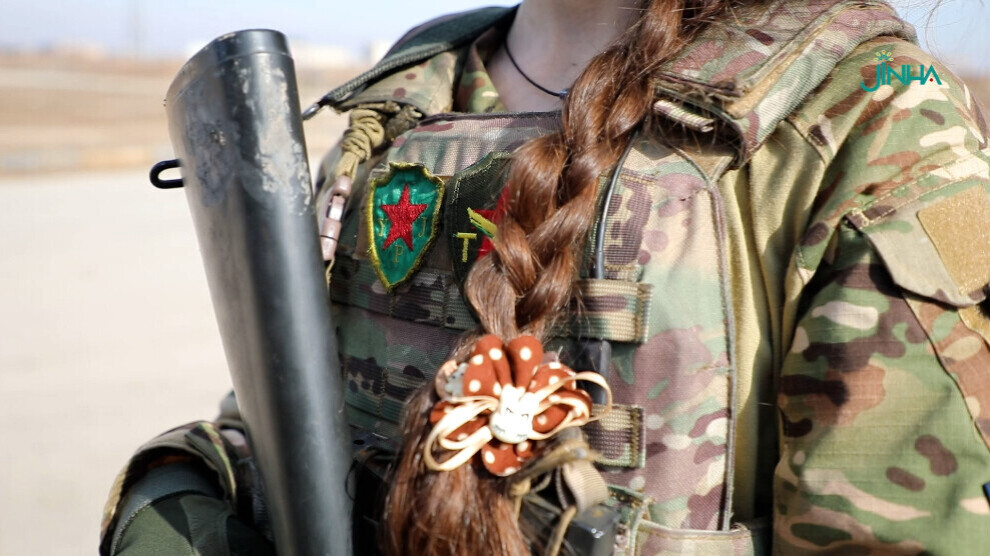
By Lamaan Sheikho, Member of the Jineolojî Academy
No matter how much oppressive forces attempt to break women’s will—whether by cutting their hair or mutilating their bodies—the will of the people does not weaken. On the contrary, every act of violence only increases their strength, determination, and resolve to confront and resist all forms of oppression and injustice, and to continue walking the path of their heroic women martyrs.
Braided hair has never been merely a traditional hairstyle in Kurdish society. Throughout history, it has represented a deeply rooted symbol of identity, belonging, and dignity. Braids, which may appear as a simple aesthetic detail, carry within them a collective memory and a long feminist experience of patience and resilience, embodying the Kurdish woman’s relationship with land, society, and existence.
Braids have been closely associated with rural and mountainous lifestyles, serving as a practical way to preserve hair while simultaneously expressing order, natural beauty, and harmony with the environment. Over time, this practice evolved into a distinct cultural marker, varying in form and style across Kurdish regions, reflecting local belonging and social identity.
In childhood, girls’ hair is braided into two or more plaits, symbolizing innocence and the early stages of social integration. In youth, long and neatly arranged braids become a symbol of vitality and beauty. Across all stages, braids remain a silent language that expresses a woman’s position within society and her relationship with herself and her surroundings.
Braids hold a powerful presence in Kurdish folklore, myths, and stories, celebrated in songs and poetry and likened to the night or to wheat ears—symbols of fertility, continuity, and connection to the land. In the collective imagination, braided hair has been associated with patience, strength, and identity, as an extension of a body that endures life’s hardships without losing its dignity.
In societies subjected to oppression, the female body is never excluded from politics. Kurdish women have not been targeted merely as individuals, but as bearers of culture, language, and memory. Thus, targeting their appearance—including their braids—has never been a random act, but a political practice aimed at breaking symbols and stripping them of meaning. Forcibly cutting braids is an attempt to control the body and redefine it according to the logic of the oppressor.
This symbolic violence was starkly manifested in the incident in which a Kurdish woman fighter from the Women’s Protection Units (YPJ) had her braid cut by an affiliate of the Syrian army. This act was not a personal assault, but a harsh political message that used the woman’s body as a stage for asserting domination. Cutting her hair was an attack on her dignity and identity, a violation of human values and women’s rights, and a reflection of deep fear toward the organization and empowerment of Kurdish women.
Yet this act did not pass in silence. It ignited a wave of anger and solidarity across different segments of society and evolved into a global feminist solidarity campaign, joined also by youth, who cut their own hair to send a clear message: the braids of our women are not symbols of submission, but of pride.
When women from different parts of the world braided their hair in solidarity with the struggle of Kurdish women, the female body shifted from a site of subjugation to a site of political action. The symbol that was meant to be broken became a tool of resistance, and braids transformed from targets of violence into a transnational language of protest.
This solidarity reaffirmed a fundamental truth: society as a whole stands united against any attempt to terrorize women or suppress their struggle. Feminist resistance cannot be separated from resistance to colonialism, racism, and the erasure of identities. The issue was never just about women’s hair, but about an entire system that views the female body as a space for control and cultural difference as a threat that must be subdued.
In this context, Kurdish braids become a political discourse in themselves—a silent discourse that declares identity cannot be cut with scissors, and that what is attacked by force returns stronger when carried by collective consciousness. It also affirms that women are not passive victims, but active agents capable of transforming pain into stance and symbols into resistance.
The case of Kurdish braids reminds us that the battle over women’s bodies is a battle over meaning, memory, and existence, and that defending women’s freedom begins with defending their right to their bodies, identities, and cultural symbolism—free from guardianship and repression. The braids that were meant to be silenced have turned into a feminist political discourse that cannot be ignored. This places a responsibility on democratic and humanitarian forces to document these crimes and hold their perpetrators accountable, especially as these violations were publicly circulated by those who committed them. Such crimes are not isolated acts, but attempts to terrorize society as a whole.
The broad popular response and strong participation of youth confirm that the will of Kurdish society—especially women—is stronger than any attempt at pressure or repression, and that the struggle for freedom and dignity continues without interruption. The struggle of Kurdish women will remain a beacon of resistance against all forms of injustice and oppression.