
Avin Basho: Building the New Syria Begins with Recognizing Pluralism and Women's Rights
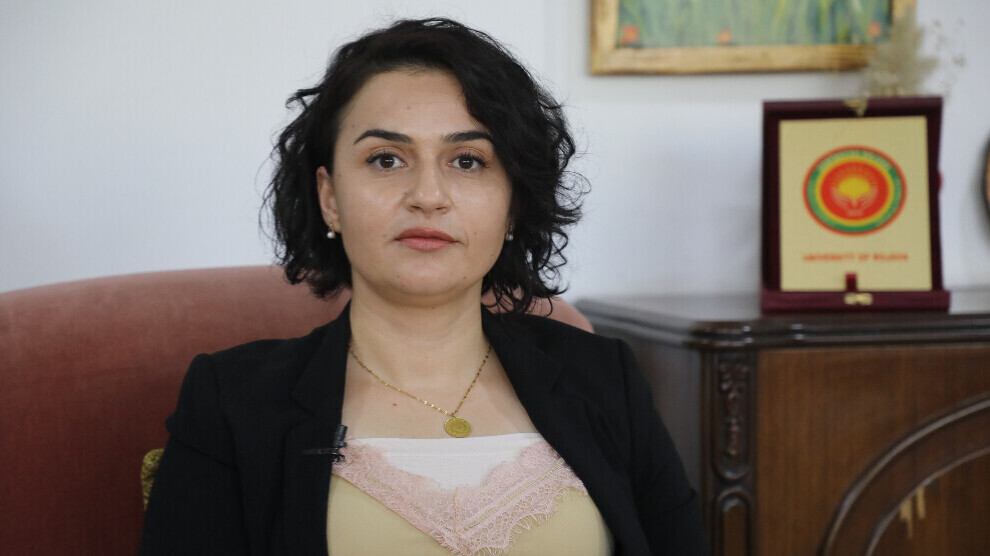
Avin Basho, administrator at the Higher Institute of Arts, confirmed building the new Syria requires recognizing national, cultural, and linguistic diversity, rejecting any orientation excluding women or making their presence a threat.
RONIDA HAJI
Al-Hasakah – On the fifteenth of last September, the Syrian interim parliament discussed the reality of the education sector with the Minister of Education. However, the discussion sparked controversy after parliamentarian Mohamed Ibrahim Al-Zoubi criticized the high proportion of female teachers, considering that the increased presence of women in education could affect students' personalities and weaken schools.
This proposition sparked widespread criticism, as it turns women's presence in education from a right and a fundamental role into a "problem," and reflects, according to its critics, a mentality seeking to reduce women's presence in education, politics, administration, and public life.
In this context, Avin Basho, administrator of the Higher Institute of Arts of the Golden Crescent Movement, rejected considering women's presence in education a threat, confirming that women, especially mothers, play a fundamental role in raising children and building their personalities, and that excluding them represents a retreat from their role and status in society.
"The Kurdish Language Must Be Recognized as a Language of Education"
Avin Basho confirmed that Syria, with its national, cultural, and religious diversity, cannot be built on exclusion or denying the rights of its components, noting that Syrians took to the streets at the beginning demanding freedom, before long years of war, destruction, and displacement swept the country.
She shed light on the experience of education in the Kurdish language in the areas of Rojava and northern and eastern Syria, explaining that education in the Kurdish language began from schools and gradually developed up to universities, in parallel with preparing curricula and educational materials by specialized cadres.
She rejected any decision that deprives learning in the Kurdish language. "The Kurdish language must be recognized as a language of education. Education in the mother tongue is a legitimate right and is recognized within the framework of human rights. Children must receive their education in their mother tongue, so that they do not feel separated from their homeland, and live as citizens in this country."
She stressed that multilingual education can be a source of strength and richness for Syria, confirming that "the mother tongue must be a foundation in education," as it is an essential part of the child's identity and connection to their society and homeland.
Avin Basho shed light on the discussions that took place in the interim parliament, and said that some opinions view the increase in the number of female cadres in the field of education as a threat to the level of education.
She explained that this opinion stems from a mentality that sees women as weak persons. "The person who sees himself as strong and sees women as weak is in fact a very weak person. Because he is weak and blind intellectually, mentally, and cognitively. The first school begins from the family, and the one who runs that school and is the first educational cadre in it is the mother. Those who see themselves as strong and see women as weak must see the role of the mother in building the child's personality and upbringing. Accordingly, this opinion that pushes women away from the field of education is a backward opinion and hostile to the existence of women."
Avin Basho confirmed that women's presence in the education sector represents a positive element and a supporting force for the educational process, noting that children can benefit from women's experiences and diverse capabilities in upbringing and education.
She said: "Children can benefit from women's experiences, and women's emotional strength, alongside their ability to analyze, can contribute to building the child's personality and achieving balance in it." She stressed that accepting women and respecting the various components of society constitute a foundation for building a stable Syria. "The mentality of non-acceptance was a reason for Syria reaching the crisis. What brought Syria to the crisis is the mentality of non-acceptance and non-recognition of pluralism. The mentality of a man who does not accept women cannot build a stable and successful country. The new Syria must be built as a mother embracing all her children."