
A War Without a Name for Global Hegemony… The Search for Alternatives and a Model for Solution-Analysis
BERIVAN ZILAN
We live today in the midst of a world war for hegemony, different in its nature and tools from the First and Second World Wars. It is a war characterized by complexity and chaos, transcending the traditional boundaries of military conflicts, and not necessarily subject to clear rules or fixed ethical and political considerations. Perhaps these features are what make it closer to a war without a name. In this war, the system based on masculine hegemony seeks to overcome its structural crises by reproducing relations of domination and deepening forms of violence. These policies are reflected in practices targeting women, children, and communities, as well as the destruction of the environment, in what can be described as environmental genocide.
At a time when political agendas are being shaped by the competition of international and regional powers, conflicting interests, changing alliances, and local conflicts, the resistance of peoples and women seeking to protect their existence, wrest their rights, and achieve their freedom also continues.
Israel witnessed general elections on 27 October, while congressional elections in the United States were scheduled for 3 November. In light of these political entitlements, speculation is increasing about the possibility that ruling powers may take strategic steps, whether before or after the elections, that could leave wide repercussions on the Middle East and the international scene in general.
The policies of active powers, such as the United States, Israel, Iran, Turkey, Russia, and China, alongside the military, economic, and diplomatic moves of the Gulf states, cannot be understood in isolation from the broader global context. In the same framework, the Kurdish, Palestinian, and other peoples facing similar conditions are waging continuous struggles for their rights and existence, while women continue their struggle for equality, freedom, and an end to forms of discrimination and violence practiced against them.
In France, the protests that began with the participation of high school students turned into a broad mass movement, whose echoes extended to different regions of the country. Despite attempts to influence the course of these movements and direct public debate about their goals, whether through provocations in the streets or through media coverage, the echoes of the movement began to reach other European countries.
However, the expansion of protests alone is not enough to guarantee the desired change; sustainable transformation requires a clear vision and an alternative capable of attracting people and unifying their efforts. Belief in the possibility of building a different future, and developing organizational and democratic tools to achieve it, constitute two essential elements in transforming protests into an effective social force.
Reshaping the Middle East and the Status of the Kurdish Issue
The Middle East is witnessing a highly complex phase, in which conflicts over influence and hegemony are escalating, and wars are intertwining with attempts to redraw political and geographical maps. In light of these transformations, contradictions are worsening, and alliances are changing according to balances of power and conflicting interests, which places states, organizations, and political forces before the necessity of defining their positions on accelerating developments.
The regional roots of the Kurdish issue go back to the Treaty of Qasr-e Shirin, and its repercussions continued during the last decades of the Ottoman Empire's life, to become one of the most prominent political issues facing Turkey, Iran, Iraq, and Syria to this day. With the redrawing of the region's borders and the formation of modern nation-states, Kurdistan was distributed among four states, and the Kurdish people came to face a political and geographical reality imposed by international and regional transformations.
Throughout the last century, the Kurds in these states were subjected to multiple policies of denial and repression, including arrest, torture, and massacres, as well as attempts to erase cultural and linguistic identity, seize economic and natural resources, and change the demographic composition in their areas.
Today, in light of efforts to reshape regional balances according to the calculations of dominant powers, indications are increasing that ignoring the Kurdish issue is no longer an option capable of ensuring sustainable stability. However strong international and regional alliances may be, any project to reorganize the region will remain vulnerable to failure unless it takes into account the rights of the Kurdish people and their political and social aspirations.
The sacrifices made by the Kurds, especially in the context of the struggle led by the Kurdistan liberation movement and women's movements, have contributed to strengthening the presence of the Kurdish issue at the regional and international levels. The Kurdish people are no longer merely a party dealt with by various powers according to their interests, but have become a political actor seeking to express its will and participate in determining its future.
Iran in the Equations of Hegemony and Regional Conflict
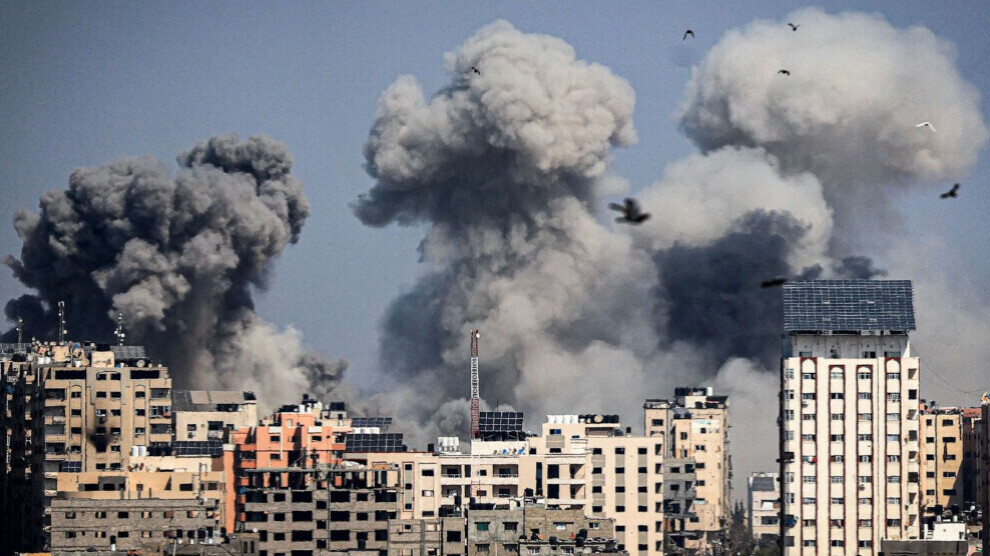
Following the attacks of 7 October, the circle of confrontations in the Middle East expanded, and conflicts took on dimensions that transcended the limits of direct confrontation between the concerned parties. In this context, tension escalated between the United States and Israel on the one hand, and Iran on the other, reaching a direct confrontation on 28 February, in a development that represented a prominent station in the course of regional conflict during the past period.
Iran was subjected, according to the course of the confrontation, to great military and economic pressures, while it responded by targeting American sites and facilities and energy infrastructure in the region, which contributed to expanding the scope of the confrontation and increasing fears of the region sliding into a broader conflict.
Despite the announcement of reaching a ceasefire agreement on 17 June, then Donald Trump's announcement of its termination on 8 July, these developments showed the fragility of understandings that are not based on addressing the root causes of the conflict. They also re-raised fundamental questions about the objectives of the conflicting powers, and the limits of their ability to impose their political and military will on other parties.
In such conflicts, it is difficult to determine a victorious party and a defeated one definitively; the wars witnessed in the region are inseparable from a complex network of conflicting interests and strategic calculations of international and regional powers. A state may be able to inflict military and economic damage on its opponent, but it does not necessarily succeed in achieving its political objectives or imposing a system compatible with its interests.
Local communities, in the end, bear a large part of the cost of these conflicts; their effects are not limited to human losses and material destruction, but extend to the deterioration of economic conditions, the widening scope of poverty and displacement, and the deepening of social divisions. Women, children, and the most vulnerable groups, alongside religious and ethnic minorities, are often the most affected by the repercussions of wars.
The Peace Path in Northern Kurdistan and Turkey Enters Its Second Year
As the political path underway in northern Kurdistan and Turkey enters its second year, discussions about its future are increasing, and questions are escalating about whether it has slowed down, reached a state of stagnation, or come to face the risk of stopping. These questions reflect the scale of complexities surrounding the process, alongside the disparity between political statements and the practical conditions necessary to achieve tangible progress.
The status of leader Abdullah Öcalan stands out as one of the fundamental factors influencing the course of the process. The continuation of the restrictions imposed on him, the unavailability of conditions allowing him to exercise his role freely, alongside the absence of a clear legal framework regulating his status and role, raise questions about the extent of the availability of the conditions necessary for the success of the dialogue.
Among the other factors that increase the complexity of the scene is the tendency of the authorities and the state to deal with the process from a narrow security perspective, instead of viewing it as an opportunity to address a deeply rooted political and social issue. The real challenge is not limited to ending armed confrontations, but also includes addressing the historical causes that led to the continuation of the conflict, and establishing legal and political guarantees that ensure rights and freedoms for all components of society.
The mechanisms of employing the judiciary in political conflicts, the restrictions imposed on journalistic and media work, and economic and social pressures have also affected society's ability to express its demands freely and participate in shaping its future. At the same time, authoritarian and exploitative economic structures have contributed to deepening inequalities, weakening the most affected social groups, including women, youth, and children, as well as harming the environment and natural resources.
In the face of these challenges, leader Abdullah Öcalan continues to push toward a path aimed at achieving political and social gains for peoples, and opening the way for a democratic solution to the Kurdish issue. This comes in light of divergent political calculations, including the Justice and Development Party's (AKP) endeavor to maintain its position in power, the state institutions' adherence to parts of the status quo, alongside the interests of regional and international powers that influence the course of developments.
These calculations intertwine to make the process more complex, as the issue is not related to the declared positions of the parties alone, but also to the extent of their readiness to take practical steps reflecting their commitment to a political solution. Hence, the necessity of evaluating the path on the basis of the actual progress it achieves, not on the basis of statements or expectations alone, stands out.
Societal Struggle Is a Decisive Factor in the Future of the Process
In various regions of Kurdistan, Turkey, and Europe, events and movements demanding the physical freedom of leader Abdullah Öcalan, and the preparation of conditions allowing him to exercise his role in any negotiating path, continue. Participants in these movements believe that improving his detention conditions and ensuring his ability to communicate and dialogue constitute two essential elements in preparing a suitable climate for progress toward a solution.
In return, the disparity between official discourse and actual practices raises questions about political intentions and the extent of readiness to transform announced initiatives into tangible steps. Trust is not built by statements alone, but needs clear procedures, enforceable guarantees, and a real readiness to address contentious issues.
From this standpoint, society's responsibility acquires particular importance in directing the process toward goals that transcend partisan calculations and narrow interests. Even when the motives of the parties differ or their final objectives remain in question, working for peace and a democratic solution remains a political and social necessity that cannot be ignored.
Building a Democratic Society Can Determine the Fate of Peoples
If the state and government fail to provide the conditions that allow leader Abdullah Öcalan to work and live freely and equally, in proportion to his status as a main negotiator, and instead continue to keep him imprisoned and refuse to seek change and transformation based on democracy, then a return to war and violent conflict becomes a very likely scenario. Preventing such an outcome will not be achieved by the ruling powers voluntarily abandoning their interests, which is impossible in any case; rather, it can only be achieved by strengthening popular societal organization and self-defense. In this context, the fundamental vision that applies to all parties stands out, which is building a democratic society based on communes; as this appears to be the only way through which society can determine its own fate.
Developments in Rojava and Syria
Tensions in Syria and Rojava are not witnessing any decline; on the contrary, they are escalating. This is a direct result of the nature of the regime, an armed structure of a jihadist character established through joint planning between international and regional powers, a situation that has existed for nearly two years. Despite social chaos and economic collapse, and instead of addressing problems through democratic transformation, embracing ethnic and religious diversity, and giving priority to popular will, the prevailing path is heading toward strengthening authoritarianism, entrenching gender-based discrimination, extremist nationalism, and the exploitation of religion. In light of this reality, provocations and attacks targeting Rojava directly are being encouraged and supported. Given that expansionist, anti-woman, and genocide-seeking agendas still constitute a continuing threat, it is clear that warding off these risks requires, through the framework of the "democratic nation," confronting the mentalities that incite hostility between peoples and religions, as well as confronting discourses and approaches based on gender discrimination, sectarianism, and nationalism that fuel such divisions.
Resisting Women in the Crosshairs of the Iranian Regime
Iran, including eastern Kurdistan, remains one of the most turbulent regions in the Middle East. In the face of external threats, the Iranian regime continues to wage a campaign of terror characterized by massacres, persecution, torture, arbitrary arrests, and death sentences against the population, with particular focus on Kurds, women, and all who resist. The Iranian regime has issued a second death sentence against "Varisha Moradi," while for months it has refused to provide any information about two resisting women, members of the Free Women's System in Eastern Kurdistan (KJAR), whom it had arrested.
This regime is fascist in nature; it not only targets Kurdish women, but also affects women from other ethnic and religious backgrounds, including Arabs, Baluchis, Azerbaijanis, Persians, and Baha'is. In an attempt to obscure this truth, the regime published footage showing women receiving military training, under the pretext of "protecting" the regime in the streets. But in reality, the Iranian state views resisting women, alongside the Kurds who represent the most organized component, as the greatest threat to its existence.
This is evident in the arrest and execution campaigns carried out by the regime, the military mobilizations and operations it has launched in eastern Kurdistan, as well as its continuous attacks on Kurdish organizations present in the Kurdistan Region. Although the nature of the consultations that the Iranian authorities received from the Turkish government and state during its visits is unclear, it is clear that unless the Iranian regime chooses to unite all its diverse components, of peoples and beliefs, within a democratic framework, entrenching the foundations of the nation on this basis and leading to a shared life based on the principles of freedom and equality, it will never free itself from internal and external threats.
A Democratic Nation Against Racist Ideologies
With the increasing global search for the best model of life for humanity and nature, and even the entire universe, the socialist option is receiving increasing attention as a viable alternative. In this context, leader Abdullah Öcalan presents his vision for addressing global social problems, based on the concepts of democratic modernity, the democratic nation, and democratic socialism. In the face of racist, nationalist, and sectarian ideologies, the democratic nation embodies a model of shared and collective life between peoples, religions, and various identities, on the basis of freedom and equality.
Deliberate Killing and Hidden Violence
With the approach of the International Day for the Elimination of Violence against Women, which falls on 25 November, and the numbers of women subjected to killing reaching dangerous levels, the need to clarify the importance of this model for women increases. In light of these circumstances, the continued treatment of the concepts of femicide and women's massacres as mere ideological statements in the world and the region calls for reconsidering ways to address this issue from multiple aspects. There is no doubt that the way problems are defined determines the paths of searching for solutions and their content. From this standpoint, the problem is exacerbated by the continuation of distorting facts and obstructing women's efforts to defend themselves and struggle for life. Even physical violence and direct assaults against women are often hidden, while the system of deliberate killing, through social, psychological, and religious exploitation, contributes to making violence invisible and turning it into a culture.
One of the most prominent lessons to be drawn from our historical studies is that addressing the woman issue and entrenching it strategically constitute an essential element in any system, through the application of policies of violence in various aspects of life and in multiple ways.
The Philosophy of Jin Jinyan Azadî
Leader Abdullah Öcalan realized the limitations of existing analyses, so he developed historical and social visions for the woman issue on an unprecedented scale, according to what this conception proposes, among leaders, philosophers, and thinkers throughout history. His vision was characterized by intellectual and philosophical depth, and a distinctive lifestyle. He affirms that the woman issue is one of the fundamental problems that socialism should address, and defines women’s place in life through his sologan JIN JIYAN AZADI.
In this ear in which women still face deeply rooted problems with states, societies and families that practice gender discrimination, amid the continuation of masculine hegemony throughout the world, his philosophical and ideological approach, alongside his alternative model of life, acquires great importance.