
A Historical Struggle… When Did Women Start Wearing Pants?
Once banned due to social pressure, women's right to wear pants became a historic struggle for equality, freedom, and the right to occupy public spaces.
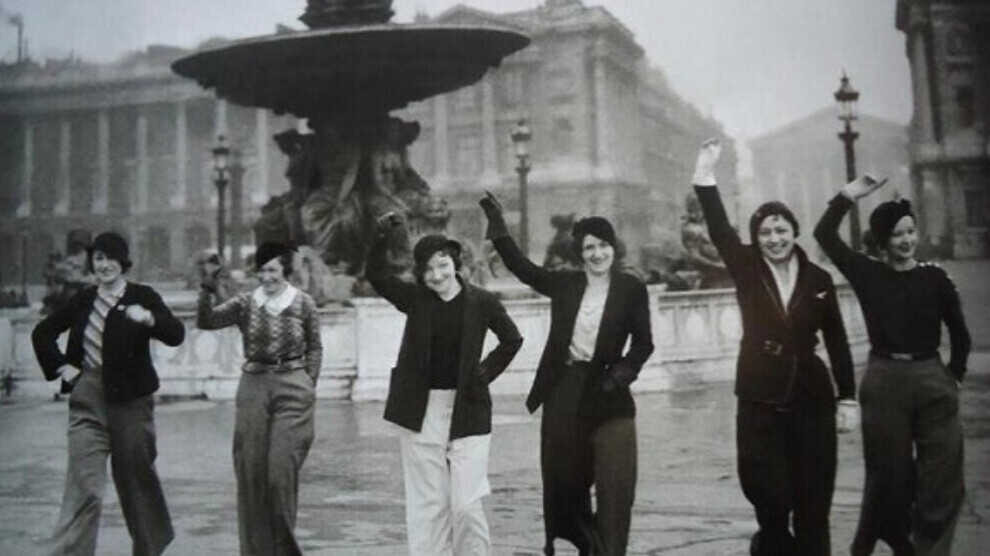
News Center-Although women wearing pants is considered acceptable and common nowadays, the "right to wear pants" is in essence a relatively modern concept. Women were banned from wearing pants in luxury international hotels until the 1970s. Furthermore, a famous department store in London banned female customers wearing pants from entering until 1970. However, after those years, women began writing the history of wearing pants.
Since the Middle Ages, pants were viewed as an integral part of knights' attire on battlefields. By the fourteenth century, pants came to be considered exclusively men's clothing. Wearing pants was mostly forbidden for women, and some places even enacted laws criminalizing it. In patriarchal society, pants turned into an ideological symbol of power and masculinity, and women wearing them came to be seen as a dangerous taboo.
Naturally, women appeared who challenged these restrictions and took bold steps. French women were the first to take this well-known step. Paris had enacted a law that did not allow women to wear pants unless they obtained approval from the city authorities.
Since the mid-nineteenth century, a close link emerged between the women's rights movement and the movement demanding the right to wear women's pants. The demand for pants for women intensified, and one of the most prominent examples was the American women's rights activist, Amelia Bloomer.
When Amelia Bloomer, the editor of the feminist magazine The Lily, advocated for dress reform in the public sphere, it triggered widespread reactions. In 1851, she published instructions in her magazine for making ankle-length pants for women; these pants were later called "bloomers." While the pants granted women a great deal of freedom in the public space, public opinion among women remained hesitant toward this new style. In the northeastern United States, some women wore bloomers on formal occasions, whereas the majority of women in Europe did not dare to appear in public wearing them. For a long time, bloomer pants continued to be considered a highly radical attire.
The movement for women wearing pants did not gain new momentum until the second decade of the twentieth century. The Parisian designer Paul Poiret, inspired by the contemporary Orientalist movement, designed wide-legged, floor-length trousers. When Poiret attended a public horse race accompanied by models wearing these trousers, he had to defend them with a cane against angry crowds. The reason for this was that, at the time, women wearing pants were only known through sexually suggestive photographs.
World War I ended the strict ban imposed on women wearing pants, after many of them were forced to work in paid jobs. Women wore work clothes that were previously exclusive to men; factory women began wearing overalls, and women working in public services used official uniforms with long trousers in winter. However, women wearing men's clothes was not viewed as a transgression of gender boundaries; rather, it was considered appropriate and temporary wartime necessity. As soon as the war ended, everyone returned to patriarchal fashion rules once again.
After World War I, names and brands emerged that became pioneers in designing women's pants. In the 1920s, a French fashion designer created pants to help women ride the swaying gondolas in Venice. Back then, a war was waged against multiple layers, lace, and ruffles, and traditional gender molds were broken. Nonetheless, the ban on women wearing pants in government buildings persisted in many countries until recently. In Turkey, a ban on women wearing pants inside government institutions was imposed during the September 12 coup, and this ban was not lifted until 2002.