
Öcalan calls for legal framework for democratic change in Turkey
Leader Öcalan told İmralı delegation: need legal framework for democratic transformation, criticized Turkey's lack of democracy, said solving Kurdish issue requires reorganizing Turkish-Kurdish relations on modern foundations.
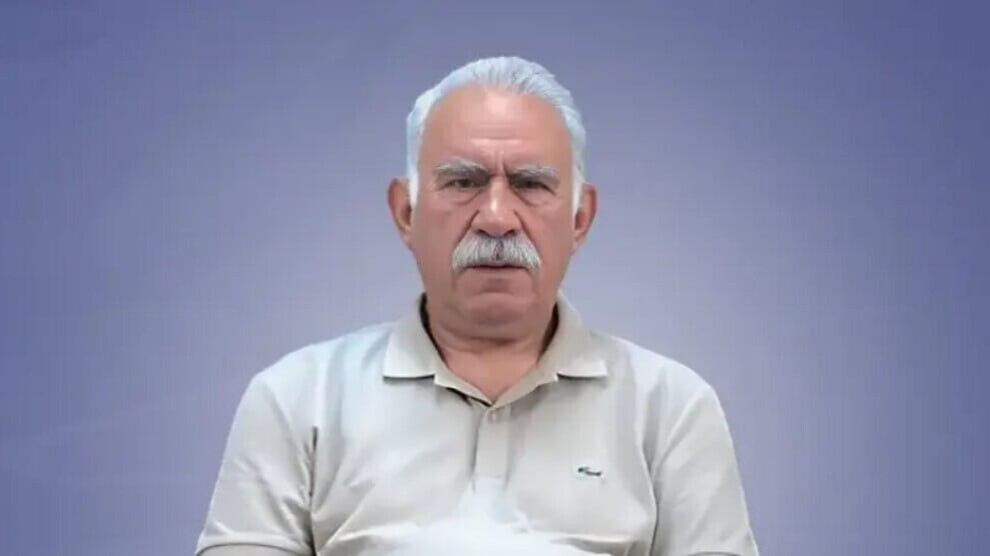
News Center – The İmralı delegation has revealed the key messages of Leader Abdullah Öcalan during his recent meeting, confirming his readiness to evaluate "every proposal, criticism, and contribution" with the utmost seriousness within the framework of the peace and democratic society process.
The İmralı delegation issued a statement about the meeting held with Leader Abdullah Öcalan on May 24, in which Öcalan presented a series of political and intellectual assessments addressing the internal situation in Turkey, regional developments, the path of democratic solution, and his vision for the future of Turkish‑Kurdish relations.
According to the statement, Leader Öcalan explained during the meeting that societies experiencing intense anger cannot be transformed or calmed without "great thought and deeply rooted moral values."
He pointed out that Turkish society is going through a state of "comprehensive suffocation" at the moral, political, legal, and economic levels, making it necessary to proceed with the political process and accelerate it.
The statement noted that Öcalan also touched on the regional situation, affirming that the Middle East remains open to all possibilities, and that "countries such as Iran and Israel are moving toward further rigidity," warning that feeding nationalist tendencies, divisions, and micro‑nationalist projects will cause great harm to the region. "We are working on a path that can monitor dangerous developments in the region, take necessary measures, and overcome blood‑soaked calculations."
The statement explained that Leader Öcalan stressed during the meeting that giving the political process a legal basis is an essential condition for its success, affirming that "waiting or remaining in a state of suspension only produces risks." He called on all parties to assume their historical responsibilities, expressing confidence that the Turkish parliament will deal with the phase with high sensitivity.
According to the statement, Öcalan considered that issuing a "framework law" could constitute the "stem cell" of the democratic transformation process in Turkey, pointing out that any legal amendment would introduce the country into a "truly positive constructive path" and restart the "wheel of democracy."
He strongly criticized the raid on the Republican People's Party (CHP) headquarters and the breaking of its door, describing it as "proof of the absence of sound democracy," saying: "Is it conceivable in a democratic system that the headquarters of a political party is raided and its door broken with a pickaxe? What is happening to the CHP and the developments we are witnessing are linked to the absence of sound democracy and genuine democratic politics. This is what has brought things to this point: the absence of the principle of democracy at the foundation of the republic. Treating democracy as a luxury, demagoguery, or mere empty talk is a grave mistake, and its consequences are serious. Nothing is more urgent today than developing the democratic character of the republic."
Leader Öcalan explained during the meeting that the ongoing work in İmralı aims to "prepare the republic for a new legal and democratic phase" and to address the lack of democracy within and between political parties. He considered that the ultimate goal is "to establish a democratic culture and build a solid legal system" that guarantees it.
He called on all parties to contribute to the peace and democratic society process, affirming that "the integration of Kurds into the democratic republic is the essence of the current process," and that overcoming the state of deadlock caused by the Kurdish issue for many years is achieved through "a solution methodology that reduces the element of violence."
He described the process as "reorganizing and modernizing Turkish‑Kurdish relations" in line with contemporary requirements, pointing out that messages from international intellectuals and academics supporting the peace path have been compiled into a book, affirming his readiness to evaluate "every proposal, criticism, and contribution" with the utmost seriousness.