
The Union Was a Tent for All Women Without Exception…Which Wind Has Struck the Women’s Union?
An Article by Tunisian Journalist NAZIHA BOUSSAIDI
How did the Tunisian Women's Union transform from a tent that gathered all women without exception for decades into a nearly deserted headquarters, empty even of its female employees?
The founding of the National Union of Tunisian Women is intertwined with Tunisia's independence, as it emerged as a fruit of a long feminist struggle by women who contributed to the national liberation phase and the establishment of the first republic—alongside men who believed that Tunisia would not progress after expelling its last colonizer except through its women. Since the 1930s, the Union has played important social roles for society, particularly in mandating education for girls and ensuring the success of the family education program.
The Journey of Liberation and Enlightenment
Following the election of Tunisia's first Constituent Assembly in 1956, leader Habib Bourguiba said: "I believe the hour has come for our remarkable female elite to roll up their sleeves, work diligently to revive and organize the women's sector. This will be a long-term endeavor that requires all sacrifices, and it will only succeed if it rests on the shoulders of women before whom even the most closed doors will not remain shut."
None of this could have been achieved unless women gathered under one tent, striving for progress, dignity, and freedom. The National Union of Tunisian Women was that tent that brought together all women, regardless of their intellectual affiliations, cultural backgrounds, or regional traditions, because the goal was one: to elevate the condition of society in general and to shake off the dust of colonial legacies—poverty, intellectual backwardness, and disease.
The goal was also to advance women's status, educate them, empower them, and involve them in numerous fields. From its first conference in 1958, the Union sought to expand its structures and branches within cities, villages, and rural areas, and beyond national borders as well.
What further strengthened the Union's position as a tent for all women's groups in Tunisia was the promulgation of the Personal Status Code, the need to disseminate a culture of education, enforce laws, and ensure women's rights within the family and society.
A succession of distinguished women's names led the Union following its electoral conferences, beginning with Radhia Haddad, then Fethia Mzali, then Naziha Mezhoud, then Fawzia Kafi, and Chadlia Boukhchina... up to the current president, Radhia Jerbi, who has led it since 2011 to the present day.
Activist Dou Bellaghaid stated that the Union was a beacon; it contributed significantly to advancing the status of Tunisian women both domestically and internationally, and ensured their presence in parliament and decision-making positions. It functioned like a beehive at the central, regional, and local levels.
The Union contributed to teaching girls crafts, traditional industries, sewing, and cooking. It encouraged girls' education in the most remote rural areas, advocated for the implementation of family planning programs to protect maternal and child health, and played a crucial role in the social care of poor and vulnerable families. Its highest aim was to serve women regardless of their orientations and cultural backgrounds. Political will was also available to make it a beacon during the eras of both the late leader Habib Bourguiba and the rule of Ben Ali, through the provision of all forms of material and logistical support.
In return, both presidents would intervene in selecting the president or endorsing the names proposed to them. However, this status and role witnessed a continuous decline after 2011. The Union was no longer the tent that gathered everyone; differences and infighting prevailed over the executive office team that runs it. Successive post-revolution governments also considered it a regime organization that should be dissolved or that it must return to obedience, especially during 2012 and 2013, with the fierce attack on women's rights and achievements, and the desire to roll them back—particularly from the Islamist faction that paved the way for Salafists to emerge further.
Continuous Decline: Where To?
Union activists, like most Tunisians, welcomed the 2011 revolution and the possibility of working in better conditions, given the opportunity for full independence from authority, liberation from instructions and directives, and serving their own agendas. In contrast, voices emerged calling for its dissolution because, in their view, it was a mouthpiece for the former regime and an extension of the Constitutional Democratic Rally (the ruling party dissolved after the revolution). Salwa Tarzi, the last president under Ben Ali, was forced to resign. After conflicts and disagreements over her successor, Radhia Jerbi—the current president—was agreed upon. She believes that the Union was and remains the tent that gathers all Tunisian women, but successive governments have not preserved it, have withdrawn their support for its efforts in serving women and society, and have reneged on granting it the subsidy it had received even before independence.
With the number of members declining from 180,000 to 30,000 currently, and preoccupation with internal tensions and differences—despite being considered a healthy phenomenon—the Union is no longer able to pay its employees' salaries for nearly two years.
Mobilizations and Protests
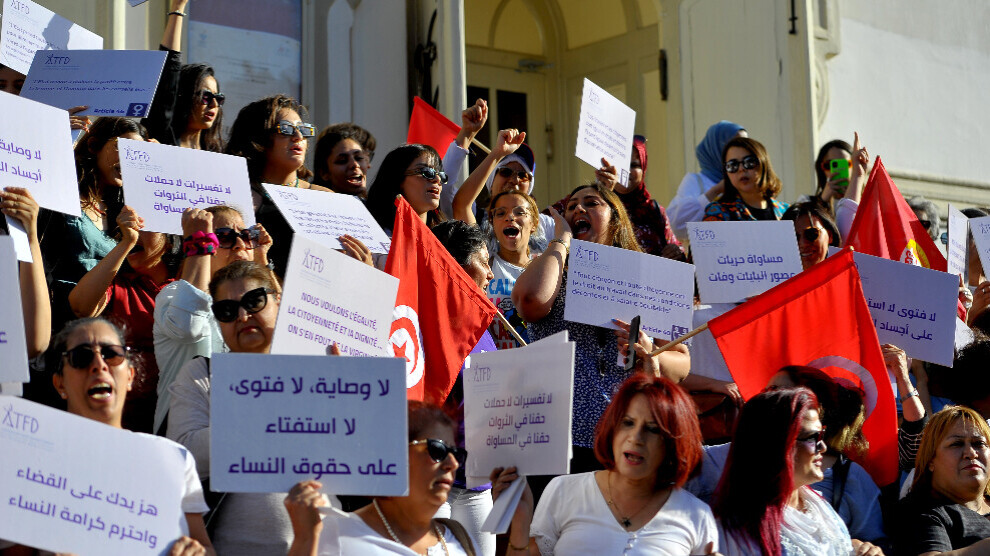
Female and male employees did not remain silent about all attempts to target the Union and efforts to tame it. They took to the streets in numerous demonstrations and protest vigils, expressing rejection of what is happening and demanding that the Union be granted its subsidy so they could continue their work. However, governments continue to remain silent on the Union's file, leaving it to face increasing life difficulties exacerbated by the rising cost of living. Even employees now visit only occasionally, unable to continue working amid the lack of financial resources.
The number of members began to decline; some chose to join other women's associations that emerged after the revolution, while others left associational work with bitter regret and pain over the decline of the National Union of Tunisian Women—the oldest organization in the country, whose history is intertwined with the nation's history.
Union activists raised a question for which they found no answer: Is it reasonable or acceptable for governments to disavow the role of the women's union that leads feminist civil society in such a humiliating and frightening manner? Is it not a shame for Tunisia that all other countries preserve their women's unions, established many years after the Tunisian Women's Union, and ensure their support, while we erase a history full of achievements with the stroke of a pen, or through neglect or disregard for a structure that was instrumental in the intellectual progress Tunisians have achieved today, and that was responsible for every Tunisian family without exception?
In parallel, voices have risen calling on the Tunisian government to move toward a phase of restoration and reform—both materially and morally—so that the Union can return to its former work, after it has become a nearly deserted place, devoid even of staff and employees. There are voices that believe reforming the women's organization must also come from within, by overcoming internal differences, opening up to rejuvenation, and changing work strategies, because most young women today—especially schoolgirls and even university students—do not know the Union, despite its venerable history and its leading position among feminist institutions.