
First Women's Swimming Coach in Rojava Breaks Barriers, Calls for Women-Only Pools
Despite limited facilities and social barriers, Rojava's first female swimming coach is training women and children, demanding dedicated pools and institutional support to expand women's sports.
SORKEL SHEIKHO
Amuda — The absence of separate or women-only swimming pools in Rojava is a common problem. Many women across the region who wish to swim are forced to do so in complete secrecy.
This delays the transformation of social awareness and the opening of paths for girls and women. To date, if swimming or other sports face obstacles for women, one reason is that relevant administrative authorities have not provided sufficient opportunities and resources to support them.
Nevertheless, women try to make use of available alternatives and solutions to learn swimming. For example, many public pools, hotels, and gyms dedicate specific days or hours each week for women, during which men are completely banned from entering to ensure privacy.
First Women's Swimming Coach in Rojava
Many women want to practice this sport but do not receive adequate support from women's or public organizations and institutions. Their individual resources are often insufficient to establish projects of this kind to support other women.
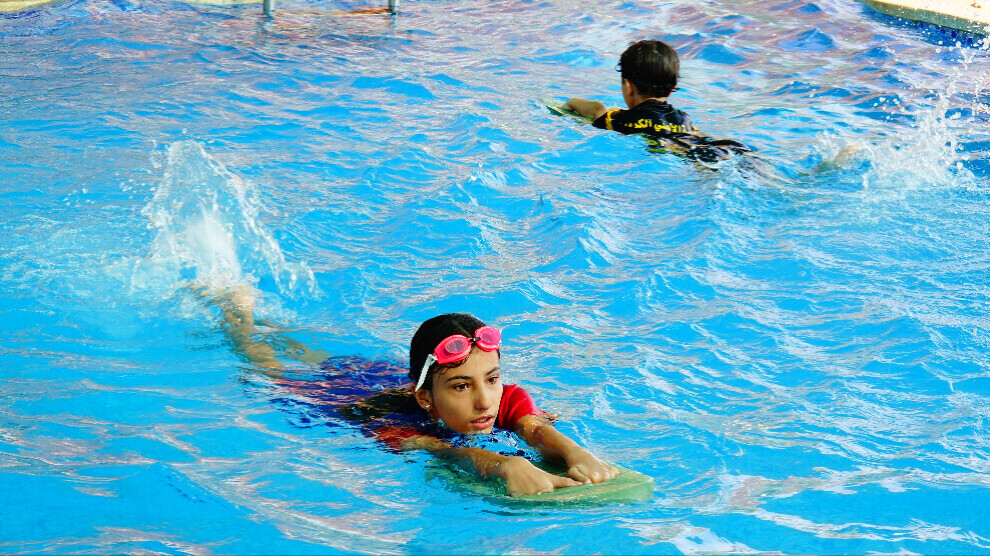
Rohel Said, who began swimming training at the age of ten under a male coach, has been working as a coach in the city of Amuda, Rojava, for two years, teaching women and children to swim. She thus became the first female swimming coach in the region.
She says: "I started swimming in 2017. I dreamed of becoming a swimming coach one day. Knowing that there were no female coaches here, I wanted to be the first to take the initiative, to be the one who opens the way for women to practice this sport."
She added: "For ten years, I and water have become very close friends. I live with it and in it. For two years, I have been turning my dream into reality, teaching women to swim." She noted that a year ago she only trained women, but today she trains both women and children.
Women and Swimming: Love, Dreams, and Obstacles
Rohel Said explained that women and children come to the pool with enthusiasm and that their desire to learn this sport is very strong. However, like any field, there are difficulties women face when participating in this sport. "The difficulties I see in women are not limited to fear of water, but also their circumstances, household responsibilities, social customs and traditions, pressure from husbands, and childcare responsibilities. Women do not have the same time available as young men, who can come whenever they want. So women try to use their free time to come and learn this sport."
She also noted that she wanted to bring women to the level men have reached. "I went through a lot of struggle against men, because they would interfere even in the type of clothing women wear inside the pool. They would feel ashamed to see a woman moving in the water, or wonder how a man or woman could look at a woman's body. They only thought about women's bodies without caring about their development."
She believes that men "are afraid of their women's freedom and of them realizing their strength. But swimming is beneficial for women's health as well as for their husbands. To this day, about 80 percent of men, along with some women, are not convinced of women's participation in swimming. I am trying to make society view women's swimming as a sport like any other, and not turn it into a problem or a subject of mockery."
Rohel Said explained that given the developments in the region and the world today, the number of women practicing swimming should be much higher. "Since I started this work for women, their numbers should increase. There are many women who want to come, but they cannot because they do not receive family support."
Establishing a Women-Only Pool
Rohel Said, who has been working as a coach for years, criticizes the absence of a women-only pool in the Jazira region of Rojava. "One or two days a week, or several hours, can be allocated for women. We want women to learn this sport like men and children, and for development to happen in our society. That is why we have dedicated a day for it."
She called on the Directorate of Sports and Youth to establish a women-only pool, with all staff—from coaches to administrators—being women. "Implementing this step will serve all women."
Health Benefits of Swimming
Rohel Said listed the benefits of this sport for human health, saying that swimming significantly improves mental health and benefits the body in general—whether for women, children, or even men. "Swimming strengthens blood vessels and heart muscles, protects against premature aging when practiced for long periods, and also helps strengthen the lungs."
Swimming, she affirms, is one of the best sports for asthma patients, as the humid environment helps prevent airway dryness, improves lung function, and reduces the frequency of asthma attacks. Many specialized doctors also recommend swimming for people with knee, back, and foot conditions.
Children and Women's Participation in Swimming Olympics
From her perspective, women can practice all the work and sports that men do. "As a coach, I see that women have very distinguished abilities that even men cannot achieve."
She called on responsible authorities to support children and women so that their talents are not wasted and to ensure they achieve great successes. "A small Olympics should be organized at the Jazira level so that we can secure the future of these children we have been training for months, enabling them later to compete at the Syrian level, like any other sport."
She noted that there are many children. "It is unfortunate that their talents are wasted." They should become coaches and participate in the Olympics, she says. "Children need the necessary support."
Rohel Said participated in an Olympic championship in the Syrian capital, Damascus, in 2019, and placed fourth. She said about that: "That was the first time I participated in the Olympics. But the war and lack of support left us standing still. Today, support is necessary for these children. I want to start again, competing and participating in Olympic championships—not only at the Syrian level but also abroad. I want to become better known in Rojava and to be able to participate in championships."