
A Upper Egypt Player Achieves Success in Volleyball for Athletes with Disabilities.
Society has become more accepting of girls with disabilities practicing sports and participating in various community activities. This transformation has helped many highlight their talents.
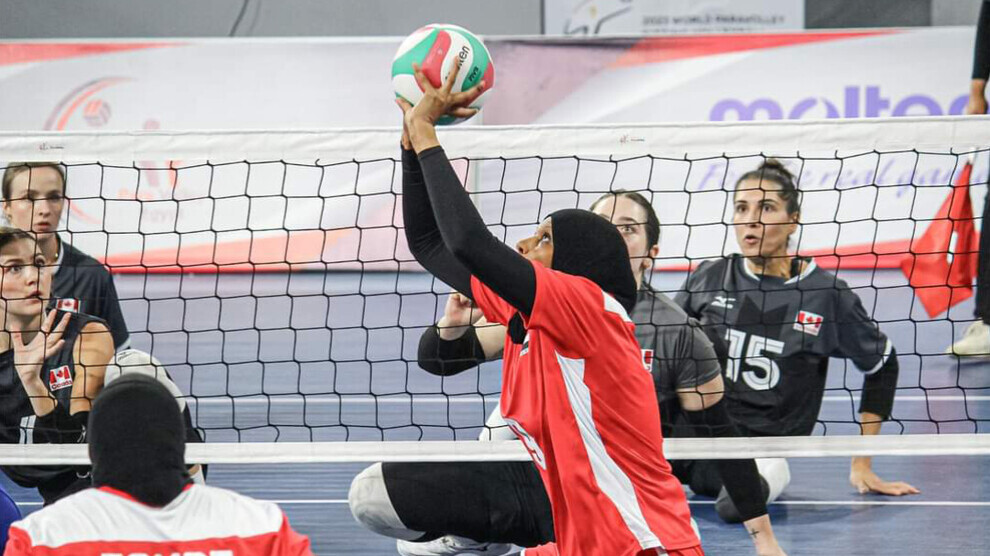
Iman Samir Ali
Egypt – Asmaa Sayed Mohamed Qandil, widely known as Captain Asmaa Qandil, a native of Upper Egypt, managed to turn her hardship into strength and her disability into a gateway to unexpected achievements.
She contracted polio early in life, yet she excelled academically and secured a job on merit before coincidence opened the doors of the sports world to her. She became one of the first players on Egypt’s national volleyball team for athletes with disabilities, building an inspiring and exemplary career.
Asmaa Sayed Mohamed Qandil, from Assiut Governorate, works in the Accounting Department at the Directorate of Youth and Sports. She was born physically healthy with no disability, but after receiving childhood vaccinations, she developed a high fever, her health condition deteriorated, and she was affected by polio.
Her family was a great source of support, never making her feel different from her siblings. She lived a normal life and continued her education until she graduated from five-year commercial secondary school, then completed her university studies at the Faculty of Commerce, earning a Bachelor’s degree in Commerce.
She says:
“When government jobs were announced, I was supposed to be appointed within the 5% quota allocated for people with disabilities, but I was surprised to be appointed within the high-score category due to my excellent university grade. I was appointed to the Accounting Department at the Directorate of Youth and Sports.”

Regarding the beginning of her volleyball journey, she explained:
“After I started my job at the Directorate of Youth and Sports, there was a department called the Sports Department. Its director saw me, and at that time the ministry was implementing a project under the Ministry of Youth and Sports to organize sports activities for people with disabilities, such as tennis, volleyball, and other sports. I was offered the idea of joining, I agreed, and I went to the YMCA Club, which was our training venue. I was completely new and knew nothing about volleyball. Over time, I started practicing little by little, but my level was still basic.”
She added:
“I learned from my colleagues that player trials would be held to form Egypt’s first national volleyball team for athletes with disabilities. I contacted the officials, but they told me that the number was already complete and the trials had ended.”
Asmaa Qandil did not give up. She obtained the phone number of the team’s coach and contacted him directly. He welcomed her participation due to her enthusiasm and determination.
She went to the club and took the trial. Some of her teammates had been playing before her, so their level was slightly higher than hers, as she was still a beginner. This was in 2015, when the head coach of the Egyptian national volleyball team for athletes with disabilities told her that she only needed some training and that she would be included in the team for the next championship.
At that time, the championship they were preparing for was canceled, and participation in the African Championship was postponed. This turned out to be in her favor, as she was later selected as a key player in the first official selection. She participated in her first championship and her first training camp with Egypt’s national team for athletes with disabilities—the first team of its kind in the country.
She said:
“I spent more than six months, maybe even a year, moving between training camps, as the team was still being established as Egypt’s first national volleyball team for athletes with disabilities. Then I participated in my first African Championship in Rwanda in 2016, where we won second place. Our level was very good, and we nearly achieved first place by a narrow margin.”
Asmaa Qandil continued to join the national team in nearly every tournament. Although the management renewed the squad from time to time, she was consistently selected due to the scarcity of tall players suitable for the libero and center positions, especially the blocking position. She also participated in the Intercontinental Championship in China in 2019 and 2020.
She explained that during a period when the national team gatherings were suspended, she moved between several clubs before settling at the Assiut Petroleum Club:
“My level improved greatly. Regular training with the club significantly raised my performance, which helped me be selected again for the World Cup in the New Administrative Capital in 2023. We delivered a strong performance and reached the quarterfinals. Since then, the national team has not regrouped, but I appeared in the last championship with a good level, especially in my position. Now we are waiting for the upcoming tournaments.”
She also noted that the Egyptian Volleyball Federation organizes an annual league for clubs nationwide, through which players are selected for the national team based on performance. Therefore, she always strives to maintain regular training, as stopping could lead to a decline in performance and, consequently, exclusion from selection.
Captain Asmaa Qandil affirms that society today has become far more accepting of girls with disabilities practicing sports, marking a significant change compared to the past:
“Today, we see girls coming from distant towns and villages such as Abnoub, El-Fath, and El-Ghanayem, and their families allow them to participate. This reflects a great level of awareness and social development.