
The boxing club: a refuge for women and girls in the Gaza Strip
In a war‑exhausted Gaza, girls return to boxing in a tent for strength. Amid rubble and fear, Rahaf Abu Naji and her friends reclaim their lives step by step.
Rafif Asleem
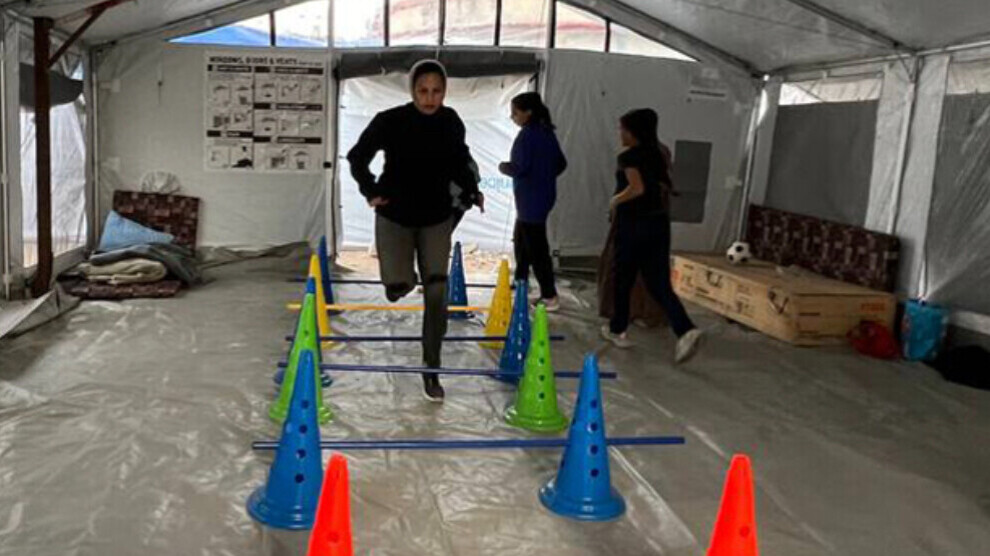
Gaza – Three years after the war on the Gaza Strip and the destruction of its official headquarters west of the city, the women's boxing club decided to return to help women practice this sport despite the lack of resources, opening a tent to support the resilience of girls and women, improve their physical fitness, and boost their mental health.
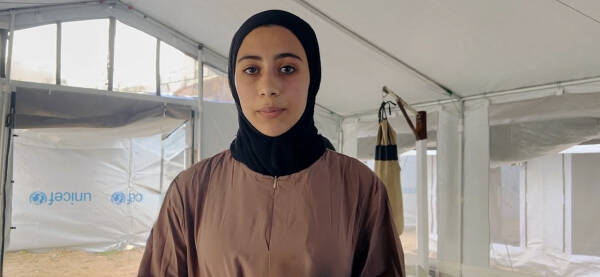
Rahaf Abu Naji, a member of the Gaza Boxing Women club, says that reopening the club, even in a tent, brought back great hope for her, as she loved this sport and joined it from a young age. She noted that she noticed the impact of her return to the sport on her physical health; she got rid of the dizziness that constantly accompanied her, and her mental health improved as she no longer suffered long bouts of anger, releasing that anger through playing.
She adds that since joining this sport, she has not missed a single day, except when the war broke out in the city and Israeli forces burned and then bombed the club's headquarters. She noted that her stay in the north under fire and the coach's and players' displacement to the south deprived her of playing for three full years, even though the club's headquarters was opened in the south, it was difficult for her to reach it.
Rahaf Abu Naji has been boxing for nine years. Now in her twenties, she describes herself as different from many girls her age, as she is not afraid to express her opinion as long as she believes she is right.
She affirms that her family's support helped develop her abilities and continue practicing boxing professionally and participating in international competitions. She explained that her parents were present at all the championships she won, and the continuous support she received from her coach played a major role in reaching the level she is at today.
She adds that society's view of a girl who plays boxing does not matter to her; she will not stop her future and cut herself off from something she loves just because society likens her to men and dislikes what she does. She stresses that she will continue until circumstances allow her to leave Gaza and win an international medal, alongside her education, which she is trying to complete despite the stricken city's conditions that make practicing anything – especially sports – difficult and exhausting for women. She was often told when she missed the club: "Enough of this nonsense; what sport in these circumstances?"
Increasing women's self‑confidence
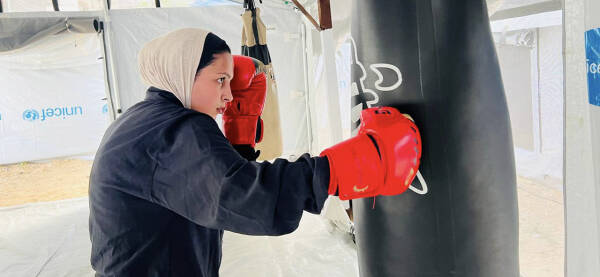
For her part, player Farah Abu Al‑Qamsan said that the club was opened about a month ago, and the decision came based on the desire of the city's girls, who reopened it through their continuous correspondence with the club's page on social media, especially with the opening of the headquarters in the southern Strip and the continuation of training as usual for about a year and a half. She added that it is important to teach girls self‑defense, especially given the exceptional circumstances the Strip is experiencing.
She added: "I opened the club's doors to all women and girls of different age groups with its simple capabilities that have been recently provided due to the acute shortage of sports equipment in the besieged city." She explained that the players currently need a floor mat for the club, punching bags, hand wraps, shin guards, mouth guards, in addition to other tools that can be dispensed with at this stage.
She praised the turnout of girls and expressed her understanding, noting that every time they visit the place for the first time, they utter the famous phrase: "Is there a specialized boxing club for women in Gaza City?" She explained that she welcomes the visitor, begins to explain to her, teaches her the first steps, and takes into account that this sport requires high concentration, not just muscle strength. She repeats the steps several times until she is sure they are correct so as not to cause a sprain or damage to the wrist and palm, while also warning against long nails.
The ages in the club range from 6 to 30 years. All of them gathered in one place because they believe their bodies need this sport, and that this game increases women's self‑confidence and improves their decisions. She called on all girls and women to visit the place and start playing, away from the negative stereotype that society projects onto the sport or the players.