
Women's Representation Shrinks in Algeria's New Parliament
Despite constitutional guarantees, women's political representation has sharply declined, raising questions about why democratic elections have failed to ensure equal representation.
RADAH KHRAISS
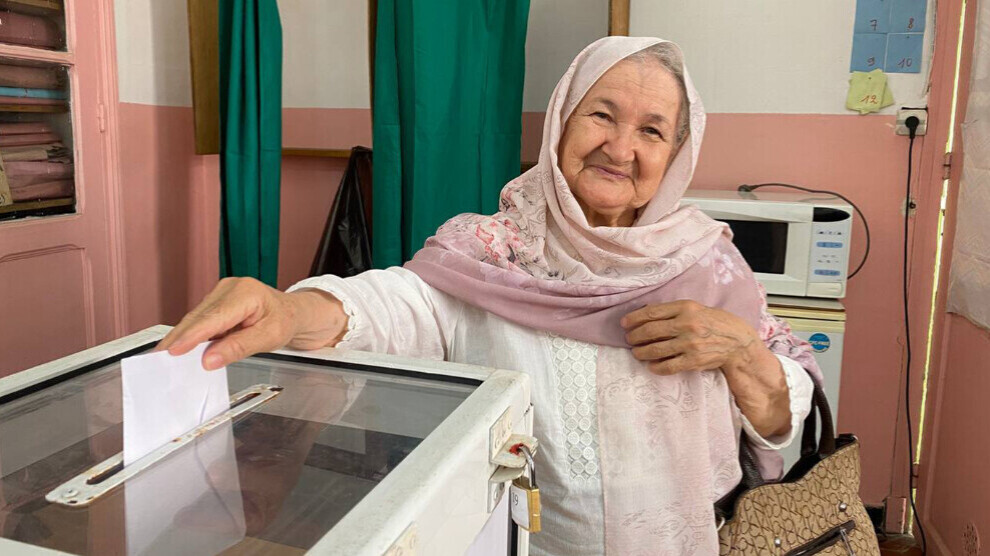
Algeria — In a sharp political paradox that manifests the vast distance between the momentum of legislative promises and the actual outcomes of the ballot boxes, Algerian women have suffered an unprecedented historic setback in the parliamentary elections held on July 2nd. Out of more than 2,000 female candidates who entered the electoral race within the lists of political parties and independents, only 23 won seats in the new parliament—with the possibility of this number decreasing slightly, according to in-depth investigations being conducted by the country's security services.
A Historic Setback
With this outcome, the number of women in the upcoming parliament stands at 23 female MPs out of 407, making up only five point six percent, This is an extremely weak percentage compared to the previous 2021 parliament, where their total was 34 female MPs, representing eight percent. This decline occurs despite the fact that women constitute the largest bloc within the country's electorate, making up $57\%$ of the total registered voters on the electoral lists—equivalent to approximately 13 million female voters out of a total of nearly 24 million voters, according to data from the Independent National Electoral Authority.
In an objective reading that reveals the background of this decline, political activist and former candidate for the National People's Assembly, Nour El Houda Douibi, believes that the crisis does not lie in a lack of female competencies. Algerian women today record a record presence and a remarkable boom in various fields. She states: "Women's representation has seen a significant increase across various sectors, including university graduates, employees, teachers, and university professors. Yet, the stark paradox is that this expansion and growth was met with a sharp parliamentary setback
The Legacy of the "Quota"
Nour El Houda Douibi attributes the contradiction between women's societal expansion and parliamentary shrinkage to a combination of factors, chief among them the negative repercussions of the "quota" legacy. She explains: "Although this system contributed to raising the percentage of women's presence in the Zighoud Yousef building [Parliament], it imposed a preferential presence that did not at all reflect the maturity of societal acceptance in terms of quantity and quality. Instead, it left a bad impression on the Algerian voter, who termed that era the 'parliament of hairdressers' (a common political and popular slang term in Algeria used metaphorically to describe parliamentary councils lacking competence)." She believes that "this heavy legacy formed a psychological and stereotypical barrier, placing all female candidates before a difficult task to regain lost trust."
These challenges manifested tangibly in her field experience. As soon as she announced her intention to run for the parliamentary elections held on July 2nd, she collided with a stark disparity in attitudes. These were divided between a discouraging tone urging her to stay away from the "men's arena" and focus on her family, and a feminist support front that trusted her ability to bring about change. In this context, she says: "As soon as I proposed the idea of running, the reactions I received were split into two. The first was preeminently traditional, advising me to retreat and care for my family. Conversely, a strong feminist support front was formed, in which women from my circle expressed their sincere desire for me to represent them and convey their voice to decision-making centers."
Family Tribalism (Al-Asabiyyah)
According to her, this barrier does not stop at the stereotypical thinking of the general public. Rather, a woman's candidacy experience collides with the "wall of Aroshya" (clan-based loyalty) and "tribal fanaticism," which continue to cast their heavy shadows over the electoral scene in several regions of the country. In this regard, she recalls a live experience from behind the scenes of the past elections within the lists of the "Renaissance Movement" (Ennahda), where one female candidate faced fierce opposition and tremendous pressure from her family environment simply because a relative of hers carrying the same surname was also in the race.
Under the guillotine of the logic that "the clan will divide and the votes will scatter," a soft exclusion is practiced against women, forcing them to relinquish their political ambition in favor of men, under the pretext that the man is "more capable of garnering votes"—a glaring discrimination and misleading pressure that male candidates do not face with the same intensity.
True Legislation and the Battle of Awareness
Nour El Houda Douibi says with absolute certainty: "We are not looking for mere numbers to furnish elected councils, but for a real presence that imposes itself on a reality shackled by customs, traditions, and stereotypes. This is a profound shift that requires giving society enough time to change and mature naturally." She stresses that "true legislation is that which creates a fair and equitable system for all, far from top-down legislation isolated from reality."
She points to the absence of this fairness through the tremendous pressure Algerian women face in vital sectors, highlighting the urgent and pressing need for real female representation capable of elevating this suffering to the highest decision-making centers, transforming it from a mere political slogan into an urgent legislative necessity to dismantle the professional and social crises besieging Algerian women.
At the forefront of these crises, Nour El Houda Douibi points to the healthcare sector, where female resident doctors find themselves facing complex professional and social balances. She cites "night shifts, which remain socially unacceptable for many, let alone how these shifts have turned into unfair punitive measures that deprive female resident doctors of their basic rights. It is neither logical nor fair to force a doctor to perform 5 full night shifts in a single month under a system that oppresses everyone without exception."
These gaps extend beyond the walls of hospitals and medical facilities to cover the basic rights of both working women and stay-at-home mothers. Here, she cites the "unemployment allowance" file, which, from another angle, witnesses an imbalance in economic and social vision. She believes that directing the allowance to stay-at-home mothers is a real investment because they are "the first and primary teachers in society."
These thorny issues and others, according to Nour El Houda Douibi, confirm "the inevitability of Algerian women's presence under the dome of parliament. For no matter how broad a man's understanding may be, he will never be able to fully comprehend the details of a woman's daily suffering or defend it with the same vigor she would."
She concludes that "reaching fair representation that achieves the true purpose requires, of necessity, an in-depth and honest study of the strong phenomenon of voter apathy recorded during this session, and analyzing its real-world causes to address them from the roots."
In this context, she says: "Behind the disappointing numbers lies a double dilemma that does not only face the female candidate but begins with the female voter herself." She believes that generalizing the concept of boycotting to all segments of society is a flawed diagnosis; women's apathy differs radically from men's apathy within the electorate.
In many cases, women did not boycott the ballots out of a conscious decision but were dropped from the political communication equation altogether because traditional communication channels were designed "by men, for men"—such as cafes, popular rallies, and streets where women cannot easily gather. This creates a serious social barrier for male candidates trying to reach female voters, making the presence of women in parliament a fateful inevitability to reach broad segments of the population that no one represents or reaches.