
Iranian capitalism… between imperialist pressures and democratic transformation
Iranian capitalism, as a nation‑state outside imperialism, faces structural pressures from non‑dominant imperialism that seek not to build a new system, but to redistribute power during the old system's collapse.
Article by Rogda Roghalat
Global capitalism has entered a stage that can no longer be explained by classical concepts of "recession" or "cyclical crisis." What we face today is not a crisis of a sector or a country, but a crisis of capitalism as a whole – a crisis that began with the disruption of value circulation, accumulated at the financial and intellectual levels, led to the collapse of cohesion at the level of nation‑states, and is now manifesting at the geopolitical level in the form of decentralized confrontations. This situation has plunged the world into a phase that can be called "non‑hegemonic imperialism" – a phase in which the great powers still possess the tools of hegemony but have lost the ability to establish order. America is powerful but has lost the ability to organize the global system; China is rising but has not yet reached hegemony; Russia is divisive but is not building a new system; and Europe has become fragmented and decentralized. In such a world, global capital dominates but lacks cohesion, and nation‑states are instruments of hegemony but incapable of reproducing the system.
In this context, nation‑states that assumed a social and economic regulatory role during the era of American hegemony have been left in a hegemonic vacuum. They are unable to manage economic crises, rebuild social cohesion, or mediate between global capital and local society. As a result, nation‑states suffer from a structural weakness that manifests not in decline but in securitization, hostility, and defensive nationalism. The weak nation‑state resorts to violence to survive, and this violence is not a sign of strength, but of crisis.
The current situation in Iran must be understood in light of this global crisis. The confrontation between imperialism and capitalism in Iran is not a moral struggle nor a limited political conflict; it is a defining moment in the crisis of capitalism as a whole. Iranian capitalism, as a nation‑state outside the orbit of imperialism, faces structural pressures from non‑dominant imperialism – pressures that do not seek to build a new system, but to redistribute power at a moment of collapse of the old system. In such a situation, any external pressure – whether economic, political, or military – instead of producing a "transition," intensifies securitization, political siege, and strengthens the far right internally. This is the logic of the crisis: the greater the external pressure, the stronger the far right becomes domestically.
This tendency in Iran is linked to a historical fact. Since the establishment of the capitalist system of the Islamic Republic, the left has been suppressed as a force carrying a project of equality, social justice, and liberation. This suppression – which included mass arrests, political exclusion, and severe restrictions on leftist activities – was not a passing event, but part of the logic of the nation‑state at the moment of consolidating capitalism. The elimination of the left emptied the political space of any force capable of resisting right‑wing politics, inequality, and securitization. The result of this structural exclusion was the formation of an uneven political field in which right‑wing forces – whether religious, nationalist, liberal, fundamentalist, or even monarchist – were able to grow without serious competition.
At present, this historical exclusion is exacerbated by imperialist pressures. External pressures, instead of weakening the right‑wing forces, strengthen them, because the nation‑state in moments of threat structurally moves toward securitization and containment. This containment is the environment in which the right flourishes. In such an environment, the left is not only isolated but also portrayed as a "threat." This process is part of the global logic of crises: the deeper the crisis, the stronger the right becomes.
This logic extends to the global scene. Migration – as a product of wars, economic crises, and climate change – has become a cornerstone of international politics. Capitalism has reframed the concept of "integration" into a means of hegemony and containment rather than genuine interaction. In this context, nation‑states promote the image of the migrant as an existential "threat" to culture, security, and identity, creating an ideal environment for the growth of the far right. This current feeds on popular fears of the "other" and of the instability produced by the crises of capitalism, turning collective anxiety into an effective political tool for control.
In Iran, the same logic prevails domestically. Economic crisis, social insecurity, external pressures, and political obstruction have all contributed to the growth of right‑wing forces. Relying on a discourse of security, order, identity, and "preserving existence," these forces dominate the political scene and limit any possibility of coexistence, equality, and freedom. Under such conditions, the left – which was previously suppressed and is now largely fragmented – finds itself not only isolated but also losing the possibility of rebuilding itself. This situation is part of the same global cycle in which crisis reinforces the right, and the right reproduces crisis.
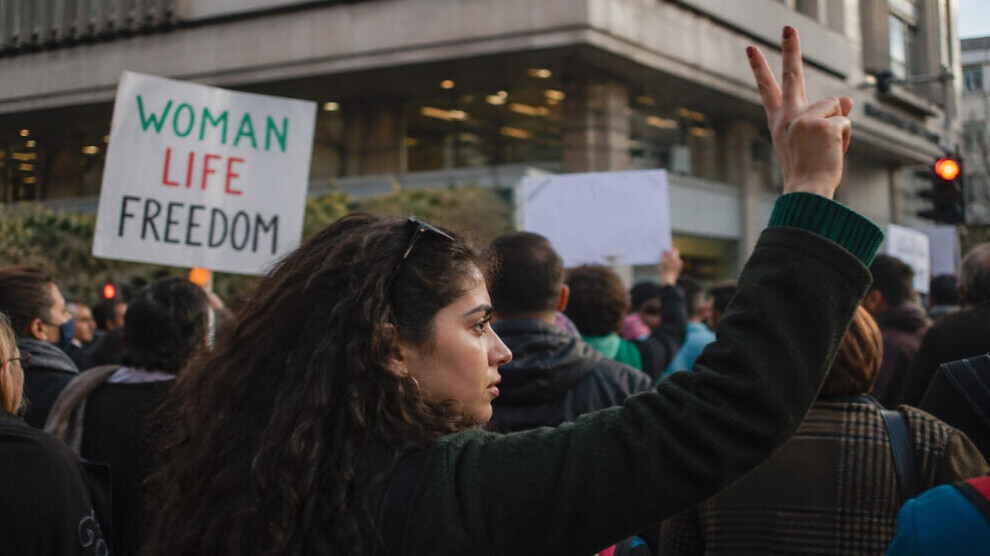
This tendency is not limited to politics; it has profound implications at the social and gendered levels. The rise of the right is always accompanied by a return to "traditional order," the "nuclear family," "fixed gender roles," and "control over women's bodies." In times of crisis, states turn to "woman" as a symbol of order, morality, family, and national identity to rebuild lost cohesion. Women become the primary arena of politics: control over dress, over fertility, over the body, as well as control over social roles, freedom of movement, and political participation. Wherever the right grows, the oppression of women intensifies. This is a structural law, not a cultural one.
In such a world, the only genuine alternative is what is proposed in "democratic integration": equal coexistence, preservation of identities, genuine participation, and grassroots democratic organization. This alternative is not merely a response to the migration crisis, but also a response to the crisis of capitalism as a whole – especially the oppression of women. Only in a structure based on equality, diversity, freedom, and participation can we confront the right, the violent nation‑state, and non‑hegemonic imperialism. In a world governed by fear, the only politics capable of defeating the right is a politics of coexistence, freedom, and equality – a politics that the left must rebuild, placing women at its very core.