
Libyan women between formal representation and real influence
“Libyan women in peace processes testify: favoritism and connections trump competence, limiting representation and often making their presence formal and weak in influence.”
Mona Touka
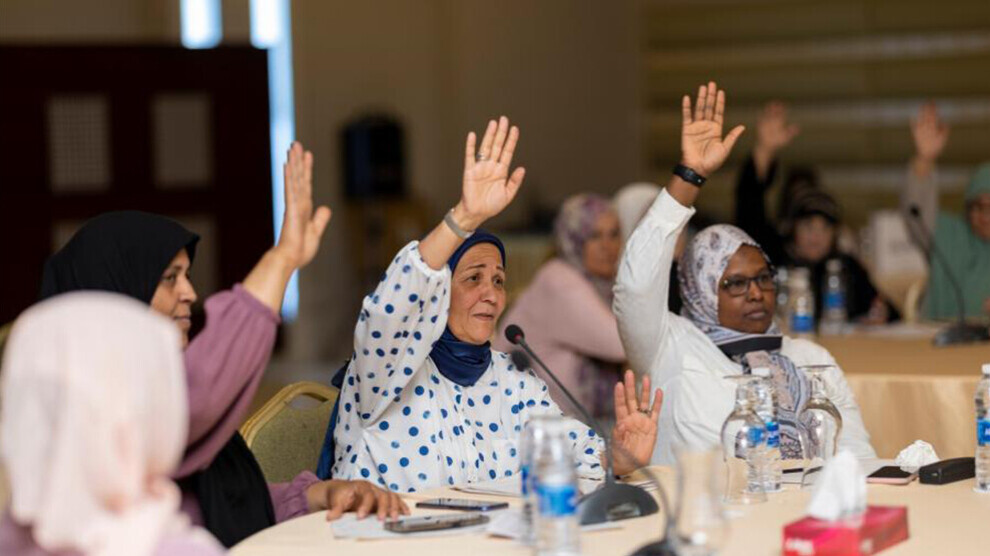
Libya — Amid the growing presence of Libyan women in political and international tracks, especially those related to peace and reconciliation files, a fundamental question arises about the nature of this presence: Does it reflect genuine representation based on competence, geographical and social diversity, or is it still governed by narrow considerations that reproduce the same elites? While women's participation is seen as necessary to enhance stability, testimonies from activists and academics from different backgrounds reveal a clear gap between formal presence and actual influence, as well as structural challenges that still hinder women's empowerment to play their full role in these tracks.
Selection of women between competence and favoritism
Aisha Youssef Ahmed confirms that the selection of Libyan women in political and international tracks is generally not based on competence or specialization, but is subject to considerations of favoritism, relationship networks, as well as tribal and social affiliations. She believes that this pattern of selection contributes to the exclusion of many qualified women, especially in the southern region, where women suffer from weak representation compared to their counterparts in the east and west, despite possessing the necessary capabilities for effective participation in political dialogue and decision-making.
Regarding representation, she notes that women, especially in the south, play an actual role in local reconciliation efforts, having participated in resolving complex tribal conflicts and contributed to achieving stability. However, this role is not reflected in formal representation within political tracks, which remains limited and weak in influence.
On selection mechanisms, she stresses that the current reality does not reflect a genuine reliance on competence. She clearly states that selections in political tracks "are not made based on competencies," but rather on "connections and favoritism," and sometimes even extend to tribal considerations that determine who is allowed to access these tracks. She explains that this pattern of selection is not limited to individual cases but has become a general characteristic, leading to the exclusion of a large number of qualified women, especially in southern Libya.
Aisha Youssef Ahmed stops at an important geographical point, noting that the representation rate of women in the south is very weak compared to the eastern and western regions. She affirms that this weakness is not related to a lack of competence; on the contrary, there are "competent women in the southern region" capable of representing and participating in political dialogues, with programs that could serve women, but they do not get the opportunity due to unfair selection mechanisms.
Despite criticism of selection mechanisms, Aisha Youssef Ahmed affirms that women, especially in the south, have played real and influential roles in local reconciliations, particularly in tribal conflicts. She notes that women "were present in peacebuilding" and participated in reconciliations between different tribes, including complex conflicts. This role, according to Aisha, reflects women's real ability to contribute to stability, but it is not reflected in official political tracks, where their presence remains weak.
Women's representation between reality and façade
Zeinab Misbah agrees with the previous speaker that the selection of women in international peace tracks is based on a mix of factors, but political considerations and influence networks prevail, along with the institutions to which the participants belong. She explains that these mechanisms recycle the same female elites, without giving opportunities to new faces representing broader segments of Libyan women, which limits the diversity of representation and weakens its credibility.
She points out that women's presence in peace negotiations appears positive in form, but it is often isolated from the broader female grassroots. She notes that only a limited percentage of women from different regions actually participate in these dialogues, leading to a lack of real reflection of women's priorities on the ground, given the weak communication channels between participants and the women's community.
Zeinab Misbah offers a more complex analysis, as she sees that women's selection is based on "a mix of factors," but the "overwhelming factors" remain political considerations and relationship networks, in addition to the institutions to which women belong. This overlap between politics, relationships, and institutions leads to the reproduction of the same female elites, limiting opportunities for new voices or more diverse representation.
She sees that women's presence in peace negotiations is "very nice" in form, but in reality "it is dominated by a limited base," meaning that the participants do not necessarily represent the broader female public. She notes that the percentage of women from different regions participating in these dialogues is "very small," leading to a lack of real reflection of women's priorities on the ground. She also points to "an absence of participation mechanisms" that link the participating women to the women's community.
Zeinab Misbah indicates that there are cases "where women were used only to grant legitimacy," without having a real voice in negotiations, which reflects the formalistic nature of some participations. However, she affirms on the other hand that there are efforts being made, especially by young women, who have begun to impose their presence through clear programs and ideas.
Selection of women between favoritism, appearance, and connections
In the same context, Al-Salha Al-Damari believes that the selections made within the framework of national reconciliations were often unsuccessful, as they were not based on competence but rather on some women's ability to appear in public and challenge social constraints. She notes that this superficial selection criterion has led to the marginalization of women with real experience and the ability to contribute, but who remained outside participation circles due to lack of promotion or support.
She sees that women's presence in reconciliation committees carries great symbolic and humanitarian value, especially since women have been among the most affected groups by conflicts, whether through the loss of husbands or sons. However, she points out that this presence is not always effective, as in some cases women are chosen as a formal façade without having tools of influence, unlike others who have indeed been able to contribute real efforts to the success of some reconciliations.
She highlighted a different social dimension in the selection process, as she believes that some women were chosen not because of competence, but because they have "the courage to appear" and the ability to challenge customs and traditions. She hints here that the criterion of "appearance" has become a substitute for the criterion of "experience," which she considers a clear flaw, especially when other women with real capabilities but less media or social presence are marginalized.
Al-Salha Al-Damari adds a humanitarian dimension to this discussion, as she sees that women's presence in reconciliation committees is very important, not only from the perspective of representation, but because women were a fundamental part of the suffering of conflict – "she is the one who lost her son and lost her husband." From this standpoint, involving her in reconciliation can contribute to reaching consensus. But she returns to confirm that the problem remains with "who represents," as sometimes women are placed as a "façade" without having real influence.
She also stresses that women's presence "completes half of the problem," meaning it is an essential element in achieving reconciliation, but this presence must be based on proper selection and genuine empowerment, not just "filling numbers." She affirms that the problem is not in women's participation itself, but in the belief in their role and the mechanisms to support them.
Women's representation... between local reality and political isolation
As for Mariam Mashmour, she points out that the selection of women in international initiatives is sometimes based on experience, but in many cases it is influenced by personal relationships and communication with power circles, which she considers a clear flaw. She stresses that selection must be comprehensive of all regions of Libya, based on competence and ability to influence, not on proximity to decision-makers.
She affirms that the absence of women and youth from reconciliation processes often leads to their failure, based on local experiences in southern Libya. She explains that involving women adds an important humanitarian and social dimension and enhances the chances of dialogue success, given women's ability to calm tensions and build trust.
Mariam Mashmour adds another dimension, noting that selection is sometimes based on experience, but is often influenced by relationships with "certain people or certain officials," or the extent of communication with these circles. She sees that this mixing of competence and relationships leads to unfair results, affirming that selection must be "on a Libya-wide level" covering all regions, not limited to narrow networks.
She presents a clearer argument in this regard, affirming that the absence of women and youth from reconciliation processes often leads to their failure, citing experiences from southern Libya where reconciliations without women's participation were "100% unsuccessful," while women's participation contributed to the success of several cases. She links this to women's nature of "seeking peace and stability," which makes them an essential element in any reconciliation process.
These four testimonies reveal a complex picture of Libyan women's participation in peace and reconciliation tracks – a picture that cannot be reduced to absolute success or failure. On one hand, they show women capable of making real change, especially at the local level, and on the other hand, they expose deep flaws in selection and representation mechanisms, making this presence often limited in influence or even formal.
Between these two levels, there remains an urgent need to rebuild this participation on fairer and more transparent foundations, ensuring the access of real competencies, reflecting the diversity of Libyan women, and transforming their presence from merely a number in the scene to an active force in shaping the country's future.