
Systematic Vioilations Against Journalists in Yemen
Journalists in Yemen face escalating dangers as violations mount and protection remains absent, turning their work into a mission farught with threats and assassinations amid a fragile, truth-suppressing security environment.
RANIA ABDULLAH
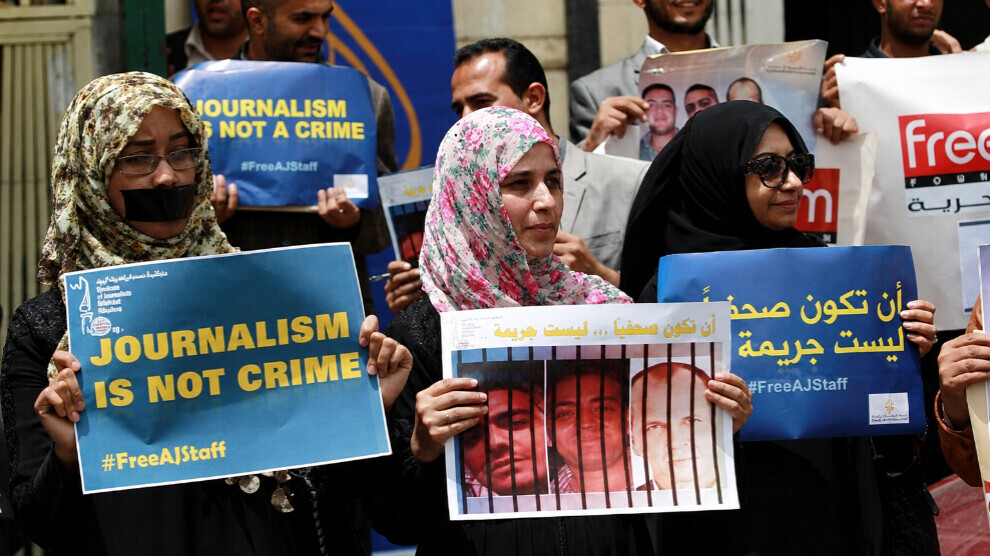
Yemen — Journalists in Yemen are facing one of the most dangerous and violation-ridden periods in the country's history, as journalistic work has turned into a genuine risk surrounded by death threats, kidnapping, systematic repression, and persecution, within a hostile environment that lacks even the most basic elements of safety and security.
Fears and Surveillance
Our agency gathered testimonies from female journalists and media professionals about the working environment for journalism in Yemen. Media professional Sally Al-Nabhani spoke of the general absence of press freedoms in Yemen, noting that the most prominent violations begin with threats that confine journalists and prevent them from leaving the geographic area in which they live, often escalating to direct kidnapping and assassination simply for shedding light on certain issues.
She pointed out that journalists are unable to express themselves freely because there are always parties harmed by the media message they convey, making them vulnerable to abduction or killing — which has forced them either to align with certain factions in order to work, or to stay home and be completely sidelined. She called for the need to provide a safe space for expression and for conveying the truth as it is, along with explicit legal protection guaranteeing journalists' full freedom to work regardless of the nature of the issue or the message they seek to convey.
For her part, journalist Sumaya Al-Amrani focused on the specific challenges facing women in the media field, affirming that restrictions on freedom of opinion represent the most prominent obstacle, given the polarization and general situation Yemen is going through. She detailed the nature of these restrictions, noting that in Houthi-controlled areas, female journalists face total and absolute restrictions on their freedoms and journalistic work, while in areas under the internationally recognized government, authorities try to steer female journalists toward covering specific, pre-approved issues, while completely barring them from expressing their own opinions or addressing violations against journalists in those areas, or violations affecting youth in general that deserve condemnation.
Journalist (F.M.A.) left journalism nine years ago, viewing it as too risky given the conditions in Yemen, and chose instead to stay home and seek other work, despite her passion and attachment to journalism. She says: "I was forced to leave the profession because of the security situation, and the total absence of protection for journalists, amid the absence of the state."
She adds: "Unfortunately, every faction or authority wants journalists to write according to its own agenda, and if a journalist deviates from that, they face danger. It's the journalist who bears the risk, without protection — not even from the media institution they work for."
Violations in Numbers
Journalistic work is fraught with numerous dangers that can escalate to physical elimination and assassination. The Media Freedoms Observatory has documented approximately 2,717 violations targeting journalists and media institutions from 2015 through mid-2026, including 72 killings of journalists.
The observatory also documented 422 cases of arrest and detention carried out by the Houthis, compared to 118 cases carried out by the internationally recognized government and its affiliated bodies, while 10 journalists remain imprisoned today, 9 of them held by the Houthis.
In this context, Fatima Mutahar, a board member of the Yemeni Journalists Syndicate, affirmed that the mechanisms used to target journalists in the country are currently going through their worst and most dangerous turning point in history, given the nature of the systematic targeting, which reflects deliberate premeditation behind assassination and physical elimination operations — making the general environment extremely dangerous and unsafe for journalistic work.
She outlined the features of this deadly targeting, citing several incidents, most notably the assassination of colleague Rasha Al-Harazi, who was killed when an explosive device was planted in the car carrying her — a crime her husband, colleague Mahmoud Al-Otmi, survived — as well as the assassination of colleague Saber Al-Haidari in the temporary capital, Aden, using the same systematic method. She considered these crimes to stem from the perpetrators' fear of free voices that convey the truth and cover events, describing it as a clear attempt to silence and terrorize the entire journalistic community.
Regarding the role of the Journalists Syndicate, Fatima Mutahar explained that the syndicate focuses primarily on monitoring and periodic monthly and annual documentation of crimes, to prevent them from being erased and to ensure they are archived, stressing that these rights and crimes are not subject to any statute of limitations and form the legal basis for prosecuting perpetrators in the future — despite some colleagues occasionally expressing frustration that the syndicate limits itself to monitoring. The syndicate also provides legal support, follows up on the progress of cases, and maintains continuous communication with security and judicial authorities.
The dangers are no longer confined to journalists working in the field, but have extended to become direct, systematic targeting of union leadership as well. Fatima Mutahar revealed that the syndicate's board operates under unsafe conditions, with its members facing constant threats. She renewed her call on the authorities to fully assume their responsibilities in providing protection, opening serious investigations, and bringing instigators and perpetrators to justice, calling for an end to the policy of impunity that remains a major international and domestic dilemma, particularly in conflict zones and dictatorial states, where cases against unknown perpetrators are shelved and victims are denied legal redress.
Monitoring and Documentation
The Media Freedoms Observatory revealed the serious challenges facing efforts to document violations in Yemen, explaining that many attacks go unreported in the first place due to victims' and their families' fear of retaliatory threats. Monitors also face great difficulty accessing witnesses and obtaining accurate details due to the deteriorating security situation and citizens' fear of arrest.
Bushra Al-Aghbari, secretary of the Media Freedoms Observatory, said: "The bigger problem lies in the weak independence and politicization of the judicial system — indeed, the use of the judiciary as a tool to suppress journalists, particularly in areas under Houthi control, which allows crimes to go without serious investigation." She stressed that protecting journalists must necessarily begin with ending impunity and holding those who target journalists accountable, followed by the need to establish rapid mechanisms for legal and security support, and to involve field workers in intensive training on professional safety during journalistic coverage.