
"Rejection Violence" Amid the Challenges of Law No. 58
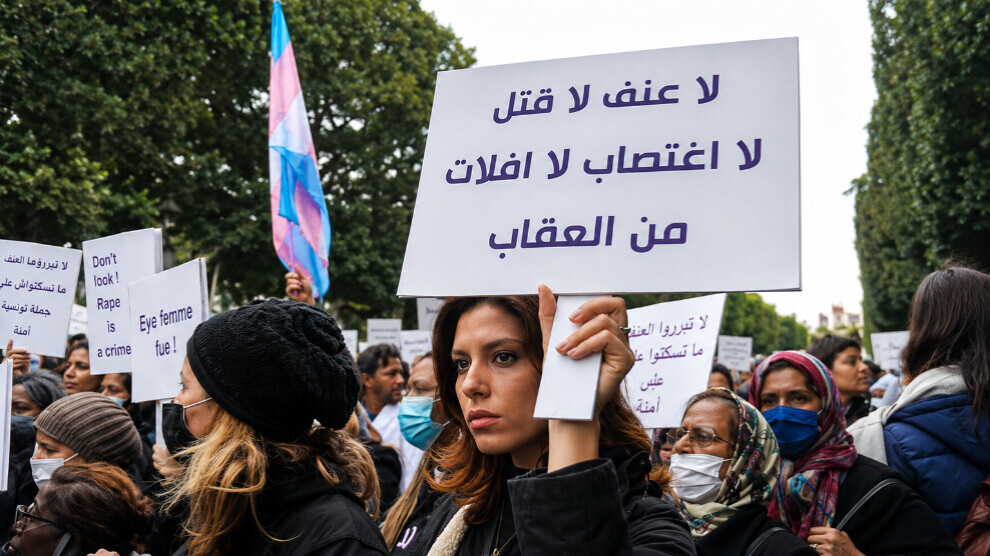
Despite Tunisia's Law No. 58 against violence, crimes remain high, with 12 women killed since January, according to Tunisian feminist associations.
ZUHOUR AL-MASHRIQI
Tunis — At a time when Law No. 58 on the elimination of violence against women represented a qualitative leap in Tunisia's legislative arsenal upon its promulgation, a painful paradox emerges today that demands pause. While the intended goal was to curb violent practices, statistics indicate an alarming upward trend in the rate of violence against women, with the phenomenon of "femicide" even doubling at a notable rate, surpassing that recorded before the law came into effect.
From 7 cases in 2017 to 30 cases in 2025
The figures reflect a shocking reality. While the number of murder victims did not exceed 7 cases in 2017, reports indicate that these rates have multiplied at unprecedented levels, rising to 25 cases in 2024 and reaching 30 women killed in 2025—meaning that femicide has effectively increased more than 4 to 5 times within a few years. This escalation in gender-based violence does not emerge from a void, but is the result of the collision between aspirations for emancipation and guaranteed rights with social structures that continue to reproduce "toxic masculinity" and the obsession with patriarchal control.
This fatal gap was recently embodied, just days ago, in the murder of the teacher "Marwa" in the rural areas of Kairouan in central Tunisia at the hands of a man she had refused to be involved with—an act that was not merely an isolated incident but a glaring embodiment of what has come to be known as "rejection crimes," where violence escalates when men reject women's autonomy and right to choose. This crime is the product of a social structure concentrated in both remote and urban areas alike, nourished by an unequal distribution of roles that perpetuates male domination.
The tragedy of "Marwa," who was brutally killed for rejecting a suitor, was preceded by warning signs that were not taken seriously, just as in previous cases such as that of Rafqa Al-Sharni, who was killed by her husband four years ago, and others—all victims failed by the security protection system, within a prevailing social culture that contributes to obscuring these threats and renders women vulnerable to systematic violence aimed at "punishing" a woman who refuses to be with a male who rejects her independence.
This reality demands the adoption of a comprehensive rights-based strategy grounded in deconstructing the patriarchal cultural framework, strictly enforcing Law No. 58 while providing adequate resources to protect women—which is not a rights-based "luxury" but a social necessity to save the group most vulnerable to fragility and violence.
Violence Against Women Is Rising at an Alarming Rate
Sawsan Al-Jaadi, a consultant for human rights organizations, begins her remarks by affirming the long and deep trajectory of her work on combating violence against women, drawing on her experience in applying Law No. 58 and the multiple forms of violence prevalent in Tunisia, particularly in the interior regions.
She clearly observes a worrying and sustained increase in the rate of violence in Tunisian society in general, and in violence against women, which is specifically grounded in gender. She emphasizes that the concept of "gender-based violence" remains, at times, misunderstood or unclear to many members of society, which necessitates further clarification and deconstruction of this rights-based concept.
Marwa Will Not Be the Last Victim
She moves on in her analysis to an incident that recently shocked Tunisian public opinion: the murder of a young teacher from the rural areas of Kairouan. She explains with precision that the teacher was brutally killed by a man who is said to have proposed to her but was met with her outright rejection. This essential detail, based on testimony provided by the victim's maternal uncle, makes this incident classifiable as a "rejection crime." However, for her and for human rights organizations, this crime must be precisely classified and strictly in rights-based terms as a "femicide."
She affirms that these crimes are not isolated or individual incidents, but are often linked to a complete and interconnected cycle of systematic violence experienced by women. Tunisian society typically focuses on surface-level crimes that shock public opinion, but it completely overlooks the "hidden side" of this tragedy—that the murder is always preceded by repeated threats and a cycle of violence from which women, alone or even with the help of their surroundings, cannot escape.
Sawsan Al-Jaadi posits that the teacher may have been subjected to prior and direct threats from the perpetrator, such as "If we are not together, I will kill you"—threats that may have been concealed from others, but more importantly, were not taken seriously by those around her. She invokes here the case of Rafqa Al-Sharni, who complained to security authorities and reported death threats, yet her request for protection was not handled with sufficient seriousness, and she was not protected until she was killed by her security officer husband.
Here, Sawsan Al-Jaadi places government institutions before their legal and rights-based responsibilities, adding that the prevailing culture among victims' close circles leads them not to advise the girl that such threats could be serious and could end in murder—a situation experienced daily by girls, especially through virtual communication platforms. The moment a girl tries to rebuff a man attempting to get to know her, this "male" does not accept rejection in a healthy manner; rather, his reaction becomes extremely violent, escalating to insults and punishment merely for refusing to be with him.
From Insult to Murder
Sawsan Al-Jaadi moves on to highlight the phenomenon of "rejection crimes" as a social problem, explaining that they can evolve from mere verbal forms of mockery or insult to physical violent practices, as a result of some men's inability to accept the reality of rejection by a woman.
She affirms that this phenomenon, which some describe as "rejection crimes," is notably concentrated in rural and remote communities, where a masculine culture prevails, fundamentally rooted in concepts of control and absolute superiority, alongside an unequal distribution of social roles that perpetuates so-called "toxic masculinity." She highlights that the social reality is witnessing a qualitative and notable transformation, as girls are achieving remarkable academic and professional success.
Women's Success Has Alarmed "Toxic Masculinity"
She points out that the prevailing culture among victims' close circles plays a negative role, as the murdered teacher, in her estimation, may have spoken to those around her about the threats, yet no one advised her that those threats could be serious and could end in murder.
She stressed the necessity of working to change social culture and eliminate the masculine culture that rejects the idea of women's superiority or their right to refuse, while reconsidering patterns of child-rearing within families to achieve greater balance.
Combating Violence Involves Many Interdependent Parties
She also affirms the necessity of strict application of Law No. 58 on the elimination of violence against women, providing all necessary human and material resources to ensure women's protection, pointing out that protecting women is not merely a "luxury" but an urgent social need, given that women are the group most exposed to violence and social fragility.
Sawsan Al-Jaadi emphasizes the role of public media, educational institutions, and cultural institutions in disseminating a culture of mutual respect and building balanced human relationships that ensure the stability of families and society as a whole, away from the spiral of violence. She affirms that this path is the only way to build a society grounded in genuine equality, free from the inherited legacy of patriarchal domination and gender-based violence.