
Women in the medical field in the south… resilience and a humanitarian message
The medical team at the “Popluar Rescue” Hospital stands firmly, led by women who have chosen resilience as a message, responsibility. Between fear and duty, the profession turns into daily resistance that preserves life despite all losses.
Rana Jouni
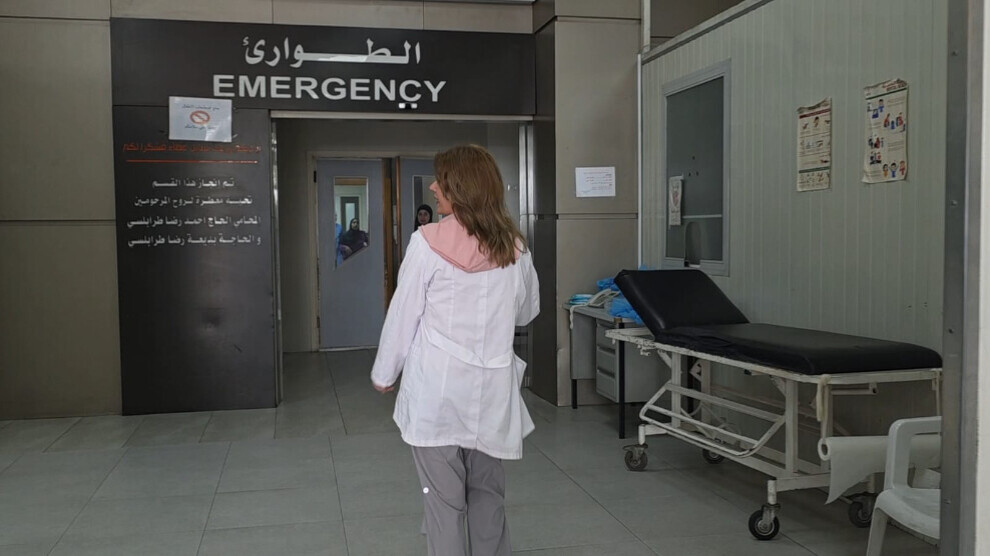
Lebanon- In southern Lebanon, where war rages, the “Popular Rescue” Hospital has turned into a humanitarian line of defense led by women who have experienced both fear and resilience together. Mona Abu Zeid and Sara Saloum continue to carry out their mission, making staying in the field a form of resistance and protection of what remains of life.
Mona Abu Zeid is a woman who believed that what is happening goes beyond the limits of job‑related work, becoming a purely humanitarian cause. For her, the hospital is not just a medical edifice; it is a humanitarian message and a model of medical resistance embodied in staying by the people's side, serving them, and protecting them in the darkest circumstances.
From her position as a woman who chose to stay, she speaks of an experience full of challenges, affirming that presence, resilience, and continuity are forms of resistance, and that standing by the people in these difficult conditions is a moral duty before being a professional responsibility.
She says that her presence today in the south is not just an administrative task or a job, but a humanitarian and national duty. Being at the hospital alongside doctors, nurses, and staff is direct support for the people in facing challenges and providing necessary medical services to the people of the region despite all circumstances.
She affirms that resilience itself is a message, a form of resistance, when health and social services are provided to the steadfast people in their areas. She points out that emergency plans set since 2023 remain unstable, constantly changing according to the security situation, and plans may change within minutes to ensure the safety of medical teams and the continuity of work.
On a personal level, Mona Abu Zeid admits the difficulty of being away from family, missing her mother, daughter, and friends, and the natural fear that accompanies these circumstances. Yet the sense of responsibility toward people imposes overcoming these feelings. She explains that communication alleviates some of the pain but does not erase longing or worry.
She notes that what leaves the deepest impact is the suffering of children, especially orphans who have lost their parents, along with the emotional and human deprivation that accompanies it – a scene that never leaves memory. She concludes by saying that war has changed much in their lives and stolen entire chapters of time, but resilience and continuity are what give them strength to continue this humanitarian message and remain steadfast.
Mona Abu Zeid is inseparable from the reality of the field; she is at the heart of the battle, believing that the medical battle today is no less important than any other battle, and that staying is a moral obligation stemming from her humanitarian message.
Suspended motherhood and a responsibility that transcends the boundaries of the profession
For her part, Sara Saloum, nursing director at the "Popular Rescue" Hospital, describes this war as the most difficult, not only because of the intensity of injuries but because of the large number of children who arrived at the hospital.
She says that the scenes of children have left an indelible mark. The team witnessed cases where children lost their entire families, and others where mothers arrived deceased and the children remained alive alone. She affirms that these scenes constituted the greatest psychological burden on nurses, who found themselves facing tragedies beyond their professional and human capacity.
She adds that this is not the first war the hospital has gone through, but it is the second in her professional life, and she is experiencing it as a mother of two daughters, which multiplies responsibility and worry. Between her duty toward patients and the institution, she tries to maintain her role as a mother, at a time when she and the father of her children both work in the same hospital.
Sara Saloum believes that the nurse's role in war goes beyond providing medical treatment to include standing by the patient psychologically and humanely, despite the constant sense of danger with every raid. She points out that the medical team tries to create a state of internal cohesion, like one family, to relieve psychological pressure on each other and continue working.
She notes that many nurses played the role of substitute mother for injured children, carrying them and trying to provide the minimum of reassurance in conditions unlike normal life. She also points out that some patients would leave the hospital after receiving treatment only to return to homes threatened by new shelling, which doubles the feeling of helplessness.
Thus, Mona Abu Zeid and Sara Saloum, along with their colleagues, continue to carry the same message: protecting human beings no matter how great the danger. Between resilience facing shelling, suspended motherhood, and determination to stay, this team writes an unforgettable human chapter in the story of the south.