
Wheat in Sweida... Will the Exceptional Season Turn into a Strategic Stock?
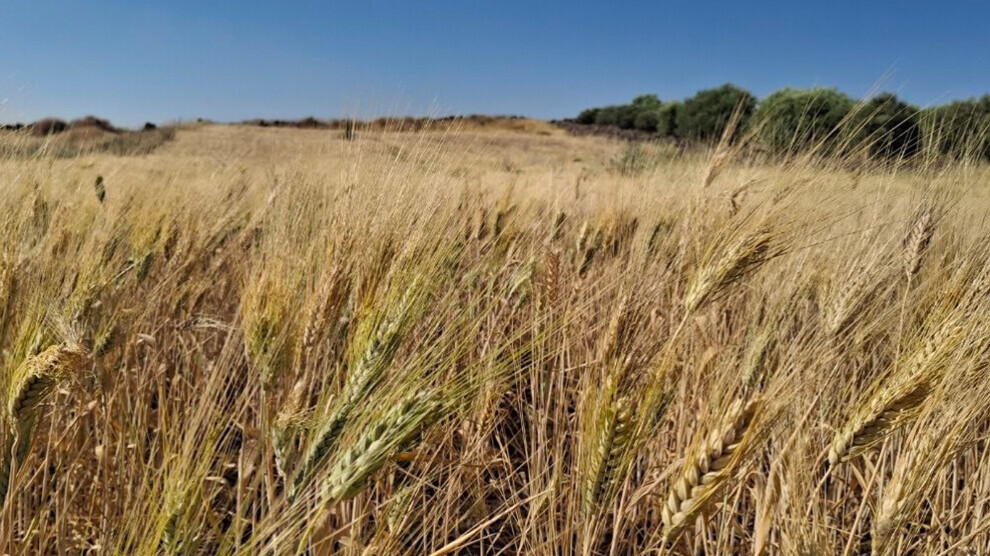
This year's wheat crop in Sweida is producing a high yield thanks to heavy rainfall, offering an opportunity to enhance food security if it is stored and marketed efficiently, despite the challenges facing farmers.
ROSHELLE JUNIOR
As-Sweida — In a rainy season considered one of the best in recent years, the wheat crop has returned to the forefront of attention in Syria as a strategic crop and a fundamental pillar of food security.
This issue gains additional importance given the economic and living challenges Syria is experiencing, and the need to strengthen reliance on local production at a time when agriculture has become one of the most important factors of resilience and stability.
While farmers are betting on production abundance this year, questions arise about the mechanisms for preserving, storing, and marketing the crop, especially after a number of silos and warehouses were burned during the events of July 2025 by Hay'at Tahrir al-Sham jihadists, creating a major challenge in securing safe places for storage and protecting the produce from loss and risks.
Agricultural engineer Amani Al-Hasabani said that this year's wheat crop has seen high production, thanks to the heavy rainfall that Sweida has not witnessed for about five years, which was clearly reflected in crop growth and increased productivity. She indicated that estimates from the Farmers' Union suggest that wheat production reached about 25,000 tons—a figure reflecting a significant improvement compared to previous seasons, and opening the door to a genuine opportunity to enhance local production and reduce reliance on external supply sources, if this season is properly invested.
She affirmed that production abundance alone is not enough to consider the season successful, as the success of any agricultural season is measured not only by the size of the harvest but also by farmers' ability to preserve their produce, market it, and achieve a fair return that covers cultivation costs. She explained that storage and marketing challenges are no less important than production itself, because losing part of the crop after harvest or failing to market it directly affects farmers' income and food security in Sweida.
Damage to Storage Infrastructure
She pointed out that a number of silos and warehouses were burned during last year's July events, causing significant losses to the grain storage infrastructure and creating an urgent need to establish new warehouses and silos distributed across multiple areas, ensuring production protection and reducing risks in the event of any emergency.
Amani Al-Hasabani explained that per-dunum productivity was high this season, but cultivated areas were not at the desired level due to damage in the western countryside and the displacement of a number of residents who left their lands uncultivated and unserved. She affirmed that the success of the agricultural sector depends not only on climatic conditions but also requires security stability that allows farmers to access their land, care for it, harvest their crop, and market it safely.
She added that wheat is not merely an agricultural crop but represents a fundamental pillar of food security because it is used in bread production—the most important food item for families. She noted that Sweida's reliance last year on food aid due to the complete siege the city experienced underscores the importance of having local production capable of securing a large part of needs. She considered that cultivating every dunum and preserving every ton of wheat through proper storage contribute to enhancing the community's ability to withstand and face crises.
A Strategic Opportunity to Build Sustainable Local Stock
She viewed the current season as an opportunity to build a strategic stock, not only by storing large quantities of wheat but also through developing an integrated plan to manage, distribute, and invest this stock when needed, ensuring the continued availability of flour and bread under various conditions. She added that achieving this requires cooperation between farmers, expatriates, and agricultural authorities—foremost the Directorate of Agriculture and the Farmers' Union—to establish silos and warehouses in multiple locations within Sweida, enhancing stock safety and protecting it from risks.
Regarding the most prominent challenges, she explained that fires still represent the greatest danger to the wheat crop, along with rising fuel prices and harvesting costs, marketing difficulties, and the decline in straw prices—which in previous years helped cover part of production costs—further increasing the financial burdens borne by farmers.
Amani Al-Hasabani praised the role of the local community, affirming that the experiences Sweida witnessed last year proved the ability of cooperatives and community initiatives, with support from Sweida's expatriates and local activists, to implement projects serving the community.
She believed that these experiences could be built upon to establish modern storage centers, secure firefighting equipment, organize campaigns to protect agricultural lands, and benefit from similar successful experiences in other regions such as the coast.
Regarding the marketing file, she considered it the greatest challenge facing farmers, noting that delays in receiving crops and the absence of clear and fair prices weaken the economic viability of the season despite production abundance. She called for establishing reception centers close to villages, especially remote ones, securing transportation, and accelerating payment processes to ensure that farmers receive their dues in a timely manner, encouraging them to continue cultivating wheat in future seasons.
She affirmed that the upcoming phase requires a genuine partnership between farmers, the Directorate of Agriculture, the Farmers' Union, and the local community, because enhancing food security is a collective responsibility that begins with supporting farmers, providing production inputs and agricultural guidance, passes through protecting agricultural lands and funding cooperative initiatives, and ends only when the wheat crop reaches the consumer within a fair and safe system.
Amani Al-Hasabani stressed that the current season represents an important opportunity, calling for its investment through clear policies supporting farmers at the stages of production, harvesting, storage, and marketing. She emphasized that preserving the wheat crop is not the farmer's responsibility alone but a shared responsibility incumbent upon relevant authorities and the local community, because protecting this crop means protecting one of the most important pillars of food security in Sweida and ensuring the sustainability of local production in the coming years.