
"A Name That Withstood Attempts at Erasure"... An 80-Year-Old From Kobani Recounts History
Hoshan Mustafa, an 80-year-old daughter of kobani, carries in her memory a city that has repeatedly faced attempts to erase its identity, affirming through her testimony that Kobani is memory deeply rooted in its people.
BARJAM JUDI
Kobani — No society can preserve its existence unless it safeguards its historical memory, and the Kurdish people embody this truth clearly — having managed, despite enduring policies of genocide, uprooting, and denial throughout their history, to preserve their identity and hold on to their existence through collective memory and inherited cultural heritage.
The city of Kobani in Rojava stands as one of the most prominent landmarks of this memory. Since its founding, it has faced continuous attempts to erase its national identity, most notably the policies of the Baath regime, which sought to alter its demographic composition and deny its Kurdish identity, going as far as imposing the name "Ain al-Arab" in place of its historical name, "Kobani." Today, amid Syria's new phase, accusations are resurfacing that the same policies are being reproduced — through denial of the city's historical name and questioning of its identity.
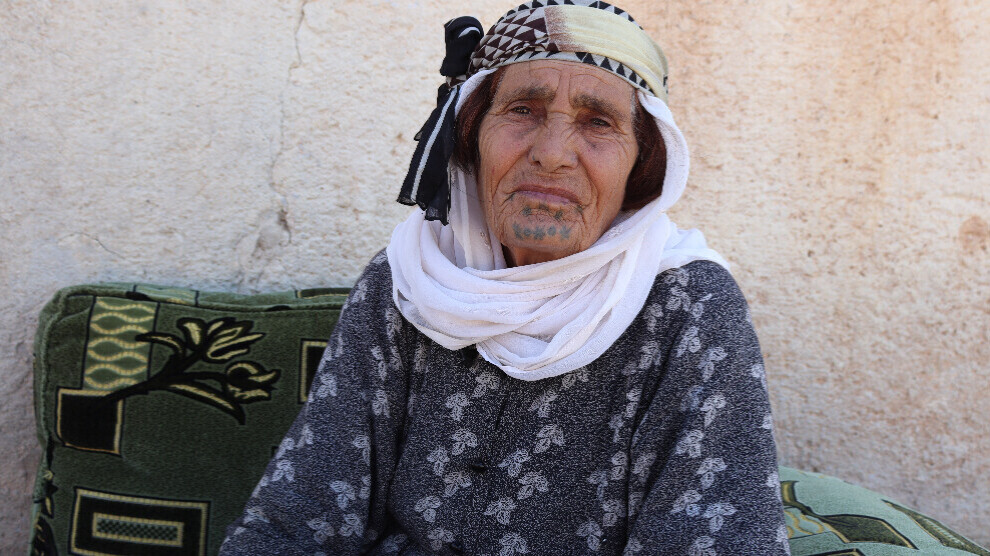
Amid these developments, 80-year-old Hoshan Mustafa stands out as one of the keepers of Kobani's collective memory. Hoshan hails from the village of Tal Ghazal and now lives in the village of Khazini. She has devoted many years to documenting the city's cultural heritage and defending its language, folklore, and identity through what she shares on social media, becoming a living witness to Kobani's history and memory.
At her home in the village of Khazini, southeast of Kobani, our agency met with Hoshan Mustafa, who, through her testimony, brought the city's history to life, spoke of the authenticity of its name, and of her people's steadfast attachment to their identity and memory, which continues to resist attempts at erasure and denial.
Hoshan Mustafa married at the age of eighteen, in keeping with the prevailing social customs of the time, and became a mother of fourteen children. Known for her strong personality and unyielding will, she also possesses a natural sense of leadership that has made her an influential figure within her community. Despite being eighty years old, she remains in good health with a sharp memory, and continues to handle her daily tasks herself — from managing household affairs and tending livestock to caring for her garden and working in the wheat and barley trade.
"Kobani Has Been a Kurdish City Since Its Founding"
Hoshan Mustafa speaks of her deep connection to Kobani, affirming that her bond with the city goes beyond mere place, extending into memory and identity. She says: "Kobani has been a Kurdish city since its founding. Arabs were never present here, aside from a small number of Armenian families who lived among us. So it is a Kurdish city, and this is a fact no one can deny. It is our land, where we lived our childhood, our youth, and now our old age — and that is why, whenever Kobani comes under attack, we feel as though fire is burning inside us."
"We Have Always Stood Against Attempts to Arabize Kobani"
Hoshan Mustafa recalled the attempts to erase Kobani's Kurdish identity: "Governments kept changing the name of our city, but we, the people of Kobani, never accepted that. Our struggle was always against attempts to Arabize the city's name. Even today, when we — along with our children and grandchildren — travel to areas under government control, we say we're from Kobani, not from Ain al-Arab. This stance has stayed with us since our youth, and we remain committed to it to this day."
"Our Homeland Will Continue to Carry the Name Kobani"
In closing, Hoshan Mustafa stressed her commitment to her city's name and historical identity, saying: "Kobani began, at first, as a town along the border line, then gradually expanded until its urban area extended into the surrounding villages. I am eighty years old today, and throughout my life, its name has always been Kobani. In my father's time, it was also known as Kobani, and he used to tell me this name has been passed down since the days of our ancestors and forefathers. So Kobani will remain as it is — in name, identity, history, and existence — a city of the Kurds."