
Tunisia's Water Crisis Worsens, and Women Farmers Are the Most Affected
Tunisia is experiencing a structural water crisis that has particularly harmed women farmers, with its severity highlighted by the recent heatwave the country has witnessed through the recurrence of water cuts across all regions.
NAZIHA BOUSSAIDI
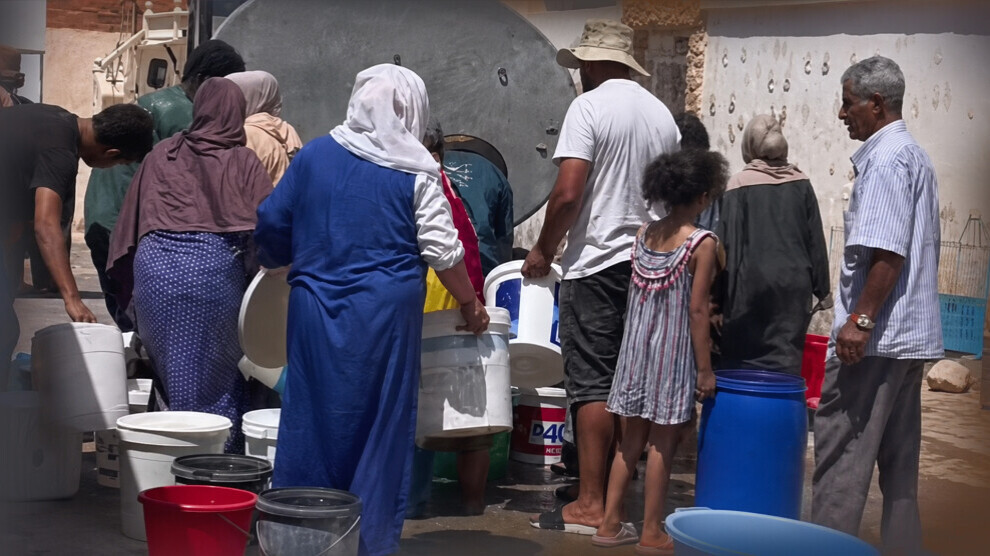
Tunis — Tunisia has been living for years under the weight of a suffocating water crisis that has worsened this summer, with experts raising their voices warning of its serious repercussions on water security, while citizens' protests demanding their constitutional right to water have increased. Despite repeated warnings, the policies adopted have failed to find effective solutions; rather, the crisis has become more complex with an exceptional heatwave reaching 47 degrees Celsius, leaving families, animals, and vegetation deprived of an indispensable resource for life.
Experts accuse the government of negligence and mismanagement in finding the required solutions, while the water crisis constitutes a major dilemma—it is not limited to climate change and its resulting crises, but years of accumulated government policies have contributed to deepening it. It stems from poor accumulated public policies that have contributed to the destruction of the water system over the past fifty years. Old and non-renewable policies have contributed to the waste of water resources through reliance on export-oriented agriculture such as strawberries, watermelons, and dates, which has contributed to making Tunisia a water-scarce country.
Numerous protests have been recorded in many regions, with women at the forefront expressing their daily suffering in searching for water due to frequent cuts in some areas, the distance of springs and wells in other areas, and the difficulty of accessing them due to distance and road hazards.
Kairouan as a Model of the Crisis
Kairouan Governorate is considered one of the areas most affected by the water crisis for many years, despite its reliance on agriculture as a source of livelihood, especially for women—whether as agricultural workers or as land beneficiaries.
Civil society activist Hayet Attar told our agency that the water crisis in Kairouan Governorate is not a circumstantial crisis and cannot be confined to a specific temporal or geographical context; it is a structural crisis that essentially stems from national policies in the management and governance of water resources.
She added that the crisis has deepened in recent years due to climate change, the decline in groundwater reserves, and the failure of legislation regulating the water sector to keep pace with economic, social, and environmental contexts and basic human needs.
She affirmed that every summer season, with rising temperatures—and in a governorate that often records record temperatures sometimes exceeding 47 degrees—the scene of searching for water and fetching it from springs, wells, and lakes is repeated. "The primary actors in this scene are women and girls walking kilometers between mountains and rugged paths, either on foot or using pack animals, their backs bent under the weight of containers and bodies exhausted from long waiting and walking under the sun. They have borne, since their upbringing, the responsibility of supplying the family and carefully managing the quantity of water brought, dividing it between drinking, cooking, and washing."
She pointed out that the water crisis in Kairouan's rural areas becomes a daily burden on women, added to other burdens such as education for girls, paid work in the agricultural sector, or unpaid domestic work—all negatively impacting their fundamental rights such as the right to education, the right to health, the right to decent work, and deepening their economic and social vulnerability.
In this context, Fatima Salmi, a farmer belonging to the agricultural products cooperative consisting of 164 women, said: "I suffer like other women farmers in the region from water scarcity because I belong to the Tunisian interior, which suffers from a significant water shortage compared to other regions."
She added that despite the existence of dams, there are areas not covered by irrigation, and people are forced to water olive trees using tankers at high cost. She noted that wells are one solution, but drilling and construction costs are very expensive for small-scale farmers.
She called on the government to support agriculture so that it can continue to work and produce, reminding that water shortages have led to the halt of olive tree production for three consecutive years, despite their annual production previously.
She pointed out that water associations provide water to farmers for a fee and in limited quantities. "I want to preserve the production of vegetables and olives, and I belong to an agricultural cooperative consisting of 164 women. Currently, only 50 are active, as some have left due to travel or marriage."
The Need for Government Intervention?
The woman who lives in rural areas and preserves the land and agriculture is most in need of water—both for household matters and for her agricultural activity of raising cattle, sheep, poultry, irrigating fruit trees, olive trees, and watering vegetables. Therefore, she suffers daily due to water shortages and calls for government intervention and civil society assistance.
In this context, Hadda Bamri, an agricultural worker in Oueslatia, said: "Oueslatia is an agricultural area par excellence, and its land is generous, but the lack of water renders it paralyzed." Speaking about herself, she said: "I am an agricultural worker, and I also practice family farming of vegetables, fruit trees, livestock, and poultry. But unfortunately, the lack of water limits my work and my productivity."
She pointed out that the area has a river that is not utilized, while its water could be directed toward mountain lakes to collect water and benefit from it more effectively.